This piece from Sinification delivers a chilling warning that transcends the usual tech-optimism or dystopian sci-fi tropes: it argues that the next generation of authoritarianism won't just monitor our words, but will surgically edit our biology and emotions to ensure compliance. While much of the global conversation focuses on AI as a tool for surveillance or misinformation, the editors highlight a more insidious shift where the state targets the very physiology of its citizens, turning health and happiness into instruments of political control.
The Biological Turn
The article opens by grounding its argument in recent, seemingly benign technological breakthroughs that serve as a Trojan horse for deeper control. Sinification reports on a surgery in Hangzhou involving a "sobriety chip," where a recipient claimed that "seeing alcohol is like seeing plain water." The piece uses this to illustrate a terrifying pivot: "If the 'sobriety chip' pertains to the control and modification of physiological and lifestyle habits, then another equally 'encouraging' piece of news touches on psychological and emotional regulation." The editors note that this isn't just about fixing bad habits; it is about the state's ability to bypass consciousness entirely.
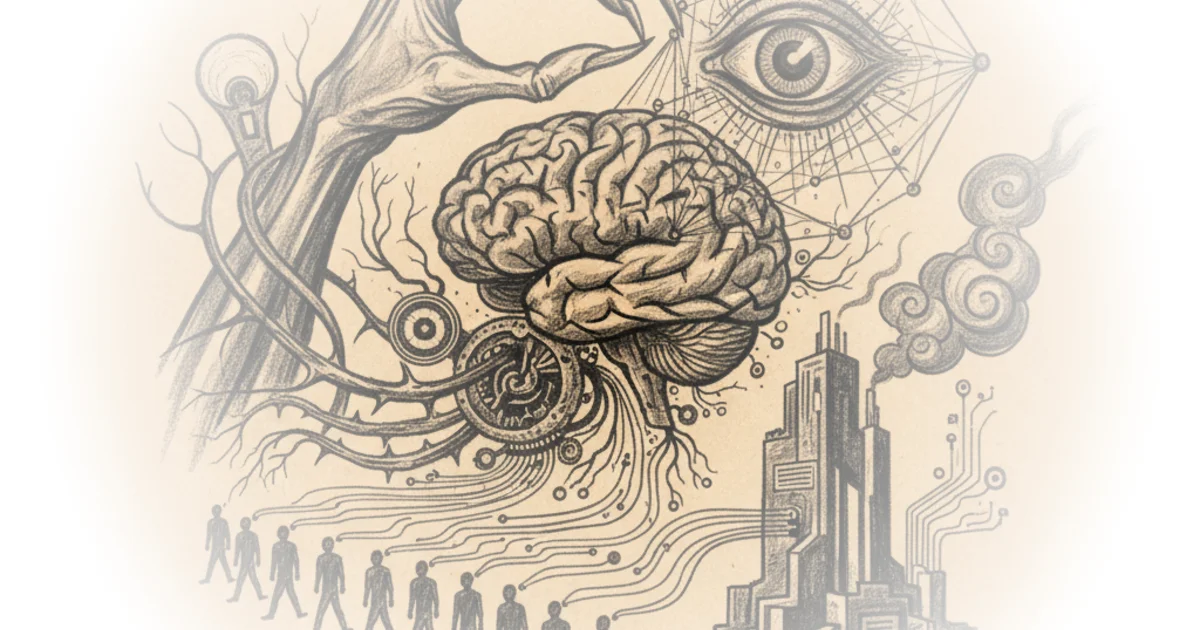
The argument gains weight by connecting these modern capabilities to historical precedents of biopolitics, a concept developed by philosopher Michel Foucault. The piece argues that "unlike classical ideological work, which operates through language, persuasion and coercion, AI-era governance can bypass consciousness and intervene at the level of physiology, sensation and feeling." This reframing is crucial. It suggests that the future of totalitarianism isn't the boot stamping on a human face, but the chip implanting a feeling of contentment that makes resistance impossible.
"The core danger is not 'technology' itself, but authoritarian power empowered by technology."
Critics might argue that the leap from a medical device for addiction to a tool of state oppression is speculative, especially when such technologies are often developed in democratic contexts for therapeutic reasons. However, the piece effectively counters this by noting that the application of the technology, not its invention, determines its political nature. As the editors observe, "Medicine and 'health' become key instruments of power, entailing both the politicisation of life and the vitalisation of politics."
The Nazi Parallel and the New Human
To drive the point home, the text draws a stark, uncomfortable parallel between modern AI governance and Nazi biopolitics. It cites the Nazi regime's obsession with "dealing with" those deemed "unworthy of life," framing mass murder as a matter of "state hygiene." The editors write that "Nazism represents modern racist biopolitics, a form of biologised racism that transformed the historical discourse of racial struggle by assigning state power the responsibility for the life of the entire population."
This historical lens is used to explain the ultimate goal of such systems: the transformation of human nature itself. The piece notes that totalitarian ideology aims "not to transform the external world or bring about revolutionary social change, but to transform human nature itself." By referencing Aldous Huxley's Brave New World, the editors suggest a future where order is sustained "not through repression alone, but through engineered satisfaction, emotional pacification and the erosion of genuine human bonds."
The argument here is particularly potent because it challenges the assumption that happiness is always a net positive. If a government can engineer a population that is perpetually happy, compliant, and chemically incapable of dissent, is that a utopia or a prison? The editors suggest the latter, warning that "algorithms can not only predict each individual's decisions but also manipulate their emotions."
The Limits of the Argument
While the historical parallels are compelling, the piece relies heavily on the assumption that the Chinese state is actively pursuing this specific form of "techno-totalitarianism" in the immediate future. Some might argue that the current focus is still primarily on surveillance and social credit scoring rather than direct biological intervention. The editors acknowledge the author's skill in "playing edge-ball," pushing political boundaries without crossing them, which implies that the full scope of these ambitions may be obscured even from the public.
Furthermore, the piece leans heavily on the idea that technology is inherently neutral until co-opted, yet it offers less analysis on the resistance movements or the technical limitations that might prevent such total control. As the text notes, "technology does not replace political authority; it enables, amplifies and optimises it," but the question of whether the human spirit can be fully engineered away remains a point of contention.
Bottom Line
The strongest element of this commentary is its refusal to treat AI as a mere tool of efficiency, instead exposing it as a potential mechanism for the fundamental re-engineering of the human subject. Its biggest vulnerability lies in the speculative nature of how quickly these biological interventions could be scaled to a population level. Readers should watch for how the definition of "health" and "well-being" is increasingly weaponized by state actors globally, turning the pursuit of a better life into a mandate for submission.