A Kyoto School philosopher once wrote: "Religion without philosophy is blind, and philosophy without religion is vacuous." That sentence has been sitting in my chest for weeks now, because it suggests something counterintuitive about how we see the world—and how we've been taught to see it.
Steven West's latest episode on the Kyoto School makes a case that's hard to ignore: most people have never actually examined what religion really means. We've reduced it to belief—a mental assent to some divine object—while ignoring thousands of years of religious practice, community, and lived experience. And here's where it gets interesting: that reduction might be exactly why we can't see other ways of framing reality.
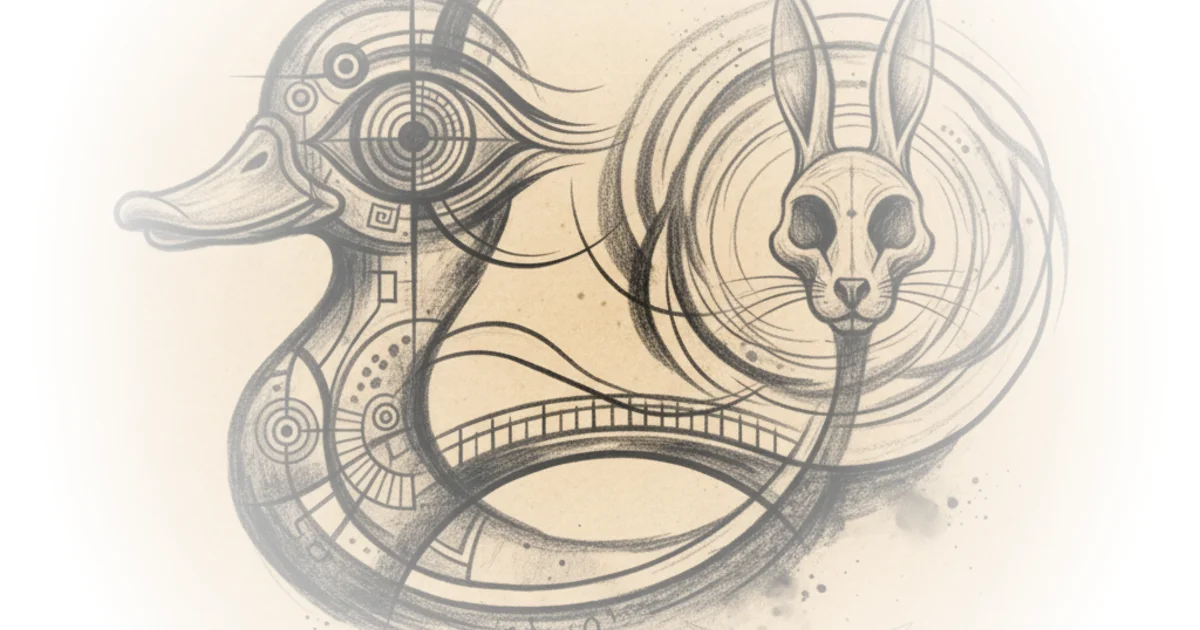
The Duck-Rabbit That Explains Everything
Consider the classic optical illusion. Half the people who look at it see a duck; half see a rabbit. No one is wrong. The image is identical—the only difference is how they've learned to see it.
Steven West argues this simple cartoon captures something crucial about human experience. We don't encounter some raw, objective world and then interpret it neutrally. We encounter things already framed—by training, by culture, by what society rewards. Someone raised in a world that incentivizes seeing ducks will strain to see the rabbit and still only find ducks. But once they learn there's another way? They can't unsee it.
What we see depends on our framing, not on what's "actually" there.
This is exactly what Nishitani spent his career exploring: the difference between dualistic, theoretical framings of reality and something more immediate—phenomenological, embodied, even religious. The problem isn't that some people are too smart to perceive this other way of seeing. It's that they live surrounded by ducks.
What Is Religion, Actually?
Nishitani didn't think there was an easy answer to what religion is—and he would have been disappointed by modern discourse on the topic.
Most people today define religion simply as belief: either you believe in a divine object or you don't. Either you're an atheist who dismisses it entirely, or you're a believer who checks the boxes. But this reduction misses almost everything that religion has historically meant to human beings.
To take religion seriously requires examining its multidimensional nature across history. What did a fourth-century Christian mystic mean when they described communion with God? How is that different from a Zen monk's daily practice of enlightenment? What was a Sufi describing when they spoke of annihilating the ego in divine love? These aren't abstract beliefs—they're modes of meaning, disciplined practice, community roles, and frameworks that hold societies together.
For most of human history, religion wasn't primarily about belief. It was defined by how you treated people—daily practice. Your religious identity emerged from living a religious life, not from assenting to propositions about divine objects.
The Protestant Reformation's Quiet Revolution
When Martin Luther nailed his ninety-five theses to the church door in 1517, he didn't just reform Christian practice. He initiated a centuries-long shift in what it meant to have a religious experience.
Before the Protestant Reformation, most people couldn't read Latin or interpret scripture directly. They participated through community rituals and traditions. Afterward, religion increasingly became personal—a direct connection between the individual and God. The priesthood of all believers meant each person could interpret their own relationship to the divine.
By the time the Enlightenment arrived—with its emphasis on individualism, choice, and subjective identity—this notion that religious experience is fundamentally about belief in something felt like a natural extension of that thinking. My religion became an aspect of my individual identity, decided by choices I make up in my head.
Nishitani believed this shift was a mistake. He committed to Orthodox Christianity not because he doubted faith's importance, but because he saw the Reformation as having moved away from what Christianity had actually been for most people throughout history—a practice embedded in community and daily life.
Critics might note that framing religion primarily around belief has produced genuine insights: the emphasis on personal conscience led to religious toleration, individual rights, and the ability to choose one's faith without social persecution. The shift wasn't purely a loss—it was also liberation.
What This Means for Seeing Differently
The Duck Rabbit isn't just a party trick. It's a mirror showing how we frame every moment of experience. When we open ourselves to non-dualistic seeing—not as contradictions but as things that require each other—the duck and rabbit start looking different. Not like opposites, but like co-constituents.
Maybe there isn't really an essence of a duck or a rabbit at all. Maybe the biggest mystery is asking: what is my experience of this moment when I'm not constantly framing it as one thing or another?
And maybe that's exactly what religion and philosophy were always trying to get at—not as competing beliefs, but as different doors into the same room.
Bottom Line
Steven West's strongest argument isn't that religion should be defined differently—it's that most people have never been shown there's another way to see. The Duck Rabbit metaphor is elegant because it doesn't require you to reject anything: just notice you're seeing one animal. His vulnerability is in the historical claim about the Reformation: whether this shift from practice to belief was definitively negative is debatable, and depends heavily on what values you prioritize. But if you've ever felt like religion is a simple matter of belief or disbelief, this episode suggests you might be looking at only half the picture.