What makes a simple math problem dangerous enough to warn young mathematicians away from it? That's the question at the heart of Derek Muller's exploration of the Collatz Conjecture — a problem so infamous that "if someone admits in public that they're working on it, there's something wrong with them." The piece immediately establishes its stakes: this isn't just an abstract puzzle. It's a mathematical time sink that has swallowed careers and reputations.
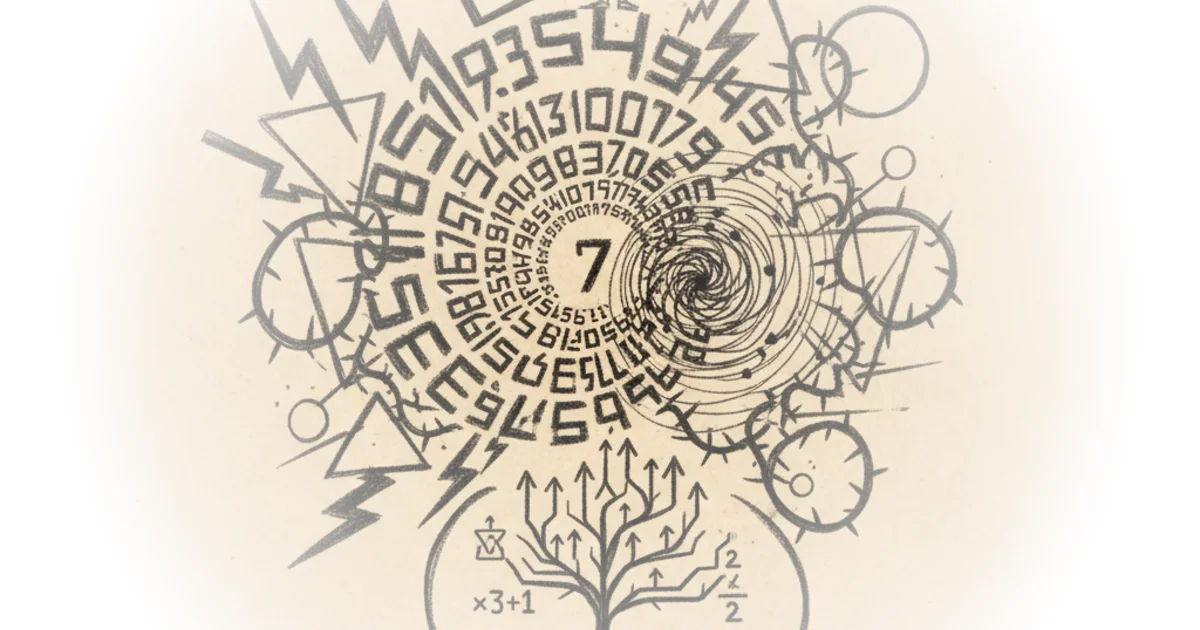
Muller explains the mechanism simply: pick any number, apply two rules depending on whether it's odd or even — multiply by three and add one if odd, divide by two if even. The conjecture posits that every positive integer will eventually end up in what he calls the "4-2-1 Loop." For 26, it takes just 10 steps to reach one. But for 27? That innocent-looking number climbs "all the way up to 9,232 — higher than Mount Everest" before falling back down, taking 111 steps to do so.
The pattern is randomness — like flipping a coin each step, if the coin is heads the line goes up, tails it goes down.
The piece's most compelling evidence comes from Muller quoting Jeffrey Lagarias, "the world Authority on 3x+1," who pulled him aside as a senior in college and said: "Don't do this. Don't work on this problem if you want to have a career." This warning alone tells us something about the magnetic pull of the conjecture — mathematicians who ignore it have found nothing but frustration.
The Evidence That Almost All Numbers Behave
Muller walks through several analytical approaches, but the most powerful is Terry Tao's 2019 proof. Muller writes that Tao "showed 3x+1 obeys even stricter criteria" — specifically that almost all numbers will end up smaller than any arbitrary function f(x), no matter how slowly that function grows. In public comments, Tao said this is "about as close as one can get to the Collatz Conjecture without actually solving it."
This is remarkable because it's the strongest partial result available: mathematically rigorous evidence that almost all sequences shrink, yet none of this constitutes a proof for every number.
The piece also introduces Benford's Law — the distribution of leading digits that appears across many natural datasets. Muller shows that hailstone numbers obey this law, with roughly 30% of numbers starting with 1, decreasing to fewer than 5% starting with 9. It's a beautiful pattern, but as Muller notes: "Benford's Law can't tell us whether all numbers will end up in the 4-2-1 Loop."
The Negative Numbers Reveal Something Strange
One of the piece's most fascinating twists is what happens when you apply the same rules to negative numbers. Muller explains that for positive integers, we haven't found any loop other than 4-2-1 — but "there are not one Loop, not two Loops, but three independent Loops" on the negative side. They start at low values like -7 and -5.
This asymmetry is strange: why should there be disconnected loops on the negative side of the number line but not on the positive side? The piece doesn't fully answer this question, leaving it as a tantalizing mystery that makes the conjecture even more compelling.
Why Can't We Prove It?
The core of Muller's argument addresses the elephant in the room: if we've tested every number up to 2^68 — that's 295 quintillion numbers — why hasn't anyone found a counterexample? The answer is simple but unsettling: "for all inputs, saying that the machine has transformed every input up to this 68 Square tape down to one should not give you a lot of confidence."
The piece cites another historical example: the Pell conjecture proposed in 1919 asserted that the majority of natural numbers have an odd number of prime factors. It was eventually proven false by Brian Hasselgrove in 1958 — and the counterexample was approximately 10^340 times larger than all numbers ever tested for Collatz.
Critics might note this seems like a weak argument for hope, but Muller frames it correctly: we simply don't know if there's a counterexample lurking far beyond our reach. The absence of evidence is not evidence of absence — and that's precisely what makes the conjecture so maddening.
Bottom Line
Muller delivers a compelling piece that balances mathematical rigor with narrative pull. The strongest section is his explanation of Tao's proof — technically sophisticated but clearly communicated. His weakest move is perhaps the implied conclusion that testing up to 2^68 means we should be confident: mathematically, that's not confidence at all, it's just a very wide river that hasn't yet found an exit.
What makes this piece work is its willingness to show uncertainty as a feature rather than a bug — admitting that almost all numbers behave doesn't prove all numbers behave. The Collatz Conjecture remains exactly what Muller presents it as: simple, beautiful, and utterly unsolved.