Ben Burgis dismantles a popular philosophical comfort zone: the idea that we only need to ensure everyone has "enough," regardless of how much more the wealthy possess. This piece is notable because it exposes how the "sufficientarian" stance—often used to deflect concerns about extreme wealth gaps—collapses when tested against real-world scenarios of racial and historical injustice. For busy readers navigating a world where inequality is eroding democratic norms, Burgis offers a sharp, logical trap that forces a choice between consistency and moral blindness.
The Illusion of "Enough"
Burgis begins by defining the battlefield. Egalitarianism argues that equality itself matters, while sufficientarianism claims only a baseline of "enough" is morally required. He notes that Steven Pinker, a prominent voice in this camp, treats inequality as a distraction from the real issue of poverty. Burgis writes, "Some readers will have already noticed that egalitarianism and sufficientarianism, at least as I've defined them above, are actually compatible." He suggests that one could theoretically care about equality only as a tool to achieve sufficiency, much like avoiding cigarettes only to prevent cancer.
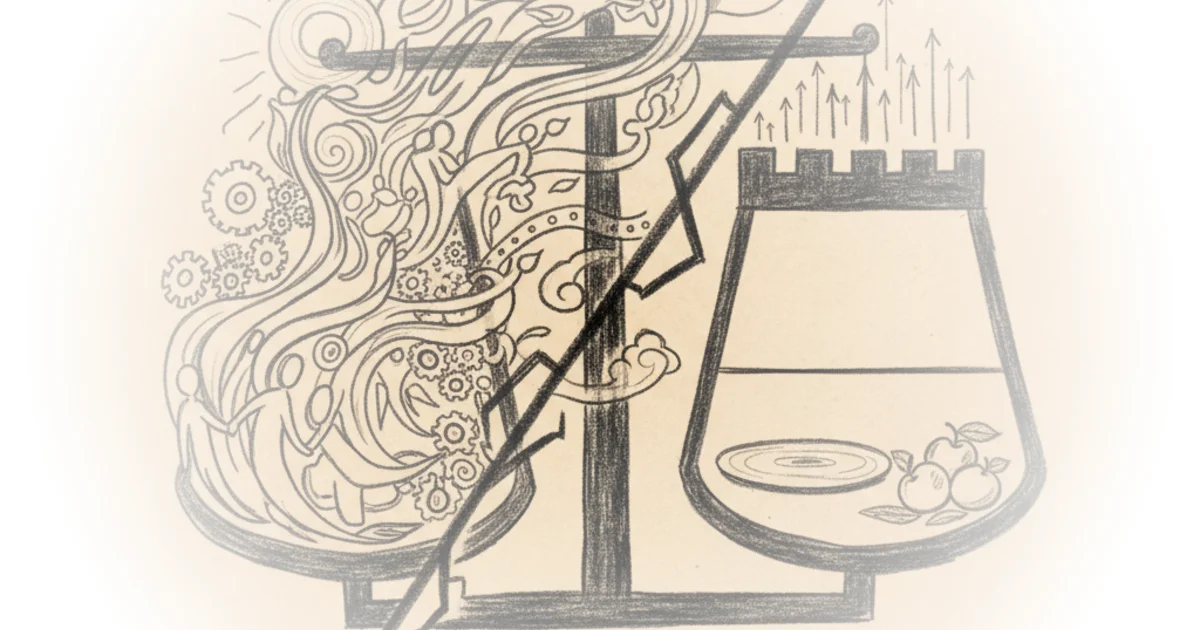
However, the author quickly pivots to why this theoretical compatibility fails in practice. He argues that in any society where the gap between the economic floor and ceiling is too wide, the wealthy will inevitably wield disproportionate political power to block redistribution. "Even conducting the discussion on normie-lib terrain... a fairly obvious worry is that in any society where we let the gap between the economic floor and the economic ceiling get too wide, those with more will exercise disproportionate political influence," Burgis explains. This is a crucial reframing: it moves the debate from abstract morality to the mechanics of power. The argument lands because it acknowledges that money buys influence, a reality that campaign finance reforms alone cannot fix.
Economic inequality can give a society cancer in lots of ways. But the ways that it inevitably degrades democracy and makes it harder to do anything about poverty should be enough to show that even in-principle sufficientarians should be egalitarians in practice.
Critics might argue that this conflates the effects of inequality with the principle of inequality, suggesting that one could theoretically maintain a sufficientarian view while fighting the political side effects. Burgis anticipates this, noting that the sheer difficulty of separating the two makes the distinction practically meaningless.
The Leveling Down Trap
The piece then tackles the classic philosophical objection to egalitarianism: the "leveling down" argument. This thought experiment suggests that if you simply take wealth from the rich to make everyone equally poor, you haven't made things better. Burgis admits this is a "very straightforward case" that challenges in-principle egalitarianism. He writes, "Surely, this wouldn't be better. In fact, it wouldn't be better-in-some-ways, worse-in-others... It would be flatly undesirable."
He acknowledges that this scenario is a serious hurdle for anyone arguing that inequality is inherently bad. However, he doesn't let this stop him. Instead, he uses it to set up his own, more devastating counter-argument against sufficientarianism. The author's strategy here is to concede a point to the opposition only to reveal a deeper flaw in their own position. This approach is effective because it demonstrates intellectual honesty while sharpening the critique.
The Un-Leveling Up Argument
Here, Burgis delivers the piece's most distinctive contribution. He constructs a hypothetical "Sufficientarian Utopia" where everyone has exactly "enough." Then, he introduces a twist: "All the white people in this society have 10% more than enough, while all the black and brown people are stuck at enough." He asks a piercing question: "If you this sounds unjust to you…why?"
The problem, Burgis argues, is that sufficientarianism cannot explain why this specific inequality is wrong. Since everyone has "enough," the theory has no moral lever to pull. "The whole point of sufficientarianism is that we should be able to define 'enough' independently of comparisons," he writes. If a sufficientarian claims this scenario is unjust, they must admit that the standard of "enough" rises based on what others have, effectively becoming an egalitarian.
Burgis extends this logic to historical injustice, imagining a French society where a descendant of the Bourbon dynasty still holds 10% more wealth than the average citizen, despite centuries of taxation and reform. "Is this unjust? Presumably yes, if you think 'resulting from historical injustices' is enough to render a distribution unjust," he posits. The luck egalitarian can explain this easily: the inequality stems from factors outside the control of the worse-off. But the sufficientarian is left speechless. "But this explanation is unavailable to the sufficientarian. They'll need to find one of their own," Burgis notes.
The whole point of sufficientarianism is that we should be able to define "enough" independently of comparisons.
This section is the intellectual core of the article. It strips away the defensive posturing of those who claim to care only about poverty, revealing that their framework cannot account for the moral weight of arbitrary advantage. The argument holds up because it forces the reader to confront the reality that "enough" is a moving target in a society defined by relative status and historical debt.
Bottom Line
Burgis's strongest move is demonstrating that "sufficientarianism" is often a rhetorical shield used to ignore the corrosive effects of extreme wealth concentration. The argument's biggest vulnerability is its reliance on the assumption that any inequality, no matter how small, is inherently suspect if it stems from arbitrary factors. Nevertheless, the piece successfully argues that in a world where power is unequal, the distinction between "enough" and "more" is not just a philosophical nuance—it is a political reality that demands an egalitarian response.