Cory Doctorow delivers a searing diagnosis of a global order in freefall, arguing that the United States has not merely lost its moral authority but has actively dismantled the very mechanisms that kept the world stable. The piece's most arresting claim is that the administration's erratic behavior has rendered the US incapable of even winning a rigged game, forcing other nations to abandon the American-led system not out of ideology, but out of sheer survival.
The Escrow Agent Who Stole the House
Doctorow frames the United States' historical role not as a benevolent leader, but as a "trusted third party" (T3P) in global transactions—much like an escrow agent holding a deed and money. For decades, the world tolerated American dominance because the cost of building a new system was higher than the toll extracted by Washington. Doctorow writes, "Just as people stay on Facebook because they love their friends more than they hate Mark Zuckerberg, the nations of the world let America control their systems because they feared the cost and difficulty of building a new system more than they resented letting America dictate and tax every part of their politics and economies."
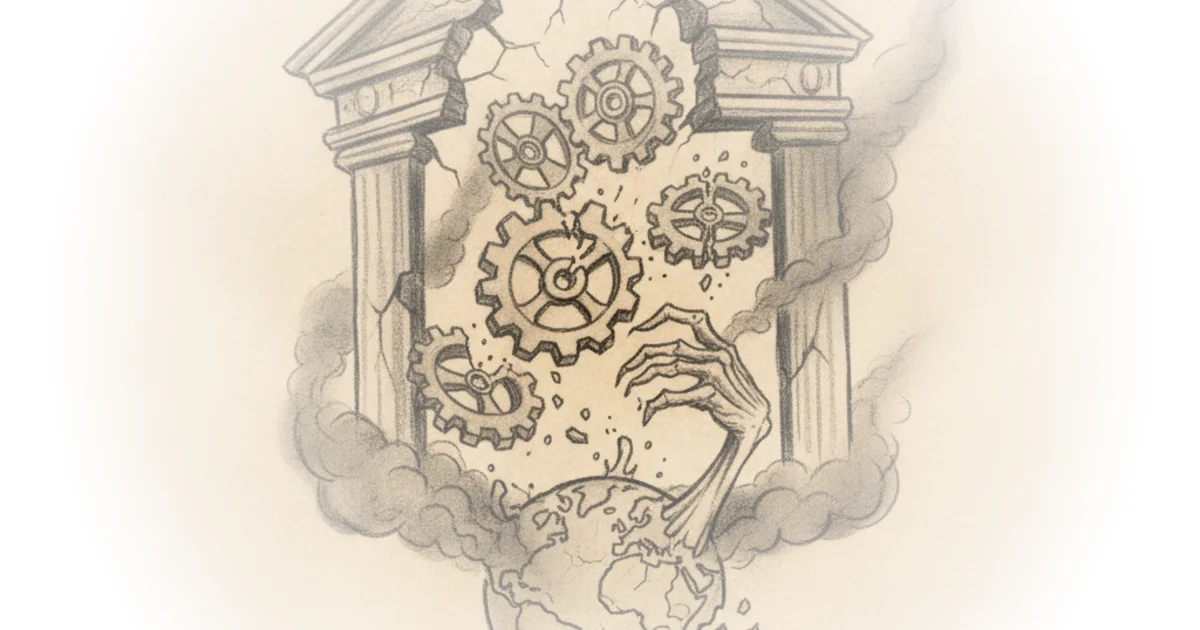
This analogy is powerful because it strips away the rhetoric of "freedom" to reveal the cold economics of dependency. However, Doctorow argues that the current administration has broken the fundamental contract of trust. He notes that under this leadership, the price of doing business has become "infinity." The administration's approach is characterized by a lack of coherence: "If you buck Trump, he doubles down and demands twice as much. If you capitulate to Trump, he interprets it as weakness and comes back for three times as much." This creates a situation where no long-term agreements are possible, only temporary pauses in aggression.
"For Trump, 'the art of the deal' can be summed up in one word: renege."
The commentary on Canada illustrates this dynamic vividly. Despite Prime Minister Mark Carney's efforts to appease Washington—allowing Palantir access to sensitive military data and canceling tech taxes—the administration responded with chaotic, escalating tariffs. Doctorow points out the absurdity of Canada's retaliatory measures, describing them as "punching yourself in the face as hard as you can in the hopes that the downstairs neighbour says 'ouch.'" While this framing effectively highlights the futility of the current trade war, critics might argue that it underestimates the domestic political pressures that sometimes force nations into defensive postures, even when those postures are economically self-harming.
The Post-American Void
The article shifts from trade to security, citing John Quiggin's observation that "the cemeteries are full of indispensable people," a sentiment now applied to nations. Doctorow argues that the US has zeroed out its value as a security guarantor. He writes, "The US can no longer credibly provide missiles and anti-missile defenses, not after Trump used up America's stockpiles in his pointless, endless war in Iran." This is a stark departure from the usual diplomatic language, forcing readers to confront the material reality of depleted resources and broken alliances.
The argument extends to the financial system, where the weaponization of platforms like SWIFT is accelerating the move away from the dollar. Doctorow suggests that the collapse of trust in American institutions is creating an opening for a new order. He notes that Europe is racing to break its reliance on US-controlled financial rails, driven by the very actions that were meant to enforce compliance. "The more Trump weaponizes these against institutions like the International Criminal Court, the faster this transition will go," he observes. This is a crucial insight: the administration's attempt to punish dissent is actually fueling the creation of the alternatives it fears.
"Trump is the escrow agent who keeps the money and the deed, then announces he did it because the seller was a fentanyl dealer and the buyer was a lizard-person."
Doctorow's use of hyperbole here serves to underscore the complete breakdown of rational statecraft. By comparing the administration's justifications to conspiracy theories, he highlights the erosion of the shared reality necessary for international cooperation. The reference to the Cobden–Chevalier Treaty of 1860, a landmark agreement that reduced tariffs between Britain and France, serves as a historical counterpoint, reminding readers that trade liberalization has historically required stability and mutual respect—conditions the current executive branch has actively destroyed.
The Real Digital Challenge
In a controversial pivot, Doctorow challenges the prevailing focus on "sovereign AI" as the primary battleground for the post-American internet. He dismisses the idea that nations need to build their own AI models, calling it "nonsense" in the face of more immediate threats. "If Trump orders Microsoft to shut off your country's access to Office 365... your country would simply cease to function," he writes, citing real-world examples of software being weaponized against foreign governments.
Instead, he argues that the priority should be on infrastructure and data sovereignty. The real challenge, he posits, is not writing code but "extracting the data, replacing the firmware, and bridging new systems." This reframing is significant because it shifts the focus from the hype of artificial intelligence to the gritty reality of maintaining critical infrastructure. He points out that the hardware and software needed for this transition are available; the barrier is legal, specifically the trade deals that make it illegal to reverse-engineer US tech. "Trump has made the case for abandoning these deals better than I ever could have," Doctorow asserts, noting that the administration's own actions have exposed the fragility of the global tech ecosystem.
Bottom Line
Doctorow's strongest argument is that the administration's unpredictability has inadvertently accelerated the formation of a multipolar world, making the US a liability rather than an asset in global governance. The piece's greatest vulnerability lies in its assumption that new systems can be built quickly enough to fill the void before the chaos causes irreversible damage. The reader should watch for how quickly other nations move to replace US-controlled financial and digital infrastructure, as the window for a stable transition may be closing faster than anticipated.