What if I told you that one of the deadliest transportation disasters in recent years was caused not by a train or a plane, but by something as mundane as an escalator? On October 23rd, 2018, at a metro station in Rome, something went catastrophically wrong. Within seconds, an escalator that had been safely transporting thousands of fans to a football match suddenly accelerated out of control. Twenty-four people were injured in what experts later called a near-impossible chain of failures. But the story of how we got from those terrifying early escalators to today's engineered marvels is far stranger than you might imagine.
The Rome Escalator Disaster
At 7:03 p.m., thousands of football fans were making their way down to the metro platform at Rome's Repubblica station. About fifty people rode the long escalator downward. Within thirty seconds, that number nearly doubled. Everything seemed normal—except inside the escalator, a problem was brewing.
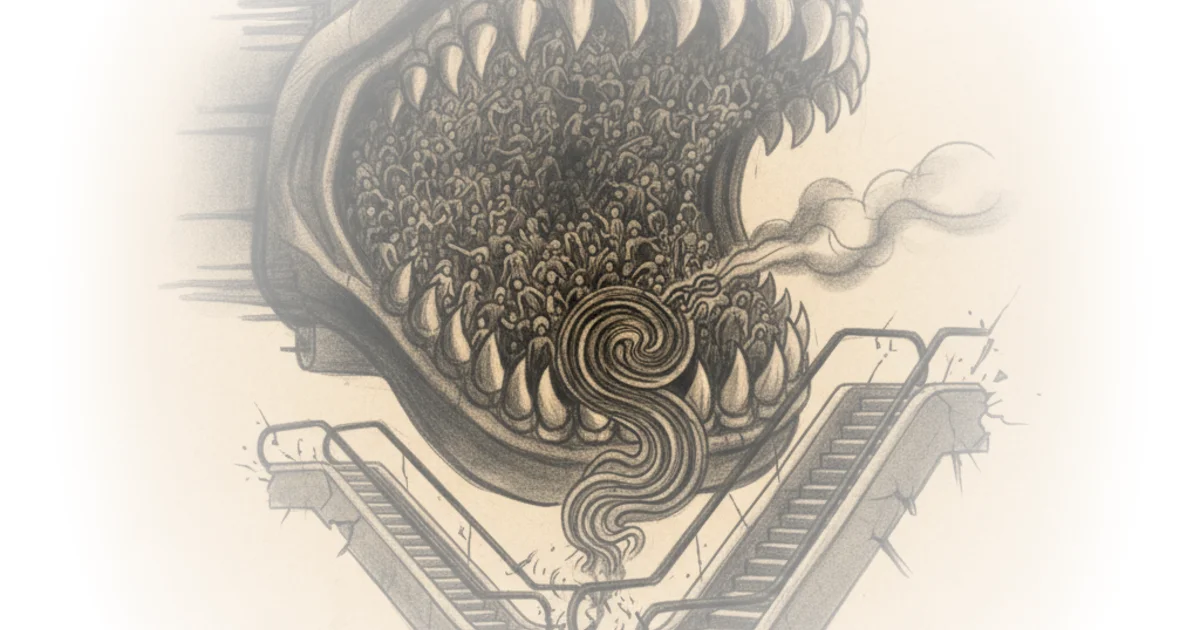
The combined weight of the passengers was bearing down on the steps. The load on the main motor was increasing. To try to slow the descent, the motor applied counter-torque. But as the force continued to grow, the stairs began moving faster instead of slower. By 7:04 p.m., the crowd had tripled. The motor reached its limit. Under massive strain, the drum began slipping.
The escalator triggered its first line of defense: a safety relay cut power to the motor. Then the main brake clamped down on the metal drum to stop the descent—also failed. The friction wasn't enough to stop the motor from spinning. The stairs continued accelerating.
Assensing it had lost control, the escalator engaged its last line of defense: an auxiliary brake designed to bypass the motor entirely and directly lock the drive shaft. Under normal circumstances, all three safety measures failing at once would be vanishingly small. But these weren't normal circumstances.
At 7:05 p.m., the third safety system failed. The stairs began plummeting. Fans were flung forward, streaming down the escalator in a crushing pileup. Some leapt over the central barrier in desperation. At the bottom, the landing became a dangerous choke point. Under pressure, the steps twisted and buckled into jagged metal, leaving twenty-four people injured.
The transit agency sealed off the site. The authorities ordered both technical and criminal investigations. After nearly two years, investigators published an eighty-six-page report detailing exactly what happened: as fans crowded onto the escalator, their combined weight increased the load on the main motor. The motor tried to resist this change, but the force grew too high. Eventually it hit a tipping point and accelerated uncontrollably.
Where Escalators Came From
Now here's the surprising part: that disaster in Rome is actually more similar to the origin of escalators than you might think.
The very first escalator was an amusement attraction from 1896. It had no steps—a slow conveyor belt made of metal and wooden parts, bringing people up a full seven feet before they walked downstairs on the other side. The inventor, Jesse Reno, called it the "continuous elevator." He created it not just as an entertainment ride, but as proof of concept for what he saw as the future of transportation.
Over seventy-five thousand people enjoyed the attraction during its two-year stay at Coney Island's Iron Pier. But as Reno watched riders, he noticed something troubling: nobody walked. They stood still, feet planted sideways, gripping the handrail tightly.
Two years later, a similar device was installed in an English department store. The ride was so unsettling that staff had to offer brandy to men and smelling salts to women just to calm their nerves. You see, both devices had a twenty-five-degree incline—precarious to walk on and unnerving to stand on. At around twelve degrees, walking becomes difficult. Twenty-five degrees is roughly the limit that our ankles can flex.
What if there was a way to replace the conveyor belt with moving stairs? Riders would always have a flat surface to stand on and a staircase they could climb if they wanted to.
One attempt had already existed for four decades: the revolving stairs. It consisted of a chain going around a loop, with fixed stair-shaped blocks attached to it, creating a flat surface during the incline. But as soon as you'd reach the top, the steps tilted forward—making it treacherous to get off. The same problem plagued you at the bottom.
You might think: just extend each landing? That doesn't work either. You end up with a jagged mess for longer.
Wheeler's Breakthrough
How do modern escalators solve this problem?
The solution came from an inventor named George Wheeler. His idea forms the basis of every escalator in use today.
A typical subway escalator has an electric motor at the top with power output around fifty kilowatts—smaller than most electric cars. This motor spins extremely fast at over a thousand rotations per minute, but it's pretty weak. To drive the steps, the escalator needs to convert this into slower output with more force. It uses a reduction gearbox and gear system, lowering output to just a few rotations per minute while increasing torque by a factor of around one hundred.
The motor connects with a large sprocket to a reinforced steel chain that pulls the stairs around a loop. The so-called step chain is fitted with wheels to roll smoothly around curves.
But unlike revolving stairs, Wheeler proposed attaching each step to this chain through a single axle, giving it freedom to rotate. He added a second set of wheels to each step that followed a different track, allowing control of the step's angle at any point. On the incline, the two tracks overlap—just like the revolving staircase—but then at the top, they separate.
This is what allows us to keep steps level throughout the entire ride. The tracks remain separated and curve around. The steps flip upside down, tuck into the loop, and start their return journey. At the start of the incline, the tracks rejoin and the whole process repeats.
Despite modern escalators adopting Wheeler's design, it caught so little attention at first that he was forced to shelve the idea. It wasn't until eight years later that another inventor, Charles Seabberger, bought the patent and capitalized on the invention.
Seabberger partnered with Otis Elevator Company and together they built a prototype. In 1900, they showcased it at the Paris Exposition Universal. Fifty-one million people flocked to the exposition to see modern technology's marvels. One of the most popular exhibitions was the world's first true commercial escalator. French historian Philippe Julianne described it as "the jolliest attraction at the exhibition," writing that "it caused many an incident worthy of the vaudeville, separating families, sending old men sprawling, delighting the children, and reducing their nana to despair."
Shortly after, escalators started installing worldwide.
The Safety Innovations
But these early escalators weren't perfect. They had smooth, flat stairs, and when they reached the top, they'd disappear under a wooden board—leaving a dangerous gap between them. Shoelaces, coats, and especially the long skirts in fashion at the time easily got caught in the machinery. One incident saw a three-year-old girl get her foot pinched in the gap. She escaped with injured toes and a missing shoe—but something had to change.
Seabberger and Otis installed a triangular shunt at the end of the escalator, forcing riders to go off to the left before reaching the dangerous gap. This worked but was awkward: people had to put one foot onto solid ground while the other was still moving—tricky when some stood still and others walked.
To reduce people blocking each other, operators asked riders to stand on the right and keep the left lane clear for faster walkers—a convention we still often follow today.
But there's a better solution than the shunt. Modern escalator steps aren't smooth—they're grooved. These grooves interlock perfectly with a comb plate at the top of the escalator. If a small item approaches the end, the comb plate lifts it up and out of harm's way. This makes it much harder for things to get stuck. Perhaps more importantly, it allows people to safely step off forwards.
The comb plate doesn't entirely solve the problem though. We still have gaps on the side that can pinch and trap objects as steps move. So in 1982, a new safety feature called the skirt brush was added.
Escalators are full of subtle safety features like this—some old, some new, but almost all designed around people.
All the way back in 1896, Jesse Reno predicted riders would need something to hold on to. So he introduced a moving handrail. In modern escalators, the motor has a separate connection to turn a friction wheel that drives the handrail. The only problem is that friction wears things down. Over time, the wheel gets smaller and as its circumference decreases, each rotation moves the rubber loop slightly shorter distance. So the handrail begins to move more slowly.
The effect is small but builds up over time. To compensate, a new handrail is calibrated to move around two percent faster than the steps. You can actually test this yourself next time you're on an escalator: place your hand next to you as you stand still and watch it drift forward. This speed difference stops the handrail from lagging too far behind.
The Electricity Generator
But it's not just the handrail. The speed of the steps themselves needs careful control. Modern escalators use AC induction motors, which are extremely good at regulating rotational speed. And this has an unexpected benefit on downward escalators.
With enough people riding, their weight is enough that the motor no longer powers the ride. Instead, the weight drives the chain and causes the motor to spin. As more people board, the force increases and pushes it to turn faster.
But modern AC induction motors work by creating a rotating magnetic field. When the motor tries to spin faster than the field, electric currents are induced inside it, which create their own magnetic field. This new field pushes back in opposite direction to the spin, creating braking force that resists the increase in speed.
Here's what's interesting: rather than consuming energy, the physics flips and uses excess mechanical energy to produce an current. This is called regenerative braking—the same trick electric vehicles use to recharge their batteries. In effect, the motor turns into a generator.
The result? On busy days, many modern downward escalators aren't just moving people—they're generating electricity. Often this channels back to the building's internal grid and powers other devices, including upward escalators.
This regenerative braking makes escalators extremely power efficient. But more importantly, it makes them inherently safe.
But there is a point where adding weight becomes too much: if you keep adding force, eventually it becomes so strong that motor can no longer resist. And if left unchecked, it would start accelerating uncontrollably. The stairs would go plummeting down—which is exactly what happened in Rome.
Critics might note that while regenerative braking is elegant, the Rome accident revealed how safety systems can cascade into failure when multiple redundancies are overwhelmed by sheer weight of numbers. The report showed that all three backup systems failed—a statistical near-impossibility that became real.
Bottom Line
This piece does something rarely seen in casual explanations: it takes a mundane technology we use every day and reveals the century-long engineering battle to make it safe. The Rome accident isn't just a tragedy—it's proof that escalator safety is genuinely hard won. The biggest strength of this argument is its narrative arc from amusement ride to modern infrastructure. Its vulnerability is that regenerative braking, while impressive, doesn't fully explain why the Rome motor lost control in the first place—the investigation pinned it on weight overload, not technology failure.