Paul Cooper's latest episode from Fall of Civilizations does something rare: it resurrects a lost empire not through dry archaeological data, but by channeling the desperate creative crisis of a 19th-century French novelist. The piece's most distinctive claim is that our modern understanding of Carthage is inextricably linked to the literary imagination of Gustave Flaubert, who had to physically walk the dust of Tunisia to resurrect a civilization that history had tried to erase. In an era of fragmented news cycles, this deep-dive narrative offers a necessary reminder that the most profound historical truths often lie in the emotional resonance of loss, not just the dates of battles.
The Writer in the Ruins
Cooper opens with a striking portrait of Flaubert in 1858, a man paralyzed by the impossibility of his task. The author writes, "I'm done for my friend done for the past month I found it impossible to write I can't find a single word just think of what I've let myself in for to resuscitate an entire civilization with nothing whatsoever to go on." This admission of creative paralysis is the hook that grounds the entire episode. Cooper argues that Flaubert's breakthrough didn't come from reading more ancient texts, but from abandoning the study to immerse himself in the landscape. The author notes that Flaubert realized he needed to "acquaint myself thoroughly with the Landscapes I'll be describing," a decision that forced a complete rewrite of his novel, Salammbô.
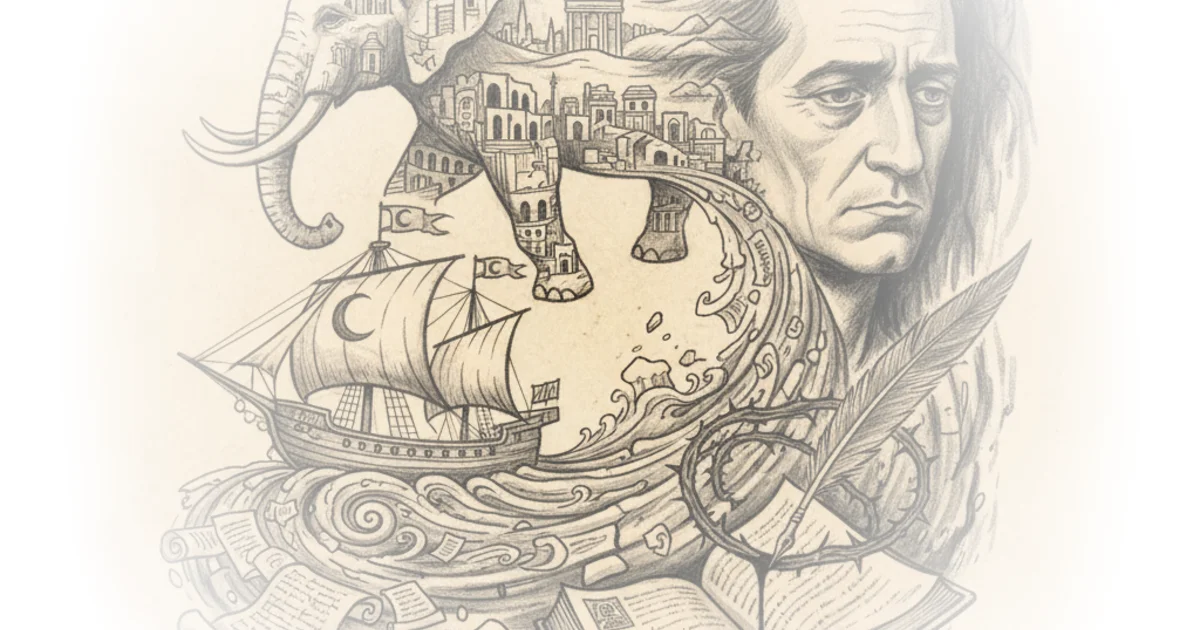
This framing is effective because it shifts the focus from the abstract concept of "history" to the tangible, sensory experience of the past. Cooper describes Flaubert's notebooks filled with impressions of "green wheat full of flowering poppies" and ruins that looked like "Palm treason here and there." By anchoring the history of Carthage in the physical reality of the Tunisian soil, Cooper makes the ancient world feel immediate and urgent. The argument suggests that to understand a fallen civilization, one must first understand the silence that followed its destruction.
To resuscitate an entire civilization with nothing whatsoever to go on.
The Purple People and the Sea
Once the narrative shifts from Flaubert to the Phoenicians themselves, Cooper masterfully dismantles the myth of a unified Phoenician identity. He points out that "Phoenician is a term invented later by their great Rivals the Greeks," and that these city-states likely never saw themselves as a single people. The author traces the etymology of the name back to the word phoinike, referring to the crimson dye derived from sea snails. Cooper writes, "The Color Purple would soon become associated with enormous wealth and as a consequence with royalty," highlighting how a specific industrial process defined a culture in the eyes of its neighbors.
The piece excels in explaining how this dye industry drove the Phoenicians to become the premier navigators of the ancient world. Cooper details their technological innovations, from waterproofing hulls with bitumen to using the pole star for navigation. He quotes the Book of Ezekiel to illustrate the global reach of their trade networks, noting how they exchanged "silver iron tin and lead" for goods from across the Mediterranean. This section argues that the Phoenicians were not just traders, but the connective tissue of the ancient economy, a role that allowed them to survive despite lacking a central empire.
Critics might note that Cooper's reliance on Greek and Hebrew sources inherently biases the narrative toward the perspectives of Carthage's enemies. The description of Phoenicians as "cunning and untrustworthy" in Homer's Odyssey is presented as a reflection of their reputation, but the author could have explored more deeply how this "untrustworthy" label was a political tool used by land-based empires to delegitimize maritime competitors. Nevertheless, the analysis of their economic leverage remains compelling.
The Price of Survival
The narrative takes a darker turn as Cooper examines the Phoenicians' relationship with the rising Assyrian Empire. The author describes the Assyrians as a terrifying war machine that viewed the Mediterranean as a "bitter river" they could not cross. Faced with the threat of annihilation, the Phoenician cities of Tyre and Sidon made a pragmatic deal: they would act as a "Navy for hire" for the Assyrians in exchange for autonomy. Cooper writes, "The Assyrians were now breathing directly down the necks of The Phoenician cities of the coast," yet the Phoenicians survived by becoming too useful to destroy.
This section highlights the fragile nature of Carthage's existence. The author argues that their survival was not due to military might, but to their unique ability to navigate the seas that other empires feared. The core of the argument is that the Phoenicians were masters of adaptation, turning their geographic isolation into a strategic asset. However, this adaptation came at a cost, as they were forced to facilitate the very wars that threatened their neighbors. As Cooper puts it, they were "allowed a degree of Independence so long as they ensured a constant flow of metals and other resources into Assyria."
Bottom Line
Paul Cooper's episode is a triumph of narrative history, successfully weaving the personal struggle of a novelist with the grand sweep of ancient geopolitics. Its strongest element is the refusal to treat Carthage as a static museum piece, instead presenting it as a dynamic, living culture defined by its trade, its technology, and its desperate struggle for survival. The biggest vulnerability lies in the scarcity of indigenous Carthaginian voices, a limitation the author acknowledges but cannot fully overcome. For the busy listener, this piece offers a rare, immersive journey into a world that was almost completely erased, proving that the past is never truly gone if we are willing to walk its ruins.