More Perfect Union doesn't just ask if Poland Spring is taking too much water; they present a forensic case that the company is actively lying about the drought conditions that supposedly forced a reduction in pumping. This is not a standard environmental complaint about resource scarcity, but a sharp investigation into corporate opacity, political capture, and the specific legal loopholes that allow a multinational private equity firm to drain a rural state while paying pennies in taxes. For busy readers, the urgency lies in the evidence that the "David and Goliath" narrative is being manipulated by a Goliath that controls the very regulators meant to check its power.
The Illusion of Scarcity
The piece opens by dismantling the company's public relations strategy. More Perfect Union writes, "This year is the fifth in the last decade where much of the state has experienced significant droughts." This statistic sets the stage for the central conflict: while the company claims to be acting responsibly by cutting back during dry spells, the on-the-ground reality suggests otherwise. The authors juxtapose the corporate narrative with the lived experience of residents like Nina Fuller, a sheep farmer who watched her wells run dry. "I think it was maybe 15 years I was here when it when the drought hit and I ran out of water and then a couple years later I ran out of water again," Fuller recalls. The emotional weight here is undeniable, but the investigative angle is what elevates the story. The authors don't just accept the drought excuse; they dug into the monthly reports filed by the towns of Fryberg and Denmark.
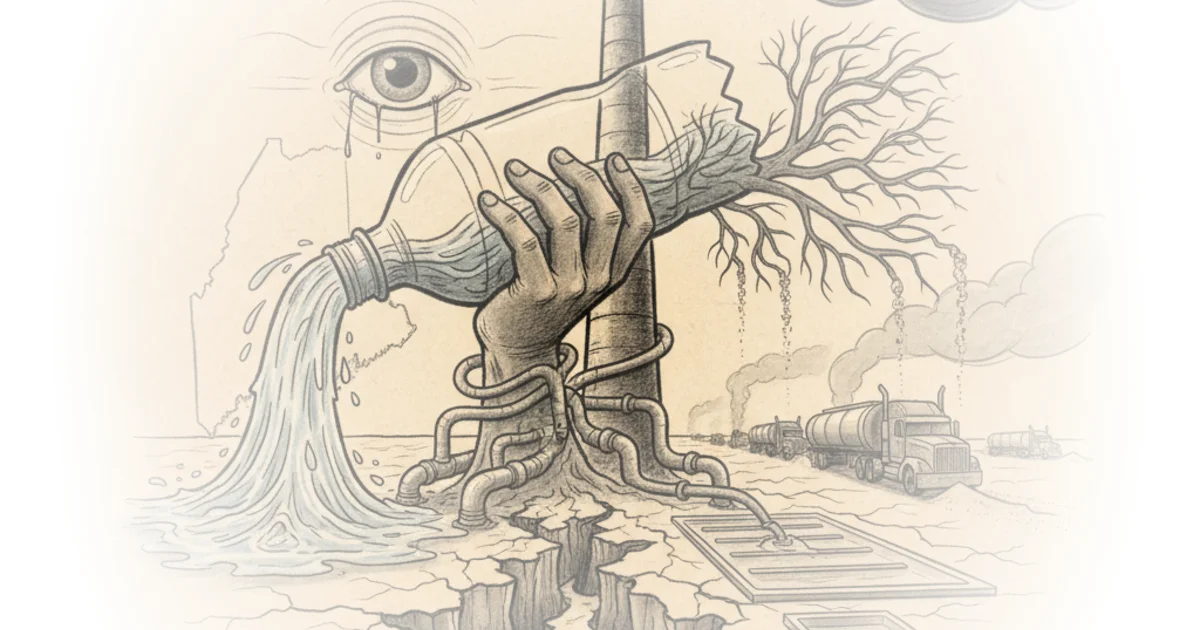
The core of the argument is that the company's public statements are contradicted by their own data. More Perfect Union notes, "The reports show that in September when Poland Springs said that they were reducing withdrawals from some sites including Fryberg, the company actually drew more water from Denmark and Fryberg than they did in September 2023 and September 2024." This is a devastating finding. It suggests that the "drought response" is a marketing tactic rather than an operational reality. Critics might argue that aquifer levels fluctuate locally and that a reduction in one spring doesn't necessarily mean an increase in another, but the sheer volume of water extracted—nearly 64 million gallons from Cold Spring alone in a single year—makes the discrepancy hard to dismiss as mere statistical noise.
"We can do what we can on a town level with our ordinances, etc. But if there isn't the will, it doesn't really happen. I do believe it needs to come from the state level."
The Mechanics of Capture
The commentary shifts from environmental impact to political economy, exposing how Poland Spring has insulated itself from local control. The authors trace the lineage of the brand from its acquisition by Nestle to its current ownership by Blue Triton, a private equity-backed entity. More Perfect Union points out, "In 2021, Nestle spun off all of its bottle water brands into Blue Triton, a company backed by private equity. After Blue Triton bought the brands, their pumping around the country increased, including in Maine." This detail is crucial for the reader to understand the motive: the shift to private equity often signals a drive for aggressive cost-cutting and revenue maximization, which directly conflicts with sustainable resource management.
The investigation reveals a disturbing pattern of regulatory capture. In the town of Fryberg, a contract was approved by a public utilities commission where "all three members... had ties to Poland Spring or firms that worked for them." It took a year and a half for them to recuse themselves, yet the replacements approved the deal anyway. As the authors put it, "decisions were being made behind closed doors and the public wasn't getting access to all the information about whether this was a good deal for their community." This is the most alarming part of the piece: the system designed to protect the public interest has been effectively neutralized by the very industry it regulates. A counterargument worth considering is that private companies need long-term contracts to justify infrastructure investment, but the 45-year lease terms granted here seem excessive for a resource as volatile as groundwater.
The Legal Loophole
The piece concludes by identifying the legal framework that enables this extraction: the "absolute dominion" law. More Perfect Union explains, "Maine is one of just three states that has what's known as an absolute dominion law. It lets land owners extract an almost unlimited amount of groundwater." This law is described vividly as "the guy with the biggest straw wins." The authors argue that this legal structure prioritizes the rights of the extractor over the stability of the community. "Holding that law in place really protects land owners who have businesses that use a lot of water and puts their neighbors at potential risk," they write. This framing is effective because it simplifies a complex legal doctrine into a relatable image of unfairness.
Despite the clear risks, legislative action has stalled. A bill to study the law passed but remains unfunded, leaving the status quo intact. The authors highlight the human cost of this inaction through the story of Chris Doyle, whose well went dry only to refill when the company's trucks couldn't pump during a storm. "In that 24-hour period, my well went up 24 in," Doyle notes. This anecdote serves as the smoking gun for the hydrological impact, proving that the company's operations are directly interfering with private water supplies. The authors' conclusion is stark: "If we fail to take action, that's on us. And it's only going to continue to happen." This is a call to civic engagement that feels both urgent and necessary, moving beyond complaint to a demand for structural change.
Bottom Line
More Perfect Union's strongest asset is its ability to pair emotional storytelling with hard, contradictory data that exposes corporate dishonesty. The piece's biggest vulnerability is its reliance on local anecdotes to prove a hydrological claim, which the company can (and likely will) dispute with its own scientific models. However, the evidence of political maneuvering and the sheer scale of the extraction make the argument compelling. Readers should watch for the outcome of the state-level legislative efforts to reform the absolute dominion law, as that will determine whether this is a one-off conflict or a systemic failure of governance.