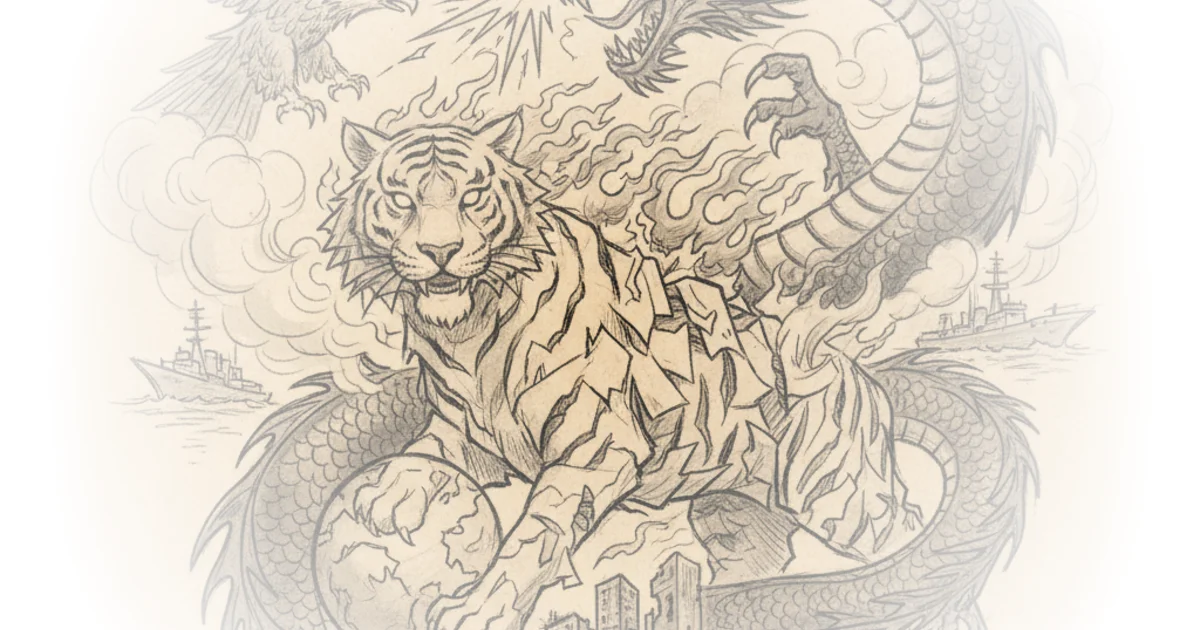
Forget both the panic and the complacency: Chris Chappell’s takedown of lazy China military narratives lands like a precision strike because he weaponizes real-world combat failures most analysts ignore. While think tanks obsess over ship counts, he proves Chinese hardware crumbles when tested—then warns that betting on this weakness is a fatal gamble. You’ll never hear "paper tiger" the same way again.
The Paper Tiger Paradox
Chappell opens by mocking the binary panic: either China’s military is unstoppable or utterly useless. He demolishes the latter myth with visceral evidence few dare cite. Iran made the Chinese HQ9B long range active radar surface-to-air missile system the cornerstone of its missile defense. How’d that turn out for the regime? Chappell doesn’t just report the failure—he paints the absurdity: This is like one of those elementary school science fair projects but for evil. The core argument is devastatingly simple: if exported Chinese tech fails repeatedly in Pakistan’s 2019 clash with India (where missiles "penetrated the defensive shield repeatedly") and Venezuela’s farcical radar purchases, why assume domestic systems work better? This lands because he cites Stockholm International Peace Research Institute data showing China’s arms sales dropped 10% while global sales rose—proof the market rejects its junk. Critics might note export-grade systems are often downgraded, but Chappell’s evidence of systemic corruption (tying equipment failures to China’s "tofu construction problem") suggests a deeper rot.
Your move militaries that would fight China.
Industrial Might vs. Battlefield Reality
Then comes the pivot: dismissing China as weak is equally dangerous. Chappell shifts from hardware flaws to chilling capacity. The US Navy has been relegated to a supporting role in recent US military operations... A war with China over Taiwan would be a type of naval warfare the US hasn’t fought since probably World War II. He contrasts this with China’s industrial dominance—232 times the US shipbuilding capacity—a fact sharpened by the Refining deep dive’s 2023 production stats. His Glass Joe vs. Mike Tyson analogy ("fighting Glass Joe 20 times in a row and thinking you could take on Mike Tyson") crystallizes why recent US military ops mislead. But he overlooks a key nuance: China’s surge in missile production matters less if guidance systems fail, as seen in Pakistan. Still, his warning resonates: That’d be like fighting Glass Joe 20 times in a row and thinking you could take on Mike Tyson.
The Psychology of Deterrence
Chappell’s masterstroke is exposing how China exploits perception. The 2012 Scarborough Shoal incident—where China seized the reef after Obama backed down—became the "Scarboro model" for incremental aggression. It was one of the only times someone unironically said thanks Obama. This historical pivot explains why China might intentionally sell faulty exports: they never expected confrontation. But his sharpest insight targets American psychology. Literally everything is at stake here—not just hardware, but whether the US public would endure casualties. He nails the vulnerability: Chinese shills are already framing Taiwan as "some tiny island... that has no impact on us," while Carnegie Endowment data shows most Americans wrongly believe China’s power equals or exceeds America’s. A counterargument worth considering: public tolerance for casualties might surge if attacked, as post-9/11 polls showed. Yet Chappell’s warning about psychological warfare feels urgent amid today’s polarization.
Bottom Line
Chappell’s strongest contribution is proving China’s military reputation is crumbling through real-world combat failures—a data point most Western analysts ignore. His biggest vulnerability? Assuming China’s domestic systems share export-grade flaws without evidence. Watch for how the US Navy rebuilds Pacific readiness—and whether China’s next island grab triggers the confrontation that finally tests its "paper tiger" hardware.