London Centric's Michael Macleod doesn't just report on a test ride; he exposes a critical friction point where idealistic technology collides with the chaotic reality of human driving. While the headline promises a look at London's first driverless bus, the real story is how an algorithm's strict adherence to rules can paralyze progress in a city built for improvisation.
The Algorithm vs. The Road
Macleod takes readers inside an Ohmio vehicle navigating Barnes, only to have it jolt to a halt because an aggressive SUV ignored its right of way at a mini-roundabout. "The autonomous vehicles are too well behaved," the technicians admit, noting that their insistence on following the Highway Code is sometimes incompatible with making rapid progress on the capital's streets. This observation cuts deep: the technology works perfectly by design, yet fails in practice because it cannot negotiate the unspoken social contracts of London traffic.
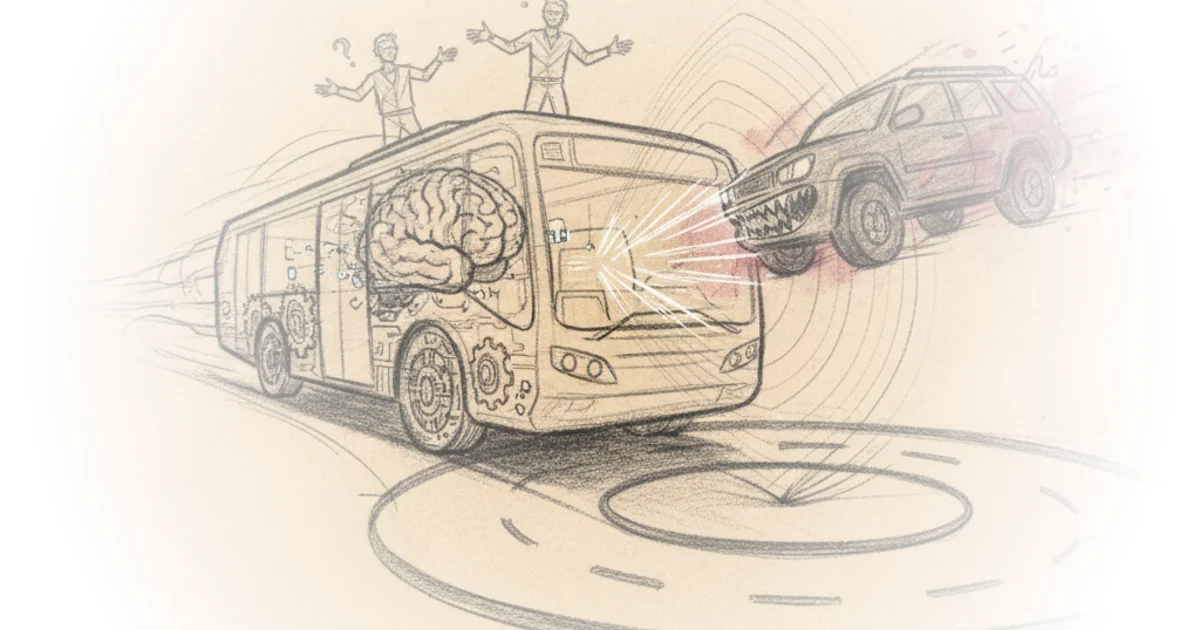
The ride feels less like a bus and more like a tram, tracing the River Thames at a steady 15mph with an "uncannily conservative approach." Macleod notes that while passengers must currently sit down and wear seatbelts, the vehicle features giant screens displaying potential risks mapped by Light Detection and Ranging sensors. This transparency is reassuring, yet it highlights a limitation: the system sees hundreds of meters ahead but lacks the human intuition to weave through gaps.
"This is the future of transport: autonomous vehicles... It's the future of taxi transport, of personal transport, but also public transport."
Charles Campion, an architect and local activist, frames this not as a gimmick but as a necessity born of infrastructure failure. The context here is vital; while self-driving pods have been tested in controlled zones like the Greenwich Peninsula for over a decade, Macleod points out that "this is believed to be the first time that an autonomous bus has been tested on London's public roads in real conditions, alongside human drivers." The stakes are raised because this isn't a simulation; it's a live experiment where safety protocols meet aggressive driving.
A Bridge Too Heavy for Bureaucracy
The narrative pivots from the vehicle itself to the specific problem it aims to solve: the collapse of Hammersmith Bridge. Macleod explains that the Grade II* listed Victorian bridge, closed to motor traffic since 2019, is too weak to carry modern vehicles without vast investment. The community group proposes a fleet of lightweight pods—weighing just three tonnes compared to a standard 15-tonne bus—to restore connectivity for the elderly and disabled.
Campion's argument is pragmatic: "There isn't a business case for the government to fund the rebuilding of Hammersmith Bridge... We've got to be real, and accept where we are now." The proposal suggests a fleet of ten vehicles could carry thousands daily, with costs tumbling down once the driver is removed from the equation. This reframes the debate from "can we build it?" to "why won't they let us try it?"
However, the institutional response is dismissive. Transport for London (TfL) stated clearly, "We have no plans to introduce these vehicles on Hammersmith Bridge and no plans to introduce driverless buses elsewhere on the network." Macleod highlights the irony that while Londoners are getting used to seeing Waymo and Wayve robotaxis circling the capital, a fixed-route solution for a specific accessibility crisis is rejected outright.
Critics might note that relying on lightweight pods creates a two-tier system where essential transport depends on experimental technology rather than robust infrastructure investment. Furthermore, the unions representing bus drivers are unlikely to welcome a model that removes operators entirely, adding a layer of labor resistance to the regulatory hurdles.
The Politics of Devolution and Displacement
The article digs into the political roots of the bridge closure, revealing it as a "microcosm of London's bodged devolution deal." Responsibility for the bridge fell solely to Hammersmith & Fulham council in 1986 after the abolition of the Greater London Council. As Macleod quotes Stephen Bush from the Financial Times, the result is that local residents get a car-free bridge while drivers from south London face longer journeys.
"The people of Hammersmith and Barnes mostly get what they want, a beautiful bridge free of cars. The drivers of Wandsworth will have to take longer journeys."
This framing shifts the blame from a simple engineering failure to a complex governance gap. The local group isn't just asking for a bus; they are asking for a workaround to a decades-old political deadlock. Yet, the administration's refusal to engage suggests that the risk of liability outweighs the benefit of solving a mobility crisis.
Bottom Line
Macleod's coverage succeeds by grounding high-tech optimism in the gritty reality of London's crumbling infrastructure and bureaucratic inertia. The strongest part of his argument is the demonstration that the technology exists to solve an immediate accessibility crisis, yet political will remains absent. The biggest vulnerability lies in the assumption that removing drivers makes the solution viable; without addressing union concerns and liability frameworks, the pods may remain a curiosity rather than a public utility.