Disorder as Opportunity: Beijing and Moscow Eye a Fracturing West
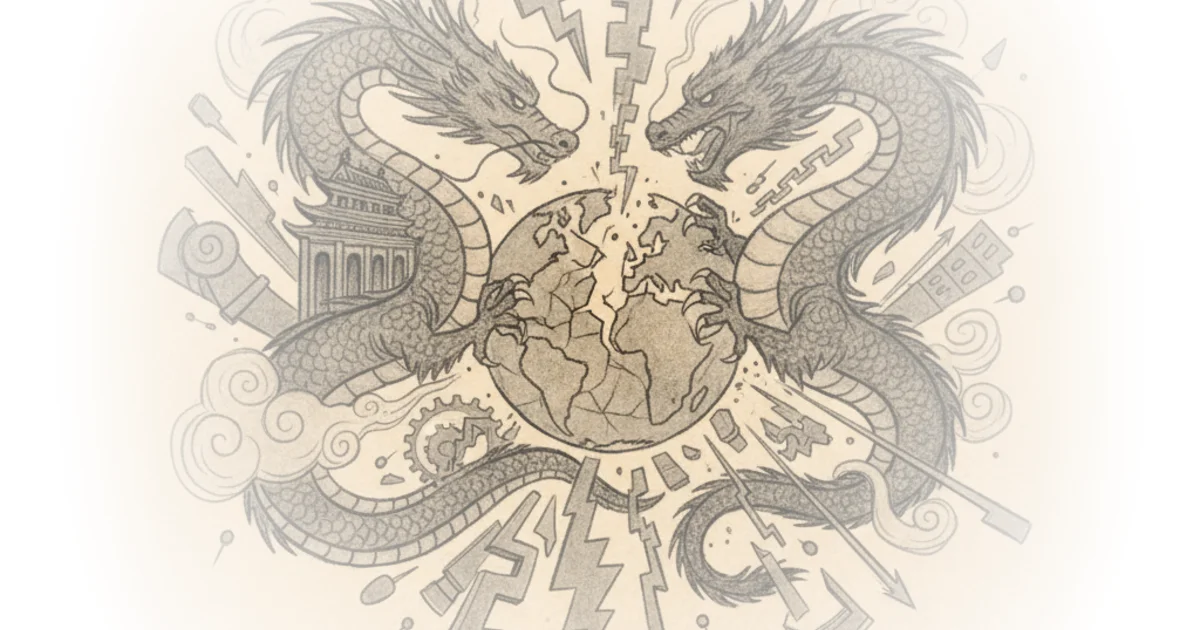
Joseph Webster's January 2026 assessment of the China-Russia relationship arrives at a moment when the geopolitical landscape looks less like a chessboard and more like a table someone has flipped over. His central thesis is straightforward but unsettling: while Beijing-Moscow ties will remain largely stable, both powers are positioned to exploit a world that is becoming dramatically more disordered -- and much of that disorder is self-inflicted by the United States.
The analysis begins on familiar ground. Webster argues that Beijing has been methodically insulating the relationship from the risks of Russian domestic politics ever since the Prigozhin mutiny exposed cracks in the Kremlin's power vertical. China has been working to "de-personalize and institutionalize" its ties with Moscow, hedging against the possibility that Putin may not sit atop Russian politics forever. Defense industrial cooperation continues, though Webster suggests Beijing may have already extracted Russia's most valuable military technology "through voluntary transfer or other means." If true, that diminishes one of Russia's few remaining points of leverage in the relationship.
The Asymmetry Problem
What makes Webster's analysis worth reading closely is his candid acknowledgment that the bilateral economic relationship is tilting sharply in Beijing's favor. As Russia eventually transitions from wartime to civilian production, Russian firms will find themselves competing with Chinese companies that have already entrenched themselves in the Russian market during the war years. The question Webster poses -- how much Chinese economic and technological influence Moscow will tolerate -- is one that Russian policymakers are likely asking themselves with increasing discomfort.
There is a counterpoint worth raising here. The assumption that post-war economic reorientation will strain the relationship presumes the war actually winds down. Webster himself notes that Putin remains "an adept manager of Russian domestic politics" and that the Russian economy "is faring better than many anticipated." If the conflict grinds on indefinitely, the economic asymmetry may deepen without producing the friction Webster anticipates, because Moscow will have no alternative but to accept Chinese dominance as the price of continued war.
The Venezuela Trap
The most provocative section of the analysis concerns not China or Russia directly, but the strategic costs the United States is imposing on itself. Webster traces a chain of consequences flowing from the U.S. military intervention in Venezuela that reads like a case study in imperial overstretch. The Maduro raid, he writes, was "an undeniable tactical success, but one of little strategic consequence." The Chavista regime remains intact, and sustaining pressure requires maintaining a carrier strike group in the Caribbean indefinitely.
The real damage, as Webster sees it, is measured in opportunity costs. He cites CSIS analysts Mark Cancian and Chris H. Park, who observe that:
The major cost [of the intervention] is the strategic trade-off: Forces in the Caribbean limit assets available for other hotspots, such as the Middle East or the Indo-Pacific.
Webster connects this directly to the Iranian protests, where the regime's brutal crackdown on dissidents -- with credible estimates of thousands murdered -- unfolded while U.S. naval assets were tied down thousands of miles away in the Caribbean. The USS Gerald Ford carrier strike group had moved from the Red Sea to support the Venezuela operation months earlier. Whether American forces could have changed the outcome in Iran is unknowable, but the strategic signal was clear: Tehran understood that the American military response would be constrained.
Critics might object that a carrier strike group off Iran's coast would not necessarily have deterred the regime from repressing its own citizens -- authoritarian governments rarely calibrate domestic crackdowns based on nearby naval deployments. But Webster's broader point holds. An aircraft carrier cannot be in two places at once, and every commitment to a secondary theater weakens the hand in primary ones.
Alliance Erosion as Strategic Gift
Webster saves his sharpest analysis for the fraying of the Western alliance system, which he identifies as the single greatest opportunity facing Beijing and Moscow. The litany of self-inflicted wounds is striking: Washington threatening to absorb Greenland, entertaining conversations with Canadian separatists, and driving traditional allies into precisely the kind of hedging behavior that benefits Beijing. Canada -- described as "traditionally the United States' closest ally" -- responded by inking a trade deal allowing up to 49,000 Chinese electric vehicles into the country.
Canadian Prime Minister Mark Carney's warning at Davos captures the mood among allies:
The world order faces a "rupture, not a transition."
Webster makes a compelling case through GDP data. At purchasing power parity, China alone is roughly at parity with the United States. Add Russia's defense industrial base, and the combined bloc has a slight advantage. But if the United States draws on its full alliance network -- NATO members, Japan, South Korea, Australia -- the combined economic weight overwhelmingly favors the Western bloc. The entire strategic logic of American alliances, Webster argues, has always been about scale.
He grounds this in history, noting that allies have not merely contributed resources but shed blood alongside American forces. Denmark, a country of under six million, sustained a higher per-capita casualty rate in Afghanistan than the United States itself. The point is not sentimental but strategic:
The United States has chosen to lead alliances out of pragmatic self-interest, not out of charity.
The AI Wild Card
One area where the analysis could use more depth is artificial intelligence. Webster acknowledges that AI "could very well be the single-most important element shaping macroeconomics and geopolitics in 2026" and presents a five-scenario framework, but the treatment remains somewhat surface-level given the magnitude of the claim. He draws a comparison to COVID-19, suggesting AI "inescapably makes the weather" across all domains. The range of outcomes he identifies is admittedly vast, and the implications for Beijing and Moscow diverge sharply depending on which scenario materializes. A severe AI market correction, for instance, could crater demand for energy and devastate Russian export earnings, while an AI breakthrough could reshape the military balance in ways that neither China nor Russia can yet predict.
Bottom Line
Webster's analysis paints a picture of two authoritarian powers that do not need to do anything particularly bold or creative in 2026 -- they simply need to wait and capitalize on mistakes being made elsewhere. The United States is stretching its military across secondary theaters, alienating allies who have bled alongside it for decades, and creating precisely the kind of fragmented geopolitical environment in which Beijing thrives. The China-Russia relationship itself may be marked by continuity, but the world around it is anything but stable. The most disquieting implication of this report is that the greatest threats to American strategic advantage in 2026 are not originating from Beijing or Moscow at all.