The Blue Jug Economy
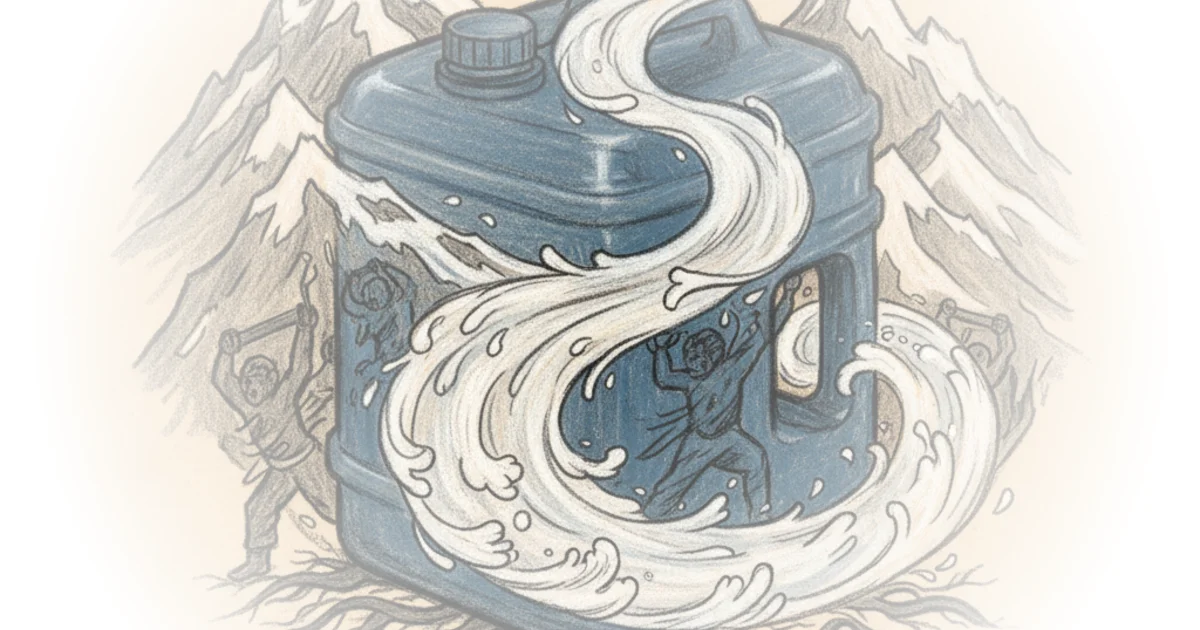
In Canada's Yukon Territory, population 47,170, an unremarkable plastic container from Canadian Tire has become the defining symbol of an entire way of life. Trina Moyles, The Walrus's regional correspondent for Northern Canada, reports on the "blue juggers" -- residents who haul twenty-litre jugs of water to off-grid dry cabins that lack running water. For Moyles and her partner, 120 litres lasts just over a week. The average Canadian uses 223 litres per day.
"Yukoners call us 'blue juggers,' or that we're 'blue-jugging it'; the lifestyle is both a noun and a verb."
The piece works as both cultural history and housing journalism. Moyles traces the blue jug tradition back through decades of Yukon settlement, from squatter communities along the riverbank in the 1950s and 1960s to government homesteading policies in the 1980s and 1990s that lured southerners north with dreams of off-grid cabin life.
Romance Versus Reality
Mark Kelly moved to the Yukon in 2000 chasing that dream. He and his partner spent a year in a poorly insulated cabin at Marsh Lake where the pipes froze so often they had to unhook the water pump entirely. Kelly captures the absurd duality of the lifestyle perfectly.
"Every day we'd drive into town, live an urban life, go for a coffee at Starbucks, but also fill our blue jugs and come back to our place."
The romance wore off. Kelly, now a professional photographer in Whitehorse, views the blue jug as part of a mythologized Yukon export alongside the Gold Rush and northern lights -- imagery that holds the territory back from modernity.
"Everybody goes into it thinking, 'I'm gonna live like this forever.' Have a kid and then tell me how much you like a blue jug."
Moyles is careful to note that the off-grid narrative carries colonial undertones. First Nations peoples, including the Kwanlin Dun with a history in the Whitehorse area stretching back more than 5,000 years, long used rivers as lifelines and procured water with spruce and birch bark vessels. The settler fantasy of frontier self-reliance obscures that deeper history.
The Housing Squeeze
What makes the article timely is its housing angle. Between 2015 and 2025, the Yukon's population grew by 26 percent. Rent in Whitehorse has skyrocketed. Moyles screenshots listings for rustic dry cabins asking upward of $1,600 a month, sometimes for structures so ramshackle she assumes they must be jokes. They never are.
Myles Brown, a fisheries biologist who moved north in 2024, found Whitehorse felt like a "mini Vancouver plopped down in the North." He puzzles over the paradox at the territory's core.
"Yukon has this puzzling diametric opposition of a very small populace in a very large place. Space seems tightly constrained, yet it's the most abundant thing that's here. It's a funny Rubik's cube."
Brown found a rhythm with the blue jug life and even philosophized about it. But the sustainability question he raises is pointed: the jugs are manageable, the rent is not.
"Is the rent going to get raised? Will you get priced out of what is effectively . . . just four walls and a roof?"
Community Infrastructure
In Mount Lorne, forty kilometres south of Whitehorse, residents are investing in the blue jug lifestyle rather than abandoning it. Jess Sellers, president of the community association, successfully lobbied for a new $3.6 million water treatment centre and fill station, funded jointly by the Yukon and Canadian governments. The existing tap at the community centre cannot keep up with demand from everyone -- nine-to-five commuters and dog mushers filling a dozen jugs alike.
Sellers has never had running water in her eleven years in the Yukon. She sees blue jugging not as deprivation but as clarity.
Genevieve Gay, a seasonal worker living in a tiny home in Gruberville, twenty kilometres north of Whitehorse, pays $365 a month for her pad fee and electricity. She has upgraded to a tank with hot water on demand, which she fills from blue jugs -- a system she calls "bouge-jug." Gay points out that when record-breaking cold hit the Yukon last December, it was the on-grid homeowners who faced frozen pipes and threatened blackouts.
"It's a different mindset," she says.
What the Piece Misses
Moyles builds a compelling case for the blue jug as cultural artifact, but the article leans heavily on lifestyle framing at the expense of harder policy questions. A $3.6 million water station for one hamlet is mentioned almost in passing -- yet that kind of infrastructure spending, and who decides where it goes, is arguably the real story. The piece also sidesteps health dimensions. Hauling water at minus forty is physically demanding work, and the article's subjects are largely young and able-bodied. Sellers mentions that some residents want to "age in this lifestyle" and need community support, but that thread deserves more than a sentence.
Bottom Line
Moyles delivers a richly reported portrait of a community built around an unlikely piece of plastic. The blue jug is simultaneously camping gear, housing policy failure, cultural identity, and quiet resistance to the assumption that modern life must mean being on the grid. What holds the piece together is its refusal to romanticize or dismiss. Kelly hung a painting of blue jugs by his kitchen sink after he moved onto city water. Brown moved into his partner's subdivision house. Sellers is lobbying for better fill stations. The Yukon is not choosing between the blue jug and modernity -- it is negotiating, one twenty-litre haul at a time.
"The community has to take care of them," says Sellers.
That may be the truest line in the piece. The blue jug works only when the people around it do too.