In an era obsessed with geopolitical chip wars, the most critical player isn't a superpower, but a Dutch firm that nearly went bankrupt three decades ago. Works in Progress delivers a masterclass in industrial history, revealing that the entire modern digital economy rests on the back of a single machine that didn't exist twenty years ago. This isn't just a story about optics; it's a blueprint for how public-private partnerships can solve problems too expensive for any single company to tackle alone.
The Impossible Machine
The piece immediately grounds the reader in the sheer absurdity of the engineering challenge. "The phones we carry around in our pockets have two million times more memory and are thousands of times faster than the room-sized computers that guided the Apollo mission to the Moon," the editors note, setting the stage for the "incredible shrinking act" that defines the semiconductor age. But the real shocker is the physical reality of the tool required to achieve this. These machines are "roughly the size of double-decker buses," requiring "40 freight containers, three cargo planes, and 20 trucks" just to ship one unit.
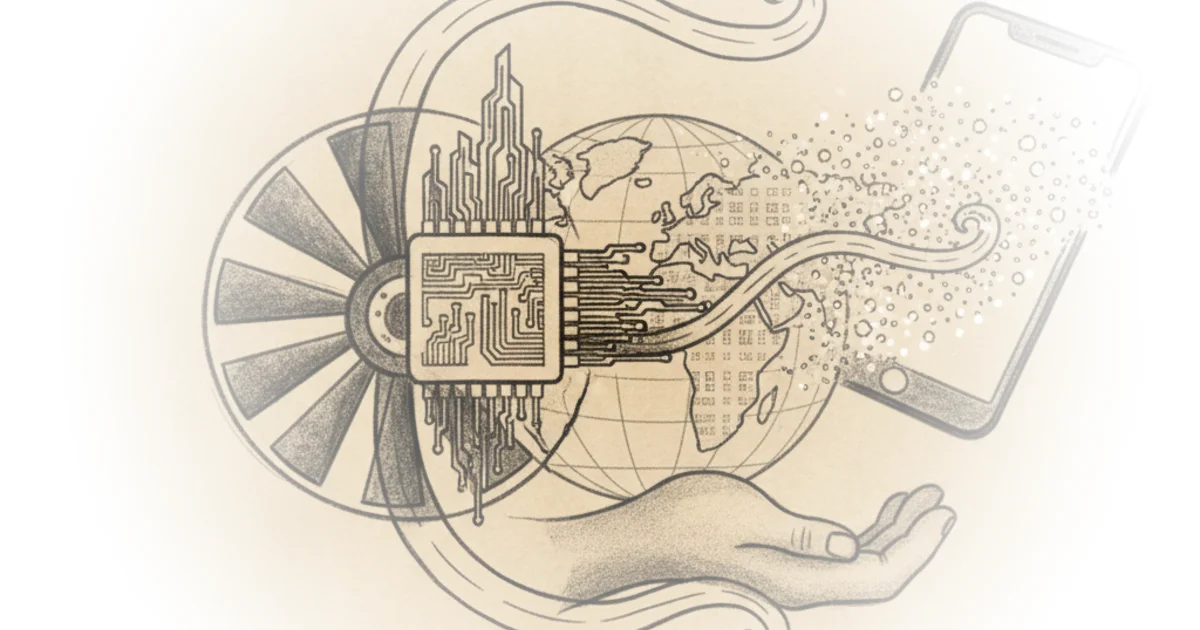
The article excels at explaining why this specific technology, extreme ultraviolet (EUV) lithography, is the bottleneck. It's not just about making things smaller; it's about the physics of light. "Longer wavelengths act like a blunt chisel, suitable for rough shaping, but they struggle to capture finer details," the piece argues. To get to the nanometer scale, engineers had to move from visible light to a wavelength so short it requires vaporizing tin droplets with lasers to create plasma. The precision required is staggering: the mirrors used to focus this light are "so flawless that, if scaled to the size of Germany, their imperfections would be measured in millimeters."
"Without EUV, producing five-nanometer nodes might require as many as one hundred different steps."
This framing is effective because it strips away the mystique of "magic chips" and replaces it with the hard constraints of physics. It makes the monopoly held by ASML feel less like corporate greed and more like a natural consequence of the difficulty of the task. Critics might note that the piece glosses over the environmental and energy costs of running these plasma-generating lasers, focusing almost exclusively on the technical triumph. However, the sheer scale of the engineering achievement remains undeniable.
The Gamble on Outsourcing
Perhaps the most counterintuitive part of the narrative is how ASML survived its early years. While Japanese rivals Nikon and Canon tried to build every component in-house, ASML took a different path. "ASML outsourced key components like optics and motors so that it could focus on assembling and optimizing the final machine," the editors explain. This decision was mocked by German engineers who warned the leadership they were "asking for trouble" and would "lose all control."
The piece argues that this modular approach was actually ASML's saving grace. When their first machine, the PAS 2000, failed due to leaking oil pressure systems, they could pivot quickly. By 1991, the PAS 5500 succeeded not because it was the most precise, but because it was the most serviceable. "This reduced downtime and, by making it easy to replace parts when they broke, it was possible to extend the machine's life," the article reports. This reliability convinced IBM to switch suppliers, a pivotal moment that shifted the industry's center of gravity.
This section highlights a crucial lesson in high-tech manufacturing: speed of iteration often beats vertical integration. The narrative effectively shows that being a "laggard" allowed ASML to be more agile than the entrenched giants. A counterargument worth considering is whether this model is replicable today; in an age of extreme supply chain fragility, relying on a global network of suppliers might be riskier than it was in the 1990s.
The American Lifeline
The most significant revelation in the coverage is the extent of US government involvement in creating a European champion. The story of the "Extreme Ultraviolet Limited Liability Company" reads like a thriller. Facing budget cuts that threatened to kill the research, Intel spearheaded a public-private partnership that combined three national labs. "The original program for EUV research was a 'virtual national lab' that combined Lawrence Livermore National Laboratory, Sandia National Laboratories, and the Lawrence Berkeley National Laboratories," the piece details.
Initially, ASML was barred from this consortium. It was only admitted after the US realized that relying on a single, struggling domestic supplier (Silicon Valley Group) was a strategic risk. The deal required ASML to establish a US research center and source 55% of components from American suppliers—a commitment the piece notes was "never enforced" in practice. The result was a transfer of intellectual property that was unprecedented. "In this case the companies in partnership got complete ownership," the editors point out, a rare move that allowed ASML to acquire Silicon Valley Group and absorb its patents.
"ASML stood alone at the vanguard of lithography."
This reframing of the US-China chip rivalry is vital. It reminds readers that the current technological dominance of the West is built on decades of collaboration that transcended national borders. The piece effectively argues that the administration and the Department of Energy made a calculated bet on a foreign entity to ensure the US remained at the forefront of computing. Without this specific intervention, the monopoly might have fallen to a Japanese firm or, worse, the technology might have stalled entirely.
Bottom Line
Works in Progress has crafted a definitive account of how a niche Dutch startup became the most important company in the world, not through marketing, but through a unique convergence of physics, modular design, and American statecraft. The strongest part of the argument is its demonstration that monopoly in high-tech is often the result of solving problems no one else could afford to try. The biggest vulnerability is the assumption that this specific model of public-private cooperation can be easily replicated for other critical technologies in today's more fractured geopolitical climate.