This investigation strips away the narrative of bad luck or personal financial mismanagement to reveal a deliberate, profitable engine designed to trap borrowers. More Perfect Union doesn't just report on rising car debt; they expose a business model where default is not a failure, but a revenue stream. For anyone navigating the modern economy, the realization that the system is mathematically rigged to extract wealth from the vulnerable is the most urgent takeaway.
The Architecture of Predation
The piece begins by dismantling the assumption that high auto loan costs are merely a symptom of inflation. Instead, the author identifies a specific corporate strategy. "It can be extraordinarily profitable to set borrowers up to fail," the investigation asserts, a claim that reframes the entire subprime lending industry. The author illustrates this through the harrowing case of Tena Cross, who was sold a 2014 Dodge Durango for a total of $46,000 despite the vehicle's market value being a fraction of that amount. This isn't just a bad deal; it is a calculated entry point into a cycle of debt.
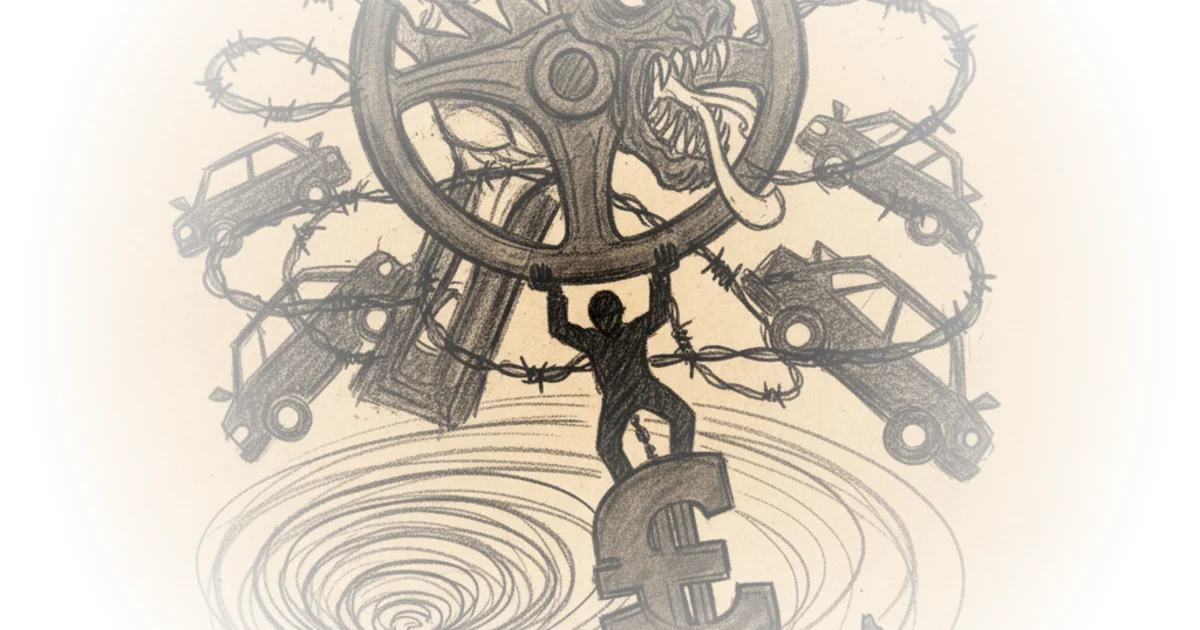
The core of the argument rests on the role of Credit Acceptance Corporation, a lender that has perfected the art of profiting from risk. The author notes that the company employs almost twice as many people in collections as it does in writing loans. "They're setting themselves up for success even though they might be setting the consumer up for failure," the text explains. This inversion of traditional banking logic is the piece's most damning insight. While a standard lender loses money when a borrower defaults, Credit Acceptance's algorithm is designed to calculate profitability based on the likelihood of repossession and subsequent fees.
CAC's business model was actually indifferent to whether borrowers paid their loan back or not.
The author connects this to a broader historical trend, noting that the company was founded in the 1970s by a salesman who realized he could monetize the "piece of every deal" that traditional banks rejected. This echoes the dynamics seen in the Credit Acceptance deep dive, where the lender's expansion has outpaced regulatory scrutiny. The evidence presented suggests that the industry has evolved from simply serving high-risk borrowers to actively manufacturing those risks to generate fees.
The Dealer-Lender Collusion
A critical component of the author's coverage is the symbiotic relationship between dealers and lenders. The investigation reveals that dealers often inflate vehicle prices to compensate for the low fees they receive from subprime lenders. "They're going to have to inflate the price of the car to make a profit at the end of the day," the author writes, highlighting how the true cost of financing is hidden within the sticker price. This practice forces borrowers into loans that are "underwater" from day one, meaning they owe more than the car is worth before they even drive off the lot.
The Consumer Financial Protection Bureau's findings are cited to bolster this claim, revealing that dealers mark up Credit Acceptance vehicles by 40% more than other used cars. The author argues that this creates a "carousel" where a single vehicle can be sold, repossessed, and resold multiple times, generating interest and fees at every turn. "It's a carousel for that one vehicle can serve multiple loans and the amount of interest they get is just it's unbelievable," a loan officer in the report observes. This mechanism ensures that the lender and dealer profit regardless of the car's longevity or the borrower's ability to pay.
Critics might argue that without these high-risk loans, millions of Americans would have no access to transportation at all. However, the author counters this by pointing out that the terms are so predatory that they often render the vehicle unusable or unaffordable, trapping the borrower in a cycle of debt rather than providing mobility. The investigation notes that the company predicted nearly 40% of its loans would fail in traditional terms, yet proceeded with them anyway because the math worked in their favor.
The Regulatory Vacuum
The most alarming section of the commentary addresses the recent dismantling of oversight. The author details how, in early 2025, the executive branch issued a stop-work order to the Consumer Financial Protection Bureau, effectively halting its enforcement actions. "Then it withdrew the bureau from the lawsuit against Credit Acceptance Corporation," the text states, leaving New York's attorney general to fight a national giant alone. This policy shift removes the primary check on the industry's most aggressive practices.
The piece highlights the irony that the industry's defense—that regulation would harm borrowers—is contradicted by the reality of their business model. "They profited when the borrower defaulted just the same as when the borrower paid off their car," the author writes, citing internal documents. This suggests that the argument for deregulation is a smokescreen for protecting a model that thrives on consumer distress. The withdrawal of federal support leaves borrowers like Grace Ridley, who is paying for a car she cannot drive, with no recourse.
The consumer's ability to pay isn't even how credit acceptance decides whether to give a loan.
The author draws a parallel to the broader struggle over consumer protection rules, noting that the Federal Trade Commission's attempt to prohibit misrepresentation was blocked by industry lawsuits. This legal maneuvering, combined with the executive branch's withdrawal, creates a perfect storm where predatory lending can operate with impunity. The investigation implies that without federal intervention, the "secret scheme" will only expand, trapping more families in debt.
Bottom Line
More Perfect Union's strongest achievement is exposing the mathematical inevitability of default within this specific lending model, proving that the system is designed to extract wealth rather than provide credit. The piece's greatest vulnerability lies in the lack of a clear, immediate legislative solution, as the regulatory landscape has been actively dismantled. Readers should watch for how state-level attorneys general attempt to fill the void left by the federal government, as the national fight over auto loan transparency has likely just begun.