Cory Doctorow doesn't just critique California's new privacy tool; he exposes it as a bureaucratic trap designed to make opting out of surveillance more exhausting than the surveillance itself. In an era where federal inaction has left states to fight alone, this piece reveals how a well-intentioned law has been twisted into a "malicious compliance" nightmare that protects data brokers more than the citizens they spy on.
The Fiction of Consent
Doctorow opens with a blunt assessment of the current landscape: "Data brokers are a cancer. There's a direct line from the unrestricted collection, retention and processing of our data to a host of evils, from deepfake porn to phishing scams." He argues that the root cause isn't a lack of regulation, but a fundamental misunderstanding of consumer desire. The core of his argument rests on the absurdity of an "opt-out" system, which implies that people start off consenting to be tracked unless they scream otherwise. "This is an incredibly stupid supposition, contradicted by all available evidence," Doctorow writes, citing the statistic that 96% of iPhone owners clicked a button to stop Facebook from tracking them.
The author's framing here is sharp because it dismantles the legal fiction of "consent" that underpins the entire industry. By comparing the current system to a dog licking its balls simply because it can, he strips away the corporate veneer of "user choice." Critics might argue that a total ban on data brokers is politically impossible, making an opt-out mechanism the only viable compromise. However, Doctorow counters that this compromise is a trap, noting that the process is so burdensome it effectively guarantees most people will remain tracked.
There is no demand for being spied on. There is no basis for taking such enormous care in making sure people aren't maliciously removed from surveillance databases.
The DROP Obstacle Course
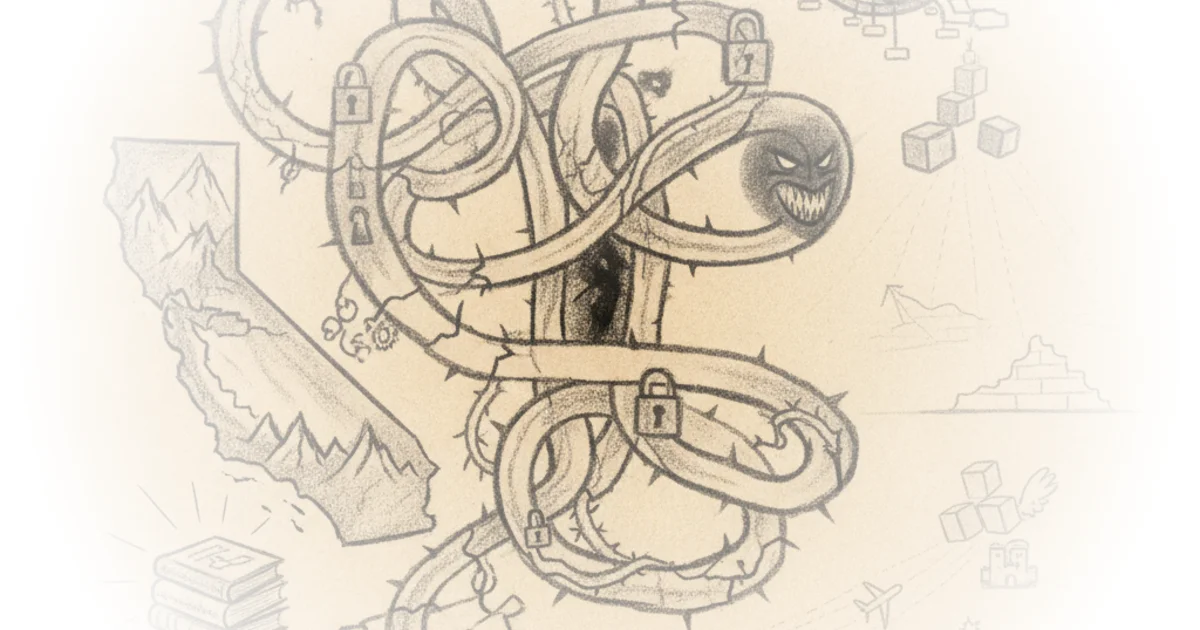
The piece then dissects California's "Delete Request and Opt-out Platform" (DROP), a system that requires users to jump through a dizzying array of hoops to prove they are real people who want to stop being watched. Doctorow details the process: creating a Login.gov ID, photographing a driver's license, verifying a phone number, and manually entering a 32-digit mobile advertising identifier. He points out the sheer redundancy: "In order to get to the stage where they ask you to photograph your driver's license, you have to have already photographed and validated your driver's license."
This section is particularly effective because it moves from abstract policy to the visceral experience of the user. The author highlights the irony that the system demands stronger authentication than filing taxes or renewing a car registration. "This whole thing is terrible, and it is predicated on the absurd premise that Californians have to be defended from the threat of strangers who pretend to be them in order to sneakily opt them out of surveillance," he writes. The threat model, he suggests, is inverted; the system is designed to protect the data brokers from being de-listed, not the user from identity theft.
Doctorow draws a parallel to the "carbon credit" fiasco, where market-based incentives replace actual bans. "The answer to too many carbon emissions is to democratically decide to ban certain kinds of carbon emissions," he notes, contrasting this with the current approach of creating "junk credits" for privacy. He even references a 2021 critique from the Climate Ad Project about "murder offsets" to illustrate the moral bankruptcy of allowing harm as long as a fee is paid or a form is filled out. This historical context strengthens his argument that the current regulatory approach is a performative gesture rather than a solution.
The Path Forward
The author's proposed solution is starkly simple: ban the practice entirely. He contrasts the current reality—where a data broker needs only to "Exist" to start spying—with the proposed reality where the burden of proof shifts to the collector. "If anyone is going to be forced to jump through hoops to participate in the mass collection and catastrophic mishandling of private data, it should be the data brokers, not the people they spy on," Doctorow asserts.
He acknowledges the tediousness of the current DROP process but urges readers to use it anyway, framing it as an act of resistance against a broken system. Yet, he refuses to let the reader feel satisfied with this partial victory. The piece reminds us that the history of privacy law is littered with such half-measures, from the Video Privacy Protection Act of 1988—which only stopped video stores from sharing rental records—to the current federal silence. The lesson is clear: without a federal ban on the data broker industry, state-level efforts will remain a "locked filing cabinet stuck in a disused lavatory with a sign on the door saying 'Beware of the Leopard'."
If these databases exist at all (they should not), then we should make spies go through all this paperwork, to prove that you do want to be spied on, and unless they manage it, then spying on us should be treated as the crime it is.
Bottom Line
Doctorow's most powerful contribution is his refusal to accept the "compromise" of an opt-out regime as a victory; he correctly identifies it as a mechanism that preserves the status quo of commercial surveillance. The argument's greatest vulnerability is its reliance on a political shift that currently seems distant, leaving readers with a clear diagnosis but a difficult prescription. The takeaway is urgent: until the executive branch and Congress treat data brokerage as the criminal enterprise it effectively is, any privacy tool will remain a labyrinth designed to keep you lost.