Erik Hoel presents a jarring diagnosis of the modern mind: time itself is accelerating not because clocks are ticking faster, but because our consciousness is shrinking. In this curated snapshot of 2025, Hoel argues that we are witnessing a "temporal squeezing" effect where neural downsampling from constant AI exposure is compressing our lived experience. This is not a nostalgic lament for the past, but a structural critique of how we process reality, selection, and truth in an era of algorithmic saturation.
The Erosion of Elite Selection
Hoel opens his curation by dismantling the modern ritual of elite university admissions. He juxtaposes a 1935 Harvard essay by John F. Kennedy with a 2014 application from tech entrepreneur Jeffrey Wang, which famously detailed studying at McDonald's. Hoel finds the modern approach deeply flawed, noting that "the very concept of the essay that is reviling." He argues that the juxtaposition of "ostensibly lofty work of secondary school lucubrations with the quotidian environs of the suburban McDonald's branch is a gimmick."
This critique cuts deeper than mere prose style; it targets the values being rewarded. Hoel suggests that admissions officers are "morons" who mistake performative humility for substance. He quotes the final line of Wang's essay—"I've learned that contentment can exist in imperfect and unforeseen places when you simply observe your surroundings, adapt, and maybe even eat a French fry"—and dismisses it as "Precious words, but wholly without value." The argument here is that the mechanism for selecting leaders has shifted from intellectual rigor to a curated narrative of relatability that lacks genuine depth. Critics might argue that admissions essays are inherently performative and that Hoel is romanticizing a bygone era of elitism, yet the contrast he draws highlights a genuine shift in what society deems "impressive."
The Transactional Public Square
Moving from education to communication, Hoel highlights Nathan Witkin's analysis of how social media has transformed the public square into a marketplace of attention. Witkin posits that social media and smartphones have created a new social institution where communication is stripped of its traditional social functions. "What is 'content' in the way we now use this term if not an instance of communication… of secondary importance to its attentional 'exchange' value?" Witkin asks.
Hoel uses this to draw a parallel to economic history. Just as premodern societies exchanged goods for complex social reasons—rites of passage, diplomatic signals, tribute—only to have those displaced by formalized market transactions, our communicative behavior is now "impersonal and transactional." We no longer care about the people we interact with online, just as we do not know the people we buy goods from. This framing effectively reframes the "toxicity" of online discourse not as a moral failing of individuals, but as an inevitable outcome of a system designed for exchange rather than connection. The loss of nuance is the price of the transaction.
The Cognitive Cost of Offloading
Perhaps the most urgent section of Hoel's curation addresses the neurological impact of artificial intelligence. He tackles the study "Your Brain on ChatGPT," which found that students using large language models displayed "weakest connectivity" in their brains compared to those using search engines or writing alone. Hoel acknowledges the alarming headline that "LLM users consistently underperformed at neural, linguistic, and behavioral levels," but he pushes back against the simplistic conclusion that we are getting dumber.
Instead, he suggests we are measuring skills for a system that is evolving into a different society. He points to Barbara Oakley's research on the reversal of the Flynn Effect, noting that countries with constructivist, student-centered education have seen a decline in cognition. "If educational practices and daily habits increasingly favor external memory storage over internal knowledge building, we might expect to see these changes reflected in standardized measures of cognitive performance," Hoel writes. The danger is not just that we forget facts, but that we lose the neural architecture required to think critically without a digital crutch. This is a critical distinction: the issue is not the tool, but the atrophy of the user.
Perception, Contagion, and the Psychedelic Sky
Hoel also explores how our altered perception affects our interpretation of the world, specifically regarding the recent "drone flap" where ambiguous lights in the sky were interpreted as extraterrestrial or military threats. He references his own work on predictive coding, arguing that "social contagion is the main culprit," similar to historical outbreaks of mass psychogenic illness. However, he adds a crucial layer: the human mind has evolved to perceive deep meaning in the sky.
"Without context, distance, shape, or texture cues, a given light in the sky could be just about anything. And so, when we do look up, we see profundity rather than triviality."
Hoel coins the term "skyborne impoverishment" to describe how the lack of visual cues in the sky forces the brain to fill in the blanks with high-stakes narratives. This connects to the broader theme of the piece: our brains are desperate for pattern and meaning, and in an age of information overload, we are projecting those patterns onto the void. It is a reminder that our perception of reality is not a passive recording but an active, often anxious, construction.
The Denial of Death and the Machine
Finally, Hoel curates an interpretation of tech entrepreneur Bryan Johnson's quest for immortality through the lens of Ernest Becker's The Denial of Death. Johnson's $2 million annual regimen to reverse aging is framed not as a scientific breakthrough, but as a cultural symptom. Hoel writes, "This would-be Methuselah has devoted his life and body, and foregone no expense, in pushing the boundaries of human longevity." Yet, this obsession with biological optimization is contrasted with the reality of our relationship with technology.
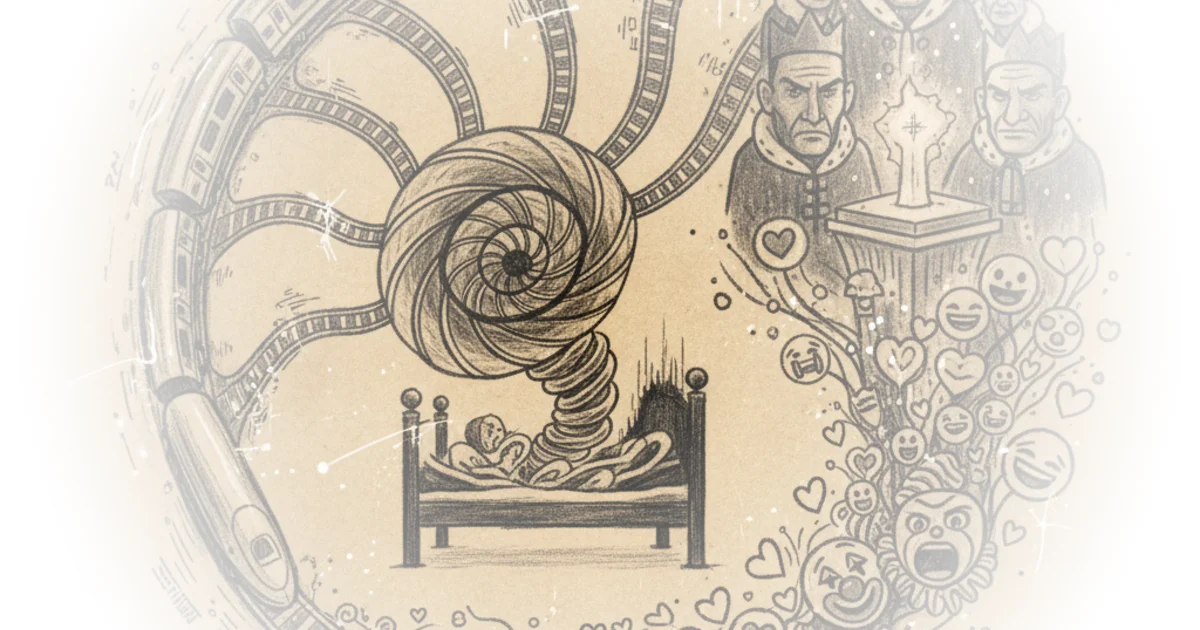
The curation ends on a haunting note from Roger's Bacon's meditation on dreams and the Machine: "Cannot you see that it is we that are dying, and that down here the only thing that really lives is the Machine?" Hoel uses this to underscore the central tension of the piece. As we offload our memory, our creativity, and even our biological maintenance to algorithms, we risk becoming the passive observers of our own obsolescence. The Machine is not just a tool; it is becoming the primary agent of our existence.
Bottom Line
Hoel's curation offers a cohesive, if unsettling, narrative: the acceleration of time and the fragmentation of society are symptoms of a deeper cognitive and perceptual crisis driven by our reliance on AI and transactional platforms. The strongest argument lies in the connection between neural downsampling and the loss of meaningful human selection, from college admissions to the public square. The piece's vulnerability is its reliance on a somewhat deterministic view of technology's impact, potentially underestimating human adaptability. However, for a reader navigating the noise of 2025, this snapshot serves as a necessary warning: if we do not reclaim our cognitive agency, we will be left watching the Machine live our lives for us.