The Caribbean Buildup: Drug War or Regime Change?
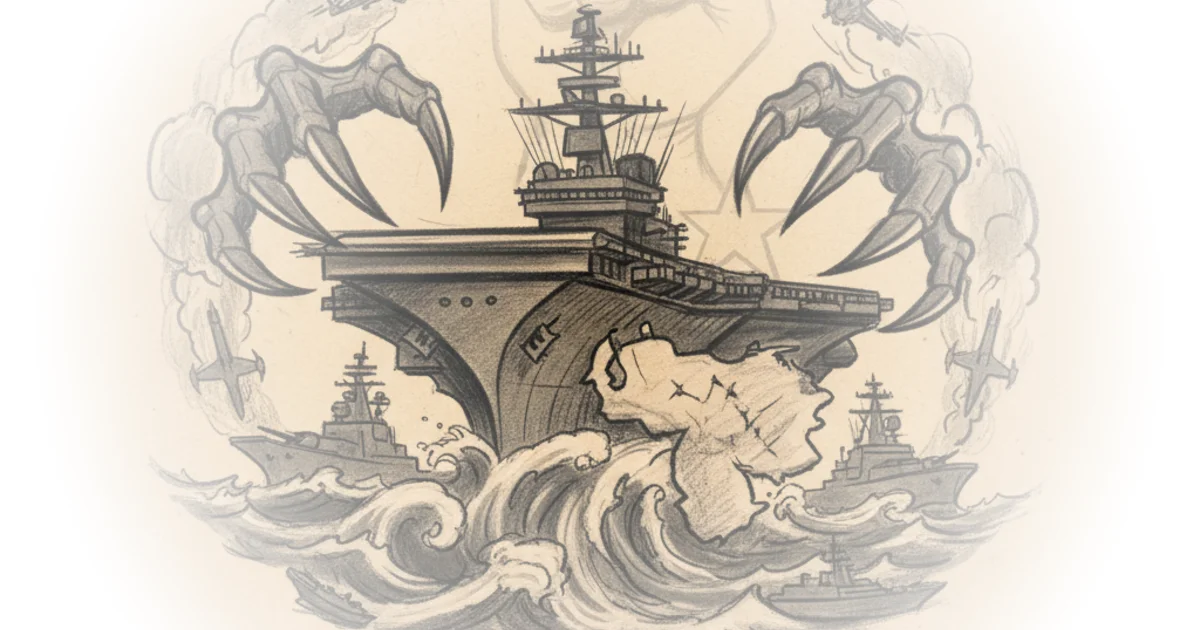
The largest American naval deployment to the Caribbean since the 1989 invasion of Panama demands more than a passing glance. More than 10,000 troops, F-35 squadrons, Reaper drones, strategic bombers, and the USS Gerald R. Ford carrier strike group have assembled off Venezuela's coast. The official justification is counter-narcotics. The actual objective, as even a surface reading of the policy reveals, is the removal of Venezuelan President Nicolas Maduro.
Good Times Bad Times lays out the mechanics of how the Trump administration constructed a legal framework for military action through a seemingly routine bureaucratic step: designating Latin American gangs, most notably Tren de Aragua, as Foreign Terrorist Organizations. Historically, FTO status was reserved for ideologically motivated groups like ISIS or al-Qaeda. Applying it to criminal syndicates was unprecedented, and the consequences are enormous. The designation empowers the president to use military force without congressional authorization, effectively bypassing the constitutional checks designed to prevent exactly this kind of unilateral escalation.
The Drug War Pretext Falls Apart
The administration's stated rationale crumbles under scrutiny. The piece notes that the DEA's own data undermines the case for targeting Venezuela as a narcotics threat:
According to DEA figures, roughly 74% of cocaine reaching the US travels along the Pacific route from Colombia and Ecuador.
Fentanyl, the drug driving America's overdose crisis, is produced almost entirely in Mexico. Venezuela is not a major producer of either substance. It serves as a transit corridor, but not even the primary one. The administration, the article argues, is fully aware of these facts and simply considers them irrelevant. The drug war provides political cover for an objective that would otherwise require far more public deliberation: forcible regime change in a sovereign nation.
It is worth noting, however, that the counter-narcotics framing is not entirely without foundation. Venezuela's state apparatus has documented links to drug trafficking, and Maduro himself faces federal indictments in the United States. The question is not whether Venezuela has a narcotics problem but whether that problem justifies the scale of military response being deployed, and whether the response is genuinely aimed at drugs at all.
The Monroe Doctrine Reloaded
The analysis situates the Venezuela confrontation within a longer historical arc, tracing it back to the Monroe Doctrine of 1823 and Theodore Roosevelt's "big stick diplomacy." The current approach, which analysts have reportedly labeled the "Don Doctrine," a fusion of Donald and Monroe, represents something more aggressive than traditional hemispheric hegemony:
In this updated version, the Monroe Doctrine is no longer merely about deterring outside powers. It frames Latin America as an extension of the American homeland, a space where Washington can act unilaterally to eliminate actors it deems hostile.
This framing is central to understanding why the administration views Venezuela through a lens that blends anti-socialist ideology with great power competition. The "troika of tyranny" formulation, grouping Venezuela with Cuba and Nicaragua, reveals the ideological dimension. The parallel effort to push China, Russia, and Iran out of what officials call "America's own backyard" reveals the geopolitical one.
The Florida Hawks and the Death of Diplomacy
One of the more illuminating sections details the internal power struggle that shaped current policy. Secretary of State Marco Rubio, who also holds the National Security Adviser post, has consolidated near-total control over foreign policy. His Cuban immigrant background and deep ties to Florida's politically active exile communities make the downfall of leftist Latin American governments a personal mission.
An alternative track existed. Richard Grenell had been negotiating a transactional deal with Maduro: preferential oil access for American companies and reduced Chinese, Russian, and Iranian presence in exchange for avoiding military intervention. Trump himself boasted about the offer:
He [Maduro] offered everything. You know why? Because he doesn't want to mess with the United States.
Yet in early October 2025, Trump ordered Grenell to halt all negotiations. The hawks prevailed. Whether this reflects genuine conviction or a calculation that televised footage of destroyed drug boats plays better domestically remains an open question. The piece fairly acknowledges that Trump may intend to return to the negotiating table after extracting maximum political value from the confrontation.
Why a Panama Replay Will Not Work
The most valuable contribution of this analysis is its sober assessment of military realities. Hawks in the administration reportedly hope to replicate Operation Just Cause, the 1989 invasion that toppled Panama's Manuel Noriega. The comparison is dangerously misleading:
Venezuela is not Panama. It is 12 times larger with 10 times the population and critically without US military bases on its soil.
The 10,000 troops currently deployed are far short of the 50,000 to 200,000 that analysts at CSIS estimate would be needed for a full invasion. Venezuela possesses 21 SU-30 fighter jets capable of carrying supersonic anti-ship missiles, plus Iranian-supplied anti-ship missiles with 90-kilometer range. These are not trivial threats to a naval force operating in confined Caribbean waters.
More fundamentally, Maduro's regime shows no signs of fracturing. Political scientist Javier Corales offers a persuasive explanation: Venezuela's elite has become shareholders in the regime, profiting from state contracts, drug trafficking, illegal mining, and fuel smuggling. For them, a transition to a pro-American government would mean not just lost wealth but extradition and prosecution. They have every incentive to hold firm.
The Chevron Contradiction
Perhaps the most striking detail is the administration's decision to renew Chevron's license to operate in Venezuela at the very moment the Pentagon was finalizing its Caribbean deployments. One hand threatens to bomb the country while the other authorizes billions in corporate investment there. This is not subtle incoherence. It is two mutually exclusive strategies running in parallel: an ideological crusade for regime change driven by Rubio's faction, and a transactional realism focused on resources and blocking Chinese expansion.
The oil argument itself may be overblown. Venezuelan production collapsed from four million barrels per day in the 1970s to under 400,000 in 2020. A recovery to three million barrels per day would require a decade and massive annual investment. If oil matters in this confrontation, it is primarily as a denial strategy against China rather than an expectation of quick returns.
What the Analysis Misses
The piece provides a thorough strategic overview but gives relatively short shrift to the humanitarian dimension. Venezuela's population has suffered through years of economic collapse, hyperinflation, and mass emigration. Roughly eight million Venezuelans have fled the country. Any military escalation, whether limited strikes or full invasion, would compound a humanitarian catastrophe that already ranks among the worst in the Western Hemisphere. The calculus of regime change rarely accounts for the people caught in the middle.
There is also the question of regional reaction. Latin American nations, including US allies like Colombia and Brazil, have shown little appetite for military intervention in Venezuela. A unilateral American operation would strain alliances across the hemisphere and reinforce narratives about US imperialism that Washington has spent decades trying to move past.
Bottom Line
Good Times Bad Times presents a convincing case that the Caribbean military buildup is regime change dressed in counter-narcotics clothing. The legal architecture, the FTO designations, the psychological operations, the sidelining of diplomats in favor of hawks, all point in the same direction. The most unsettling conclusion is that the administration may have spent far more time planning potential strikes than envisioning what comes after Maduro. History suggests that toppling a government without a credible plan for succession produces not stability but chaos. The comparison to Libya, raised in the article itself, should give even the most committed interventionists pause.