The most provocative claim in recent discourse on artificial intelligence isn't that machines will replace writers, but that the very idea of a 'human-only' writer is now a fiction. Justin E. H. Smith dismantles the performative purity of the 'AI-free' label with a surgical precision that few have attempted, arguing instead for a nuanced spectrum of reliance that mirrors how we actually live in a digitized world.
The Illusion of Purity
Smith opens by observing that the debate over generative AI has calcified into a cultural wedge issue as sharp and divisive as the masking controversy of five years ago. He notes a disturbing continuity in the camps: "those claiming today to be 'AI-free' appear predictably to be the same who, circa 2021, were claiming that nothing valuable to human community is lost when you can no longer see the mouths and noses of your fellow human beings." This parallel is not merely an ad hominem attack; it is a structural observation about how technology anxiety often maps onto existing cultural fractures.
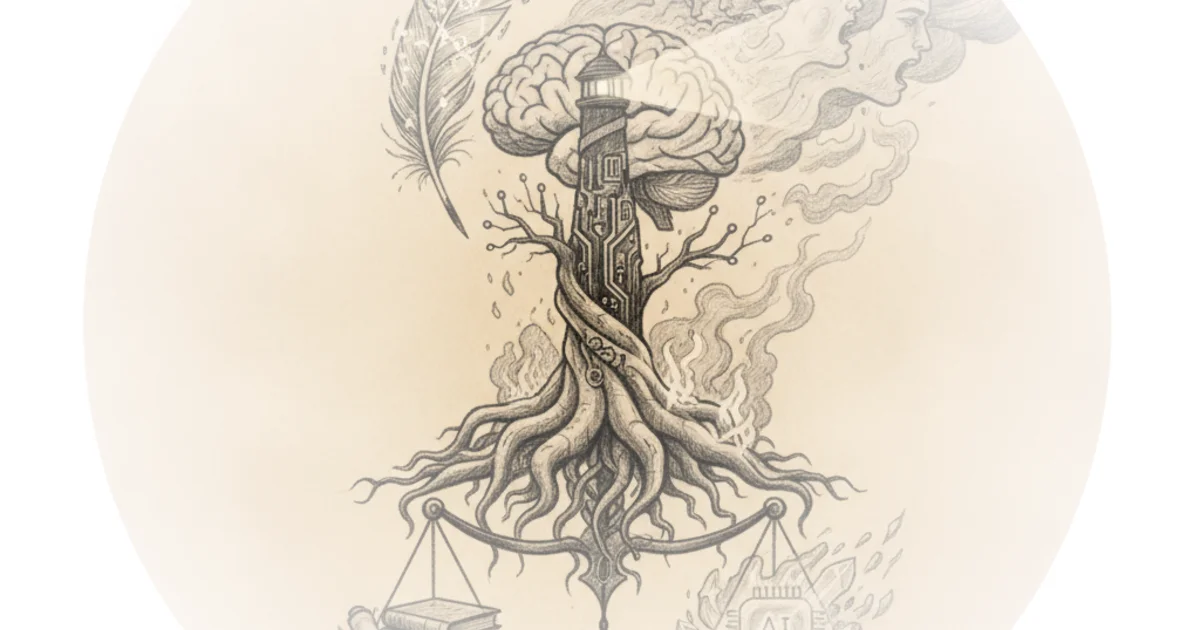
The author argues that the binary choice between total rejection and wholesale adoption is a false one, largely because the infrastructure of modern writing already contains AI. "Unless you have been living in a cave for the past 15 years... you are in fact 'using AI'," Smith writes, pointing out that the language models have become part of the default communicative frame. This reframing is effective because it shifts the question from 'did they use a machine?' to 'how much did the machine shape the voice?'
"To some extent all this is an inevitable and predictable development in the history of technology... Madame de Sévigné's liquid correspondence could only have poured from a plume put to paper."
Smith's historical analogy suggests that every writing tool leaves its signature on the text, from the quill to the typewriter. The argument holds weight because it refuses to treat AI as an alien invader rather than the latest evolution of the tools writers use to think and speak.
A New Scale for Old Habits
Moving beyond critique, Smith proposes a practical solution: an "AI scale" modeled on the Mohs Scale of Mineral Hardness. This is where the piece transitions from cultural commentary to a concrete framework for accountability. The scale ranges from zero (living off-grid) to ten (purely automated content farming), with most working writers falling somewhere in the messy middle.
The author describes Level 3 as using AI for "bullshit" tasks like emails and grant budgets, while Level 4 involves consulting machines for ideas that inevitably seep into original work. Smith captures the subtle erosion of boundaries perfectly: "You try to suppress any memory of the earlier dialogue... But it's hard entirely to suppress all the lively thoughts and speculations that dialogue triggered in you." This admission resonates because it describes a reality many writers feel but rarely articulate—the fear that their own ideas are now hybridized with algorithmic suggestions.
The scale also addresses the ethics of style. At Level 6, a writer might use an AI to verify a historical detail about paper quality, feeling "moral certainty" that the machine is right without checking primary sources. Smith calls this judgment "something like the judgment of an expert chicken-sexer," a vivid metaphor for intuitive expertise based on opaque data.
"We could then dispense with the impossible ideal according to which only entirely AI-free writing is honest, meritorious, or worthwhile."
Critics might argue that any reliance on large language models for fact-checking or stylistic polishing introduces a risk of hallucination or homogenization that a strict 'human-only' standard would avoid. However, Smith counters this by suggesting that the current binary debate ignores the reality that the "human voice" is already mediated by digital norms.
The Spectrum of Complicity
The scale reaches its most interesting levels at the extremes. Level 8 describes using an AI as "starter yeast," where a machine generates a conclusion in another language, which the writer then translates and transforms into their own voice. This process makes the causal sequence "essentially untraceable." Conversely, Level 9 captures the anxiety of writers who use AI for promotional paratexts but run iterations to "humanize" it so they aren't caught.
Smith writes with a wry humor about this level: "You used an LLM as 'starch', or as 'caulking glue'... At least you tell yourself that's what you've done, but you continue to worry, like a naughty child, that you're gonna get spanked." This psychological insight is the piece's strongest element; it identifies the shame and cognitive dissonance that currently drive the secretive use of these tools.
At Level 10, the scale ends with the "lazy borderline-illiterate person" who commands an AI to write essays for profit. Smith notes the irony that such content often outperforms human work in engagement metrics: "it gets 11.2k hearts... and hundreds of comments from people declaring your work 'brilliant'." This observation serves as a grim warning about the decoupling of quality from authenticity in the attention economy.
"To put the matter bluntly, unless you have been living in a cave for the past 15 years... you are in fact 'using AI', to the extent that it is by now built into basically all of the technologies that you, as a writer, are almost certainly using."
Bottom Line
Justin E. H. Smith's most significant contribution is replacing the moral panic over AI with a taxonomy of use that acknowledges our collective entanglement with these tools. The argument's greatest strength is its refusal to pretend we can opt out; its vulnerability lies in whether a self-reported scale can ever enforce transparency in an industry built on anonymity and speed.
Readers should watch for how this proposed spectrum might evolve from a theoretical exercise into a standard disclosure practice, forcing the publishing world to decide if 'human' means 'unassisted' or just 'ultimately responsible'.