Anna McCullough uncovers a startling thread connecting Victorian anthropology to modern science fiction, arguing that our deepest fears about the future are rooted in a 19th-century obsession with what we leave behind. While the article centers on Edward Bulwer-Lytton's 1871 novel The Coming Race, its true value lies in exposing how the concept of "survivals"—cultural relics that refuse to die—shapes our understanding of progress itself. In an era obsessed with technological acceleration, McCullough's analysis of a society that perfected itself into stagnation offers a chilling mirror to our own ambitions.
The Anthropology of the Lost World
McCullough begins by contextualizing Bulwer-Lytton not just as a sensational novelist, but as a man deeply embedded in the political and intellectual currents of his time. She notes that Bulwer, who once served as Secretary of State for the Colonies, was a contemporary of Charles Darwin and Edward Burnett Tylor. The core of her argument rests on the parallel between Tylor's anthropological theory and Bulwer's fiction. Tylor argued that humanity progresses through stages, leaving behind "survivals"—superstitions, rituals, and folklore that are "worn out, worthless, frivolous, or even bad with downright harmful folly." McCullough writes, "Tylor perceived little value in survivals and portrayed them as 'things worn out, worthless, frivolous, or even bad with downright harmful folly'."
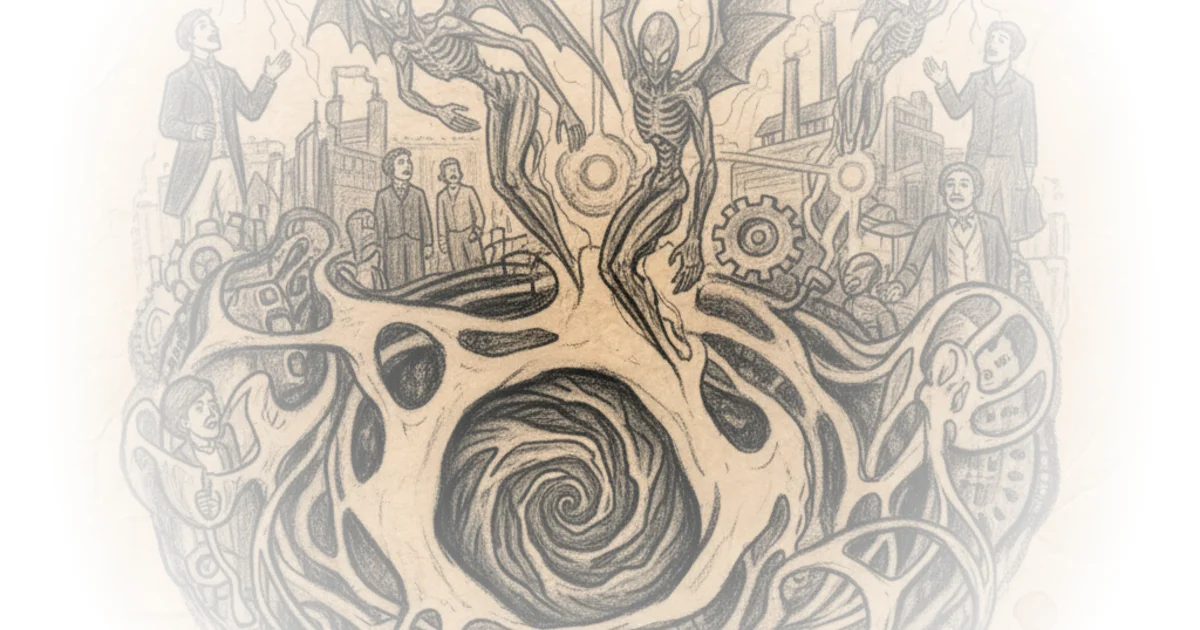
This framing is crucial because it sets up the novel's central tension. Bulwer's narrator, Tish, discovers an underground civilization, the Vril-ya, who have seemingly eliminated all such survivals. They possess a mysterious energy called vril, which allows for telepathy and telekinesis. McCullough points out that this energy was meant to be a fictionalized version of electromagnetism, yet its influence bled into reality; she notes, "In 1886, John Johnston named his beef drink 'Bovril' — a portmanteau of bovine and vril. Bovril can still be found across the world today — in fact, I saw it in a supermarket this week, a tangible reminder of The Coming Race's lasting impact." This detail effectively grounds the abstract literary theory in a tangible, modern object, reminding the reader that these Victorian ideas are not dead relics but active ingredients in our culture.
The Paradox of Perfection
The most compelling part of McCullough's commentary is her dissection of the Vril-ya's utopia. The Vril-ya have achieved a society free from violence and competition, yet they have paid a terrible price. McCullough explains that by eliminating the "survivals" of their past—specifically the capacity for strong emotion and conflict—they have also eliminated art and poetry. She quotes the novel directly: "Without its ancient food of strong passions, vast crimes, heroic excellences, poetry therefore is, if not actually starved to death, reduced to a very meagre diet."
This is a profound critique of the Victorian faith in inevitable progress. McCullough argues that Bulwer was suggesting that "primitive characteristics may conceal, or even contribute to, vitality and power beyond what the human race can conceive." The Vril-ya are not just advanced; they are stagnant. They have become a "monument" to their own perfection, devoid of the very chaos that drives human evolution. As McCullough puts it, "Tish soon finds the Vril-ya utopia full of 'dullness and monotony', realizing that 'whatever our dreams of perfectibility […] we, the mortals of the upper world, are not trained or fitted to enjoy for long the very happiness of which we dream or to which we aspire'."
Without its ancient food of strong passions, vast crimes, heroic excellences, poetry therefore is, if not actually starved to death, reduced to a very meagre diet.
Critics might argue that Bulwer's portrayal of the Vril-ya relies on Orientalist tropes, describing them with "the gravity and quietude of Orientals" and "sphinxlike faces." McCullough acknowledges this, noting that the narrator views them with an "instinct of danger" akin to seeing a tiger. While this racial coding is a significant flaw in the text, McCullough's analysis remains powerful because it separates the racist framing from the structural argument about the necessity of imperfection. The danger of a society that purges its own history is the real takeaway, regardless of how the author chose to visualize that society.
Evolution by Will
McCullough also highlights a fascinating divergence between Bulwer's fiction and Darwin's theory. While Darwin saw evolution as aimless, Bulwer's Vril-ya have mastered their own biological destiny through willpower and habit. The novel suggests that evolution can be directed. McCullough writes, "This explanation suggests that evolution is driven by willpower and habit, and that individuals can purposefully influence it." She cites the character Aph-Lin, who tells the narrator: "We are all formed by custom – even the difference of our race from the savage is but the transmitted continuance of custom, which becomes, through hereditary descent, part and parcel of our nature."
This idea resonates with contemporary discussions about the malleability of human nature and the potential for directed evolution. However, McCullough points out the tragic irony: the Vril-ya's success in controlling their evolution leads to their eventual decline. By removing the "survivals" that Tylor despised, they have removed the engine of their own growth. The novel ends with the narrator fleeing, warning that the Vril-ya are the "inevitable destroyers" who will one day emerge. But McCullough suggests the true horror is not their power, but their emptiness. She concludes that Bulwer "ultimately undermines this vision of certain progress, questioning whether his readers have fully grasped what they mean by progress, and whether perfectibility is even possible."
Bottom Line
McCullough's piece is a masterclass in connecting literary analysis to broader cultural anxieties, revealing that the fear of a "perfect" future is as old as the Victorian era itself. The strongest element of her argument is the demonstration that eliminating the messy, "primitive" parts of our history does not lead to utopia, but to a sterile stagnation. The biggest vulnerability, however, is the text's reliance on racial stereotypes to define the "other," a flaw that requires careful navigation by modern readers. As we face our own technological singularities, the warning of The Coming Race remains urgent: a society without its scars may have no soul left to save.