The Economist Who Embraces the Gamble
Tyler Cowen sits down with Rick Rubin on Tetragrammaton and does what he does best: range freely across enormous topics while maintaining a contrarian calm that borders on stoic detachment. The conversation sprawls from stablecoins to Yemen to the meaning of life, but three threads hold it together. First, that the American financial system is undergoing a tectonic shift away from traditional banking. Second, that artificial intelligence will reshape economic geography, education, and culture in ways most people still underestimate. Third, that the United States faces a fiscal reckoning with no painless exit.
Stablecoins and the Slow Death of Banks
The most substantive section of the conversation concerns stablecoins and the Trump administration's legislative push to regulate them. Cowen frames stablecoins not as a crypto curiosity but as the latest stage in a decades-long erosion of the traditional banking system. Banks, he argues, have already shrunk from well over half of the financial system to roughly twenty percent. Private equity, private credit, and now stablecoins are filling the vacuum.
The banks are screaming bloody murder, but the banks a bit need to realize time is not on their side. They're not innovating. They don't give great returns. They're a pain to deal with. They're heavily regulated.
His willingness to endorse the Trump stablecoin legislation is striking in its candor. He admits the risks are real -- companies can cheat on reserve requirements, off-balance-sheet risk can contaminate supposedly one-to-one backed assets, and the rapid draining of deposits from regulated banks could be destabilizing. Yet he sides with progress, explicitly framing it as a gamble worth taking.
My view is we should go for it. US banking system is a mess. It's in some ways too heavily regulated. We rely on sanctions too heavily to try to achieve foreign policy objectives. And for there to be this other alternative that is useful to people, I'm willing to take that chance. But I recognize I might regret these words someday.
That last sentence is characteristic Cowen -- the intellectual honesty to acknowledge he could be wrong, paired with the temperamental bias toward action over caution. A critic might note that "I might regret these words" is a peculiar foundation for policy advocacy. The 2008 financial crisis, which Cowen himself references, was fueled by precisely this kind of reasoning: that innovation is inherently good, that regulation is inherently costly, and that disruption of legacy systems is worth the transition pain. The shadow banking system he mentions as a cautionary tale bears uncomfortable structural similarities to the stablecoin ecosystem he is endorsing.
The Speculative Frontier of Corporate Money
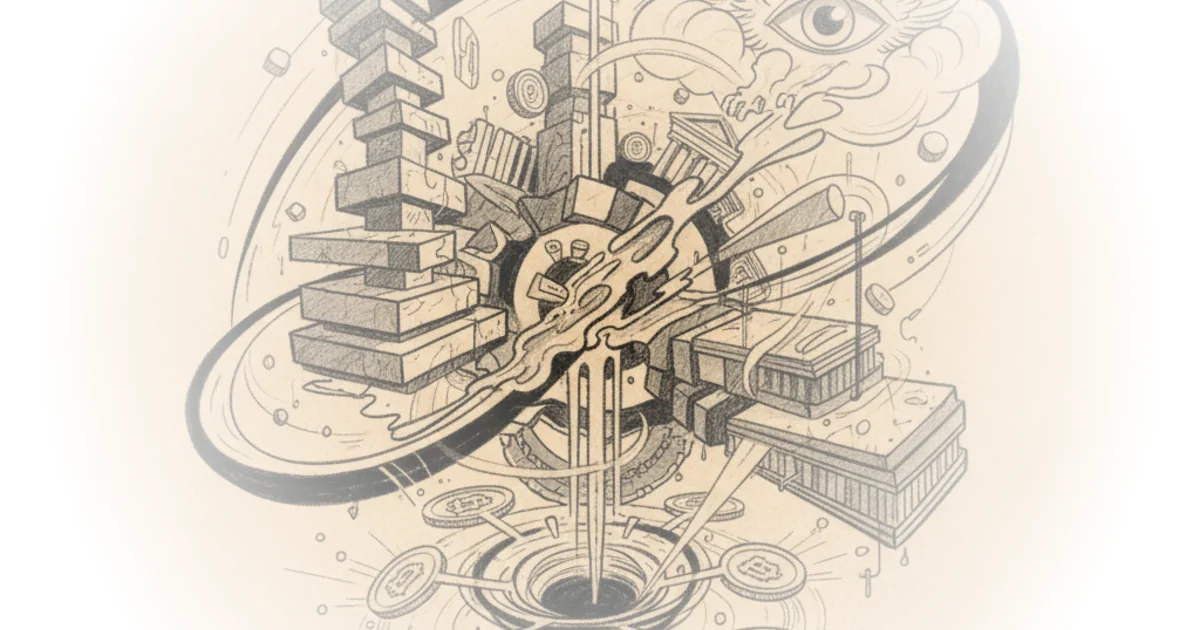
Cowen floats the possibility that Amazon and Meta could become stablecoin issuers, comparing their potential digital currencies to corporate gift certificates that have scaled into a monetary system. The comparison is deliberately casual, but the implications are profound. If the most important money in the economy is issued by private technology companies rather than central banks, the locus of monetary authority shifts in ways that democratic institutions are poorly equipped to manage.
To imagine the main money suppliers as being Amazon and Meta and in a way they're issuing gift certificates. Remember you used to get like gift certificates from Nordstrom, from Macy's. But imagine that being a big part of a monetary system.
Cowen treats this as an interesting possibility rather than a cause for alarm. But the analogy to gift certificates obscures a crucial difference: a Nordstrom gift card is a claim on a specific retailer's goods, while a stablecoin functioning as general-purpose money is a claim on the entire economy's output. The failure of such a system would not be a minor inconvenience; it would be a monetary crisis. Cowen's breeziness here reflects a broader libertarian tendency to assume that market discipline will substitute for regulatory oversight, even when the stakes are systemic.
AI as Fiscal Savior
The conversation's most revealing moment comes when Cowen discusses the United States' thirty-eight trillion dollar debt. He systematically dismisses every conventional solution. A value-added tax is "too efficient" and would make America more like Europe. Cutting benefits is politically impossible because older voters will block it. The remaining option -- inflation combined with financial repression -- is ugly but at least temporary.
I actually prefer that to the VAT. Like, it's terrible. It makes people worse off. So does the VAT, but precisely because people hate it so much, it's temporary rather than permanent. Whereas, you have the VAT, you become addicted to the revenue.
This is a genuinely provocative argument: that a policy's painfulness is a feature, not a bug, because it prevents governments from becoming dependent on the revenue stream. It is also deeply pessimistic about democratic governance, implying that elected officials will always overspend if given a reliable revenue source. Whether this represents hardheaded realism or ideological commitment to small government is a question Cowen leaves conveniently unresolved.
He then pivots to the optimistic scenario: that AI-driven productivity gains could raise growth rates enough to outgrow the debt. He puts the odds at thirty percent -- "I'm making up that number," he admits -- but it is the only scenario he discusses with genuine enthusiasm. The implication is clear: Cowen is betting, intellectually if not financially, that technological progress will solve the fiscal problems that political institutions cannot.
Europe as Cautionary Tale
Cowen's critique of Europe is relentless and, at times, almost contemptuous. The European Union overregulates, overtaxes, and fails to innovate. Its AI Act is stifling. Its brightest minds are fleeing to London and the Bay Area. Its cultural institutions, from the World Economic Forum on down, are increasingly irrelevant.
America creates, China builds, and we regulate. And if that's your self-image, maybe I'm too American in this perspective, but I think that's kind of sick actually. You don't have a future doing that.
There is truth in this diagnosis, but it also suffers from selection bias. Cowen does not mention that several European nations consistently rank above the United States in quality of life, healthcare outcomes, and social mobility. Poland's economic success, which he does credit to EU membership, somewhat undermines his broader anti-EU argument. A system that can transform a post-Soviet economy into one approaching Western European wealth levels within a generation is not simply a regulatory burden.
The Oral Culture Thesis
Among the conversation's quieter insights is Cowen's observation that the world is shifting from a print culture to an oral culture, driven by podcasts, YouTube, TikTok, and AI chatbots. He notes the tradeoffs with characteristic even-handedness: oral culture excites and motivates people, but print culture is more analytical and more likely to converge on truth.
There's something about reading that's quite analytical and you have a more reasoned back and forth and I think you're more likely to converge on truth. But oral culture excites people, motivates them, involves them.
The irony is that Cowen is making this argument on a podcast -- contributing to the very shift he identifies as potentially corrosive to reasoned discourse. His concept of "mood affiliation," where people judge ideas by their emotional register rather than their content, seems particularly relevant to the medium in which he is operating. A podcast rewards personality, warmth, and narrative flow. A blog post rewards precision. Cowen has both, but it is worth asking which medium brings out his better analytical instincts.
Bottom Line
Tyler Cowen remains one of the most interesting public intellectuals precisely because he is willing to endorse positions he knows might be wrong. His support for stablecoins, his preference for inflation over taxation, his thirty-percent bet on AI as fiscal salvation -- these are all positions held with intellectual humility but acted on with temperamental boldness. The danger in Cowen's worldview is not that he is wrong about any particular claim, but that his consistent bias toward disruption and against precaution may underestimate the costs of transition for people who lack the cushion of wealth, education, and social capital that he and his interlocutors enjoy. When he says "you've got to take some lumps and move on," it is worth asking who, exactly, takes those lumps.