Sam Denby reveals a counterintuitive truth about modern sports economics: the most efficient path to profitability isn't maximizing asset utilization, but rather embracing staggering inefficiency. While most industries panic over facilities that sit idle 99% of the year, Formula 1 has turned the 'terrible inefficiency' of building billion-dollar street circuits for single 90-minute events into a global expansion strategy.
The Economics of Waste
Denby anchors his analysis in the sheer financial audacity of the new Las Vegas Grand Prix. He notes that to facilitate a race on the Strip, the organization paid $240 million for a plot of land and spent upwards of another $100 million on the paddock alone, with total development costs reaching half a billion dollars. "All in, Formula 1 is reported to have spent upwards of a half a billion dollars developing its Vegas Street circuit so that's to say they spent more than a small nation's GDP to build the facilities for one annual 90-minute race." This comparison is not just hyperbole; it is a deliberate rhetorical device to shock the reader out of traditional cost-benefit analysis.
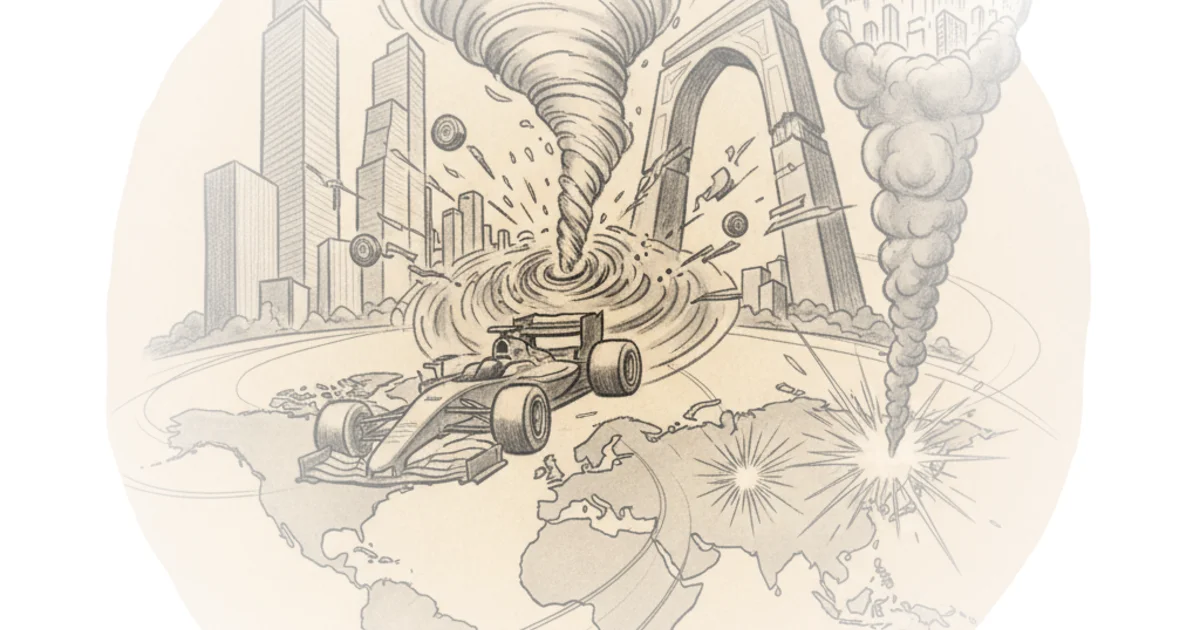
The author juxtaposes this against Allegiant Stadium, home to the NFL's Las Vegas Raiders. While the stadium cost $2 billion, it hosts a variety of events year-round. Denby calculates that the cost per annual home game for the Raiders is roughly $250 million. "This means at minimum F1 spent double as much in facility construction costs for its annual Las Vegas event." The argument here is that F1 is not competing with the NFL on volume, but on exclusivity and spectacle. The disruption required—relocating trees, draining iconic fountains, and resurfacing public roads for six months—would be political suicide for most leagues. Yet, Denby points out that "plenty of these races actually turn a profit for the circuits and promoters not all but enough that F1 now has far more venues to host a race than they can reasonably accommodate." This suggests a market where the scarcity of the event itself creates value, rather than the utility of the infrastructure.
Critics might argue that this model is unsustainable if the novelty wears off, especially given the high barrier to entry for new markets. However, the data on crowd sizes—often nearing 500,000 fans per weekend—suggests the demand is currently outstripping the supply of races.
The Boring Problem
The commentary then pivots to the internal crisis that necessitated this external expansion. Denby argues that the sport's decline in the 2010s wasn't due to a lack of marketing, but a fundamental flaw in the product itself. "Formula 1 was unequivocally and objectively just plain boring." The evidence is stark: in the 2015 season, Lewis Hamilton never left first place in the driver's championship standings. The top three drivers combined led 97% of all laps. "Racing was rarely tight the Mercedes cars often finished dozens of seconds ahead of first place for a casual TV audience it was just plain boring."
Denby traces this back to the very name of the sport. The "formula" refers to the open-ended rules allowing teams to engineer their own cars, which was intended to be a battle of engineering and skill. Instead, it created a scenario where wealthier teams could dominate indefinitely. "Sometimes these shakeups only perpetuate dominance as wealthier teams are able to devote more of their budget to developing the new era of cars years in advance whereas smaller teams must concentrate their spending on improving the car for the current season." The solution was not to change the rules, which would alienate purists, but to change the narrative.
The sport attempts to make mitigate the downsides of this system by dramatically revamping the rules every five or so years which tends to shake up the hierarchy of performance as teams must find new Technical Solutions to achieve superlative performance.
This framing is crucial. Denby suggests that the sport's fatal flaw—predictable outcomes—could not be fixed by engineering alone. It required a shift in what the audience was watching. The old leadership, under Bernie Ecclestone, dismissed the need for digital engagement. "Why invest in pushing content over Facebook and Twitter his logic went when young people won't have the money required to interact with the sports sponsors like Rolex or UBS." This logic, Denby implies, was a fatal miscalculation that ignored the future revenue base of the sport.
The Human Element Revolution
The turning point arrived with the 2017 acquisition by Liberty Media, which prioritized brand building over rule changes. Denby highlights a specific moment in Barcelona in late February 2017 when social media restrictions were lifted. The result was immediate: teams began broadcasting the human side of the sport. "Fans it turned out wanted to know more about who was under the helmet and F1 obliged." The focus shifted from the car to the driver. Daniel Ricciardo, for instance, saw his Instagram following explode not because he was winning, but because he was "equally fun-loving and emotionally open." Even Lewis Hamilton, whose dominance was the problem, became a character study rather than just a winner.
The strategy extended to the broadcast itself. By 2018, viewers could hear the high-stress communications between drivers and teams. "Now what the viewer could not see in a standard race the Strategic communication the high stakes high stress decision-making and the occasional argument over rules they could experience through the audio." This transformed a technical sport into a drama. Denby notes that this required a massive increase in content output, with YouTube video counts doubling and Twitter activity shifting from links to direct engagement.
A counterargument worth considering is whether this humanization dilutes the sport's technical prestige. Purists often argue that the engineering is the soul of F1. However, Denby's evidence suggests that without the emotional hook of the drivers, the engineering details were invisible to the casual viewer. The strategy was to make people care less about who was going to win the race and more about the struggle to get there.
Bottom Line
Sam Denby's analysis effectively reframes Formula 1's explosion not as a triumph of racing, but as a triumph of storytelling and brand management. The strongest part of his argument is the demonstration that the sport's greatest weakness—predictable dominance—was successfully mitigated by shifting the focus to the human drama behind the wheel. The biggest vulnerability remains the inherent risk of the "boring" engineering cycle returning; if the cars become too similar or the racing too predictable again, the human element may not be enough to sustain the massive global investment. The reader should watch for how the sport balances this new narrative focus with the technical regulations that continue to define the actual competition.
The transformation began at the circuit of catalunia in Barcelona Spain where preseason testing was taking place in late February 2017 first a letter circulated to the teams stating that existing social media restrictions on filming and sharing photos and videos from The Paddock were being lifted.