Dan Perry doesn't just describe Vienna; he diagnoses a civilization that refuses to age out of its own grandeur. In an era obsessed with speed and disruption, Perry argues that this city's true power lies in its stubborn, almost defiant patience—a quality that once defined the Austro-Hungarian Empire and now defines its modern identity as "the most successful failed city in the world."
The Architecture of a Vanished Empire
Perry opens with a sensory memory from the 1990s: waiting for a Käsekrainer sausage at a late-night stand, surrounded by young men fighting over scraps. He uses this vignette to anchor a broader observation about Vienna's resilience. "Sausages were no laughing matter in Vienna in the 1990s," he writes, noting that while the city has changed, its core rhythm remains untouched by the frantic modernity of London or Berlin. The author suggests that unlike other capitals that reinvented themselves through catastrophe, Vienna simply preserved itself, becoming a museum of a lost world where "the boulevards are too grand, the buildings too monumental, the ceilings too high."
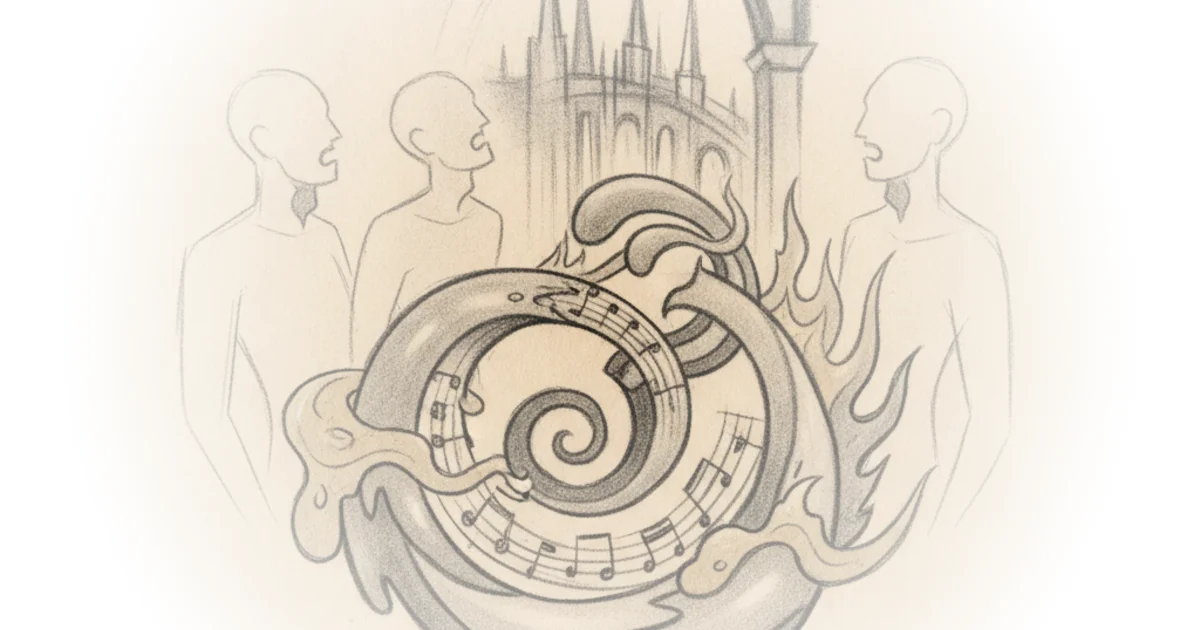
This framing is effective because it rejects the standard narrative of urban decline. Perry acknowledges the encroachment of global fast food and the rise of kebap shops—a nod to the shifting demographics that also define the modern Mitteleuropa landscape—but insists these are surface-level changes. "Mostly, though, it still seems the very same Vienna," he observes. The city's identity is not built on current economic output or political clout, but on an aesthetic of continuity that feels increasingly rare in a globalized world.
Vienna was cosmopolitan, theatrical, hierarchical, and deeply self-confident. Austria-Hungary was also the intellectual center of the wider idea of Mitteleuropa – attached to the strange idea that something very special was to be found in Germanic central Europe.
The piece leans heavily on the historical weight of the Austro-Hungarian Empire, describing it as a "supranational state" where diverse nations coexisted under a single imperial roof. Perry reminds readers that this was not just a political entity but an intellectual hub, home to figures like Freud, Mahler, and Zweig. He argues that the destruction of this empire in World War I did more than redraw maps; it shattered a specific worldview. "The world of my own language sank and was lost to me," Perry quotes Stefan Zweig, capturing the profound sense of loss that haunts the city's psyche. Critics might argue that Perry romanticizes an empire that was deeply hierarchical and prone to ethnic tension, but his point is not to praise the politics of 1914, but to understand the cultural vacuum left behind when it collapsed.
The Weight of History and Memory
Perry navigates the city's dark chapters with a journalist's precision, refusing to let the beauty of the architecture obscure the atrocities of the past. He notes that "Austria after the collapse of the empire was not just small but oddly uncertain," leading to the catastrophic Anschluss in 1938 when the country was annexed by Nazi Germany. The author highlights how modern Vienna has invested sincerely in memorialization, from Holocaust monuments to plaques, yet he finds a lingering disconnect between these efforts and the city's daily life.
The narrative takes a personal turn as Perry recounts his time covering the Yugoslav wars from Vienna in the 1990s. He describes the city briefly regaining its status as a "gateway" between East and West, a role it had held for centuries before the Iron Curtain fell. "In a curious way Vienna partially resumed its old role as a crossroads," he writes, noting that migrants then were primarily from neighboring Slavic nations who sought to blend in. This contrasts sharply with today's geopolitical reality, where the city sits on the periphery of the European Union rather than at the center of global power struggles.
"The world of my own language sank and was lost to me, and my spiritual homeland, Europe, destroyed itself," Zweig wrote in his suicide note. He meant central Europe.
Perry's reflection on the Anschluss is particularly poignant. He notes that Hitler himself was Austrian, a fact that remains a source of shame rather than pride. The author suggests that while Vienna has done "memory very well" through its museums and monuments, the city still struggles to fully reconcile its imperial past with its small-state present. A counterargument worth considering is whether this focus on memory allows the city to avoid confronting current challenges, such as rising right-wing populism or integration issues in a changing Europe. Perry hints at this tension but ultimately chooses to focus on the enduring spirit of the place rather than its political vulnerabilities.
Slow Down: The Philosophy of Time
The piece culminates in a cultural analysis centered on Billy Joel's song "Vienna." Perry interprets the track not as a love song, but as a philosophical manifesto for the city itself. He explains that Joel wrote the song after visiting his estranged father in Vienna and realizing that the American obsession with constant achievement was alien to this place. "Where's the fire, what's the hurry about? You'd better cool it off before you burn it out," Perry quotes, highlighting the contrast between the frantic pace of modern life and Vienna's deliberate slowness.
This section serves as the emotional core of the commentary. Perry argues that Vienna represents a civilization still attached to "patience, cultivation, aging with dignity." He connects this to his friend Seryozha, a musician who believes in "light, love and beauty," suggesting that these values offer an antidote to the burnout of contemporary society. The author concludes that while Vienna may no longer be a global power center, it offers something more valuable: a reminder that life is not a race against irrelevance.
Slow down, you're doing fine — you can't be everything you wanna be before your time … When will you realize? Vienna waits for you.
The framing here is powerful because it elevates the city from a tourist destination to a state of mind. Perry's observation that "Vienna symbolizes a civilization still attached to patience" resonates deeply in an age of instant gratification. However, one might argue that this philosophy is a luxury afforded only by a wealthy, stable society, and may not be replicable elsewhere. Yet, as Perry suggests, the mere existence of such a place offers a necessary counter-narrative to the relentless drive for progress.
Bottom Line
Dan Perry's piece succeeds in reframing Vienna not as a relic of a dead empire, but as a living testament to the value of slowness and continuity. Its strongest argument is that the city's "failure" to become a modern superpower is actually its greatest strength, preserving a cultural depth that faster-moving capitals have sacrificed for efficiency. The piece's vulnerability lies in its occasional tendency to romanticize the past, potentially glossing over the systemic inequalities and political stagnation that can accompany such deep-rooted traditions. Readers should watch how this "patience" holds up as Vienna navigates the complex geopolitical shifts of a post-Ukraine war Europe.