In an era where cultural discourse often fractures into performative outrage or hollow optimization, Maria Popova offers a radical counter-narrative: that the artist is not a celebrity, but a stubborn witness who pays the price of authenticity with their own life. This piece does not merely profile a rock icon; it excavates the spiritual mechanics of creativity itself, arguing that the 'indissoluble filament' connecting humanity is forged not in moments of triumph, but in the quiet, painful act of saying 'no' to the world as it is. For the busy mind seeking depth without distraction, this is a masterclass in how to read a life as a text of resistance.
The Architecture of Refusal
Popova frames the artist's existence as a series of deliberate rejections. She writes, "Every visionary, every person of greatness and originality, is a resounding yes to life... a yes made of unfaltering nos." This is a crucial distinction. The argument posits that creativity is not just about adding something new, but about subtracting the expected, the banal, and the commercially safe. Popova traces this back to Smith's childhood, where a simple book of poems taught her that entry into the "mystical world" required a currency she didn't yet possess.
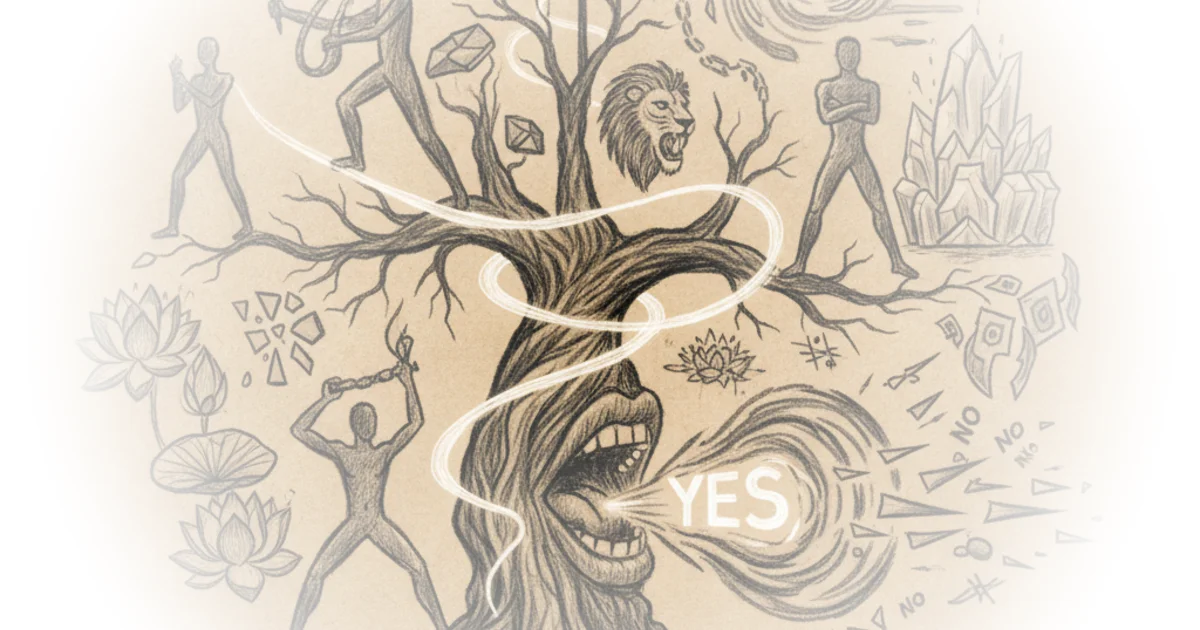
The author suggests that Smith spent her life not finding these silver pennies, but making them for others. This reframing of the artist's labor is potent. It moves the focus from the output—the song, the poem—to the internal cost of production. As Popova puts it, Smith spent her life "paying the price of her nos in living the enchanted yes of being an artist." This lands with particular force because it strips away the glamour of the rock star persona, revealing the grueling, often lonely work of maintaining one's integrity against the pressure to conform.
"We are born with a mind, open to everything, no fear, no known boundaries, but with each new rule, restriction the mind divides."
Critics might argue that this romanticization of struggle overlooks the systemic barriers that prevent many from accessing the "mystical world" in the first place. Not everyone has the privilege to say no to a paycheck or the safety net to survive the "seasons of subsisting on eggs and oranges." Yet, Popova's point remains that the internal act of refusal is the primary engine of the art itself, regardless of external circumstance.
The Alchemy of Grief
The commentary deepens as Popova turns to the role of loss. She details a life punctuated by a "cascade of losses," from the death of a childhood friend to the AIDS-related death of her artistic soulmate and the sudden slaying of her brother. Rather than treating these as biographical footnotes, Popova presents them as the raw material for the art. She writes that Smith came to see the struggle as "the holy price of the real work: to open the wounds of poetry."
This is where the piece transcends biography and becomes a philosophical treatise on suffering. Popova argues that art is the "alchemy of transmuting the wound into wonder." It is a compelling, if heavy, thesis: that the artist's duty is to remain "enthralled by small things" even while carrying the weight of the abyss. The connection to Arthur Rimbaud, whom Smith revered, is subtle but significant; like Rimbaud, who famously sought to "disorder all the senses" to reach the unknown, Smith uses her grief to pierce the veil of the ordinary.
The author notes that Smith felt chiefly a "worker" who believed the struggle was a "privilege." This inversion of the typical narrative of victimhood is striking. It suggests that the capacity to feel pain deeply is not a curse, but a prerequisite for the kind of vision that can hold a community together. Popova writes, "All we had to do was kick with all our power, topple walls, clear the rubble and create space." This active, almost violent imagery of creation contrasts sharply with the passive acceptance of fate, offering a model of agency that is deeply resonant in times of uncertainty.
The Filament of Connection
Ultimately, Popova argues that the artist's work is an act of connection. She describes the artist as the "material mouthpiece" of the divine, tasked with giving form to the "unpremeditated gestures of kindness" that are "the bread of angels." The piece culminates in the idea that love is the "training ground for trusting time."
Popova writes, "With such trust, time becomes not a river but a fountain, pouring in every direction into a pool of itself at the center of the sunlit plaza of the possible." This metaphorical shift from linear time to a cyclical, abundant present is the piece's emotional core. It suggests that the artist's legacy is not a static monument, but a living, breathing resource that others can draw from. The reference to the "corpuscles of mist gilded for a moment" serves as a reminder of our own fragility, grounding the lofty spiritual claims in the physical reality of human mortality.
"Art, like love, is that mysterious alchemical reaction between time, truth, and trust."
While the piece leans heavily on the spiritual and the metaphysical, potentially alienating readers who prefer a more secular or sociological analysis of art, its emotional resonance is undeniable. It succeeds because it does not ask the reader to believe in a specific dogma, but to trust in the transformative power of attention and the courage to feel.
Bottom Line
Maria Popova's commentary on Patti Smith is a triumph of reframing, turning a biography into a manifesto for the creative spirit. Its greatest strength lies in its insistence that the artist's value is measured by their capacity to endure and transmute suffering, not by their commercial success. The argument's only vulnerability is its reliance on a specific, almost mystical worldview that may feel inaccessible to those who view art purely as a social or political tool. However, for the reader seeking to understand the deeper currents of human connection, this piece offers a rare and necessary map.