Donna Rifkind reframes the centenary of Mrs Dalloway not as a literary history lesson, but as a psychological autopsy of why we cling to fiction. While the world celebrates with "cupcake-heavy receptions," Rifkind cuts through the fanfare to ask a sharper question: why does this specific book, with its minimal plot and fractured consciousness, still feel like a personal love affair to millions?
The Architecture of a Century-Old Obsession
Rifkind anchors her analysis in Mark Hussey's new biography of the novel itself, a text that treats the book as a living entity with its own "birth and welfare." She notes that Hussey's work is "efficiently written, yet chock-full of virtues large and small," serving as a paragon of how to discuss a classic without descending into pedantry. This approach allows Rifkind to pivot quickly from the mechanics of publishing to the raw emotional core of Woolf's ambition. She reminds us that Woolf, having survived the Great War and her own "madness," rejected the traditional novel structure. Instead, she sought to capture a reality made of "scraps, orts and fragments."
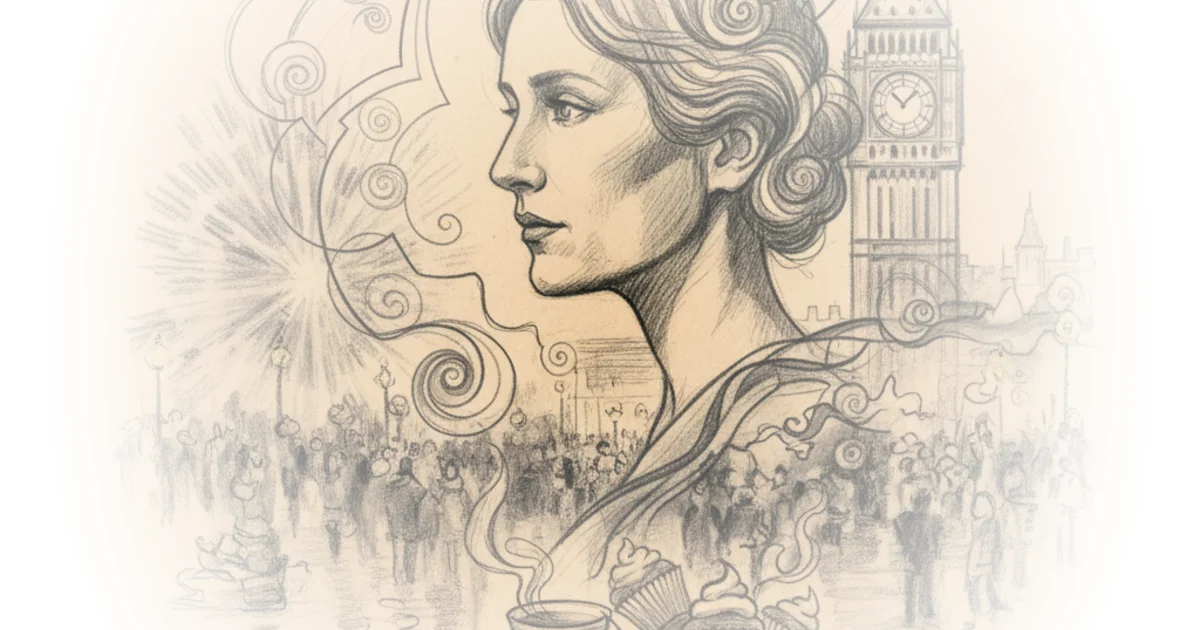
This shift in perspective is crucial. Rifkind argues that Woolf's genius lay in her refusal to smooth over the chaos of the human mind. "She was convinced that preconceptions about character in novels of previous eras were no longer applicable in her own," Rifkind writes. By focusing on the "distinct but intertwined consciousnesses" of her characters, Woolf created a mirror for a post-war world that felt irreparably broken. The inclusion of Septimus Smith, a shell-shocked veteran, alongside the party-planning Clarissa Dalloway, was not just a narrative device; it was a political act. Rifkind points out that Woolf wanted to "give life & death, sanity & insanity" in a single breath, forcing readers to confront the trauma of the war that the upper classes tried to ignore. This is where the Bloomsbury Group's influence becomes tangible—not just as an aesthetic circle, but as a radical rethinking of how to represent human suffering.
"We all seem to feel that we have our Virginia Woolf."
The Reader as Co-Conspirator
The piece takes a fascinating turn when Rifkind explores the friction between authorial intent and reader interpretation. She recounts the story of Philip Morrell, a politician who was furious to find himself modeled after two "dullest characters" in the novel, despite Woolf's intention that he be liked. Rifkind uses this anecdote to illustrate a profound truth about the lifecycle of a great book: once published, it escapes the author's control. "No writer can really control how readers react to their inventions," she notes, citing Hussey. Woolf herself agreed, insisting that a novel "ceases to be the property of the author" and belongs entirely to the "Common Reader."
This dynamic is further illustrated by the trajectory of Michael Cunningham's The Hours. Rifkind details how Cunningham, initially ignorant of Woolf's work, fell in love with the novel and wrote a "book about reading a book." The result was a cultural phenomenon that reignited sales and understanding of the original text. Rifkind observes that Cunningham's success proves that "a book could matter to someone as much as a love affair." This is a powerful framing. It suggests that our attachment to Mrs Dalloway is less about literary analysis and more about emotional resonance. We project our own lives onto the text, often misunderstanding the author's specific goals, but finding a deeper truth in the process.
Critics might argue that this focus on personal projection risks reducing Woolf's complex modernist experiments to mere self-help or therapeutic tools. However, Rifkind anticipates this, noting that even Woolf's closest intimates, her husband and sister, only partially understood her work. The "wrongness" of the reader is not a bug; it is a feature of the text's endurance.
The Simmering Cauldron
Rifkind concludes by connecting Woolf's literary credo to the sentence itself. She references Woolf's father, Leslie Stephen, who believed a sentence should be "alive to its fingers' ends." For Rifkind, this vitality is the secret to the novel's survival. "Look at any paragraph of Woolf's... to find it alive to its fingers' ends," she urges. The text is not a static artifact but a "simmer[ing] cauldron" of human impulse.
The article also touches on the modern trend of using Woolf as a "wellness retreat" during times of crisis, such as the pandemic. While some might view this as a trivialization of her work, Rifkind suggests it is a testament to the text's ability to adapt to our changing psychological needs. Whether we are reading for solace, for rage, or for intellectual challenge, the "cauldron is still simmering." The book's power lies in its inexhaustibility; it offers endless possibilities because it refuses to offer a single, easy answer.
Bottom Line
Rifkind's commentary succeeds by shifting the focus from the biography of the author to the biography of the book itself, arguing that Mrs Dalloway endures because it allows readers to project their own fragmented realities onto its pages. The argument's strongest element is its refusal to treat the novel as a museum piece, instead presenting it as a living, breathing entity that changes with every reader. Its only vulnerability is the potential for this "love affair" framing to overshadow the rigorous political and formal innovations that made the novel revolutionary in the first place. For the busy reader, the takeaway is clear: the book is not about Clarissa Dalloway; it is about the reader's own capacity to find meaning in the chaos. "