Devin Stone doesn't just watch movies; he prosecutes them. In his breakdown of Die Hard, Stone, a former Marine and current prosecutor, makes the startling claim that the film's hero, John McClane, is arguably more legally culpable than the terrorists he fights. This isn't a simple list of crimes; it is a rigorous application of 2025 legal standards to a 1988 blockbuster, forcing the audience to reconsider the very definition of heroism when the law is the judge.
The Flying Gun and the Smoker
Stone immediately dismantles the audience's sympathy for McClane by pointing out a critical oversight in the film's opening. "It doesn't matter that he's a New York beat cop because according to TSA regulations, even law enforcement officers can't just take a gun onto an airplane," Stone writes. He clarifies that without specific authorization—such as escorting a prisoner or serving as an assigned bodyguard—McClane's decision to carry his weapon onto a commercial flight is a federal crime. The author notes that under 49 USC section 46314, this act carries a potential year in jail and fines up to $12,000. This is a sharp, necessary correction to the movie's logic, reminding viewers that the rules of the road, and the sky, apply even to the good guys.
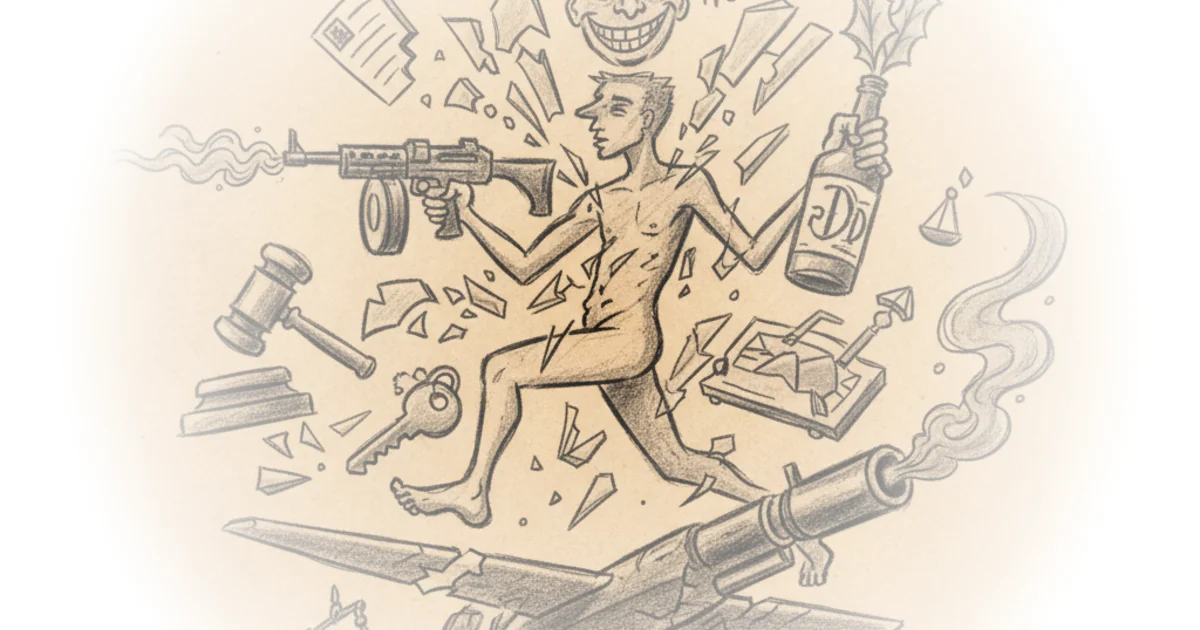
Stone then pivots to the era-specific context of smoking. He notes that while smoking was banned on flights under two hours in 1988, it was still technically legal on longer flights at the time of the movie's release. "Before 1988, smoking on commercial flights in the US was perfectly illegal," he explains, highlighting how the film inadvertently captures a legal gray area that existed for only a brief window. This attention to historical nuance elevates the commentary from a simple critique to a genuine legal history lesson.
Carrying a gun onto an airplane without authorization is a pretty serious crime that would definitely land you on Santa and the US government's naughty list.
Critics might argue that applying modern TSA strictures to a 1988 film is anachronistic, but Stone's point stands: the legal landscape has shifted, and the protagonist's actions would be scrutinized far more harshly today. The humor in the piece comes from the juxtaposition of a gritty action hero and the mundane reality of federal paperwork.
The Death Penalty and the Accomplice
The analysis deepens when Stone turns to the villains, Hans Gruber and his crew. He dissects the specific flavor of their crimes, citing California Penal Code section 187 to define murder as the "unlawful killing of a human being with malice of forethought." Stone argues that the gang's cold-blooded execution of the security guards demonstrates an "abandoned and malignant heart," a phrase he notes is actual legal language. "Did Carl and Theo demonstrate an abandoned and malignant heart? Sure looks like it," Stone quips, grounding the film's violence in statutory reality.
He further complicates the legal picture by examining the liability of Theo, the hacker who didn't pull the trigger. Under California Penal Code section 31, anyone who aids or abets a crime is punishable as though they committed it themselves. Stone explains that Theo's distraction tactics make him just as liable for the murder as the gunman. This is a crucial distinction often missed by casual viewers who might see Theo as a mere sidekick. The author drives the point home with a chilling statistic: "Over the course of a 2-hour movie, John McClane managed to execute almost as many criminals as California has in 50 years." This comparison reframes the movie's climax not as a triumph of justice, but as a massive disruption of the state's capital punishment timeline.
The Tech Crime and the Terrorist Label
Stone also tackles the digital crimes committed by the gang, noting that while the Computer Fraud and Abuse Act of 1986 might not have caught them due to the lack of interstate internet traffic in 1988, California's own laws would have. He points out that Theo's unauthorized access to the building's systems to steal bearer bonds violates California Penal Code section 502. "Theo is accessing the computer systems of both the building and the vault in order to steal the bear bonds," Stone writes, confirming that the heist was a felony under state law regardless of federal loopholes.
The most provocative section of Stone's commentary addresses the definition of terrorism. He challenges the common assumption that the Gruber gang are terrorists, citing the USA Patriot Act's requirement that the act must be intended to "intimidate or coerce a civilian population" or influence government policy. "Did the Gruber gang and Die Hard intend to one population or two influence government policy or three affect the conduct of government? Not necessarily any of these," Stone asks. He suggests that while the gang's actions were violent, their primary motive was monetary gain, which legally separates them from terrorism.
However, Stone offers a counter-narrative: the potential political motivation behind targeting a Japanese corporation during the 1980s economic panic. He posits that if prosecuted under 2025 laws, a clever attorney could argue that targeting the Nakatomi Corporation was an act of intimidation against a specific demographic. "Maybe targeting this company in particular was politically motivated," Stone suggests, before conceding, "Would it actually work? I don't think so." This willingness to explore the gray areas of legal theory, even when the conclusion is negative, adds significant depth to the piece.
The Hero's Legal Liability
Finally, Stone returns to McClane, questioning the legality of his vigilante justice. He notes that under California law, carrying a concealed weapon in public is generally illegal without a permit, and out-of-state police status is not automatically recognized. While the Law Enforcement Officer Safety Act (LEOSA) provides a federal exemption for off-duty officers, Stone points out a critical limitation: "the right of officers to conceal carry across state lines does not supersede state laws that allow private entities like the Nakatomi Corporation to prohibit firearms on their private property."
This means that by entering the Nakatomi building with his gun, McClane was technically trespassing with a firearm, breaking the law before he even fired a shot. "So, by concealing his Brea 92F, John McClane is breaking the law and could be subject to civil and criminal penalties if California prosecutors decided to go after him," Stone concludes. This final twist leaves the reader with a lingering question: Is McClane a hero, or just a cop who got lucky?
Over the course of a 2-hour movie, John McClane managed to execute almost as many criminals as California has in 50 years.
Critics might note that Stone's analysis relies heavily on the assumption that the movie takes place in a strict legal framework, ignoring the narrative necessity of the hero's actions. However, the strength of the piece lies in its refusal to let the plot armor protect the characters from legal scrutiny.
Bottom Line
Devin Stone's commentary is a masterclass in applying real-world legal rigor to pop culture, successfully arguing that Die Hard is as much a crime drama as it is an action film. The strongest part of the argument is the relentless focus on the protagonist's own legal vulnerabilities, which reframes the entire narrative. The biggest vulnerability is the inevitable tension between cinematic logic and statutory reality, but Stone navigates this by treating the film as a hypothetical case study rather than a historical record. Readers should watch for how this legal lens might change their perception of other action heroes who operate outside the law.