This piece from Compact Magazine offers a startling diagnosis of modern masculinity: we are witnessing the rise of "corporal philosophers" who treat their bodies as engineering projects to be optimized, rather than vessels for human connection. It is not merely a report on internet subcultures; it is a philosophical inquiry into why two men—one seeking aesthetic perfection through self-destruction, the other immortality through algorithmic control—have become unlikely icons of our age. The article's most provocative claim is that these extreme figures are not outliers, but logical endpoints of a society that has stripped life of higher meaning, leaving only the body as the final frontier for status and identity.
The Architecture of Ascension
The narrative begins with Braden Peters, known online as Clavicular, a figure who embodies the violent extremes of "looksmaxxing." Compact Magazine reports, "Peters's face was the product of years of looksmaxxing," detailing his descent into using steroids at fourteen and engaging in "bonesmashing" to alter his bone structure. The piece argues that Peters views these dangerous acts not as self-harm, but as a rational strategy: he sees pharmacology as a "video game cheat code." This framing is chilling because it strips away the notion of madness and replaces it with a cold, transactional logic where pain is merely an investment cost for social capital.
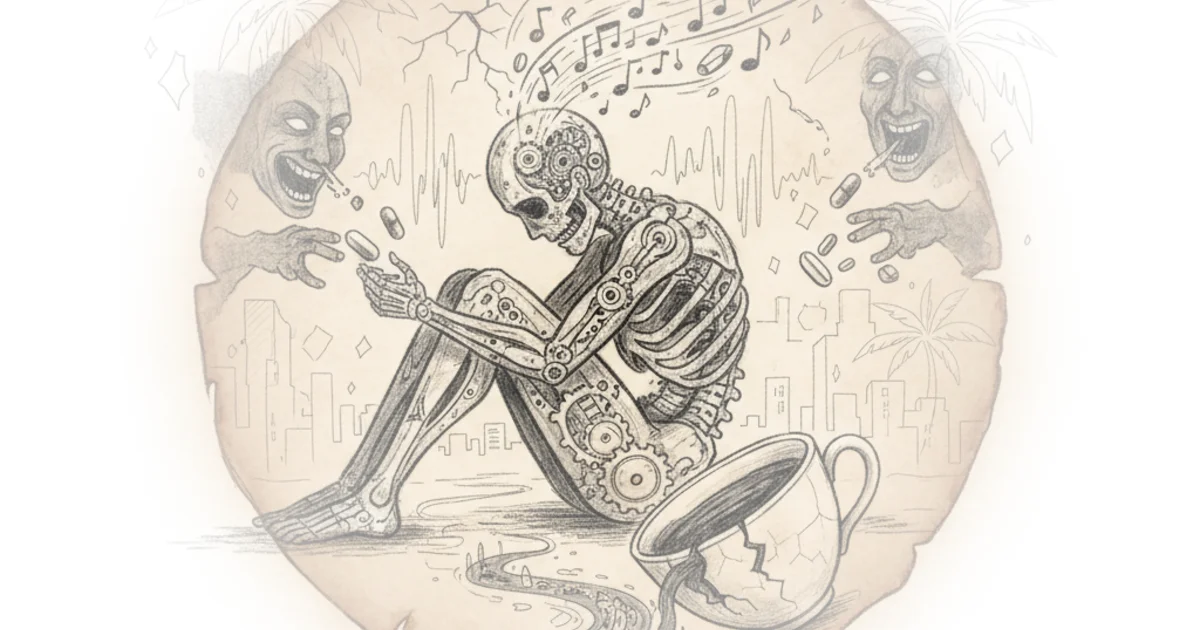
The article notes that Peters has "sterilized himself permanently through premature testosterone injections" yet claims to have "ascended." This creates a paradox at the heart of his philosophy: he seeks to maximize his biological utility while simultaneously destroying its reproductive function. The editors suggest this reflects a broader cultural shift where traditional markers of success, like family and community, are dismissed as having no "ROI" (return on investment). Peters tells a journalist that getting married is "comical," preferring instead to live-stream every moment to an audience of parasocial admirers.
Unless society was ready to rebuild, it's very much a cope to try to go against it and go against its ways—even if it's wrong.
This admission reveals the fragility of Peters' worldview. When pressed by conservative podcaster Michael Knowles on whether there are higher goods than beauty, Peters retreats into cynicism, arguing that the world is too broken to pursue anything else. The piece effectively uses this dialogue to show how "looksmaxxing" has evolved from a niche internet hobby—rooted in the same subcultures as "hypergamy," where physical traits are weaponized for mating success—into a defensive philosophy for navigating a perceived social collapse. Critics might argue that Peters is simply a troubled young man suffering from addiction, but the article insists he represents a coherent, if terrifying, response to a culture that values surface over substance.
The Algorithmic Body
If Clavicular represents the chaotic side of bodily optimization, Bryan Johnson represents its sterile, billionaire extreme. Johnson, who sold his company for $800 million, is attempting to turn himself into a "small science experiment" to conquer death. Compact Magazine highlights the absurdity and rigor of his regimen: he monitors 250 vital signs daily and lives under "algorithmic control," eating only what his data dictates. The piece quotes Johnson's frustration with regulation: "They give me the freedom to kill myself, but I don't have the right to experiment on myself."
The article draws a sharp contrast between Johnson's pursuit of eternal life and the messy reality of human biology. By reducing his own existence—and even his family's—to data points, such as tweeting about his wife's "vaginal microbiome report," Johnson attempts to erase the unpredictability of life. The editors note that while he claims this brings him happiness, his life appears "impoverished" by a lack of spontaneity. He has traded the joy of a pizza or a donut for the promise of more time, yet the piece questions whether a life lived entirely in service to an algorithm is truly living at all.
Johnson's daily life is subject to algorithmic control.
This section serves as a critique of the "biohacking" movement, suggesting that it is merely self-improvement logic taken to its most expensive and dehumanizing conclusion. The article points out the inherent selfishness in Johnson's project: his quest for longevity requires the exploitation of his son's blood and his wife's biological data. While proponents might say he is pushing the boundaries of human potential, the piece argues that he has lost sight of what makes life valuable in the first place. He is not fighting entropy; he is trying to become a machine.
The Body as Moral Frontier
The commentary then pivots to a broader historical context, invoking the German writer Ernst Jünger and his observations on "total warcraft." Compact Magazine suggests that modern man has lost the ability to dissociate from a body that can be destroyed, viewing it instead as the "main force and essential core of life." In this light, both Clavicular and Johnson are described as "hypermoderns" who have transcended bodily sensitivity not for a collective good, but for individual optimization.
The piece contrasts these figures with former Senator Ben Sasse, whose recent cancer diagnosis forced him to confront mortality in a way that neither of the "corporal philosophers" can. While Clavicular and Johnson seek to avoid pain at all costs, Sasse embraces his suffering as "sanctifying." The article reports Sasse's reflection on his illness: "I didn't like the idea of my fourteen-year-old son not having a dad around at sixteen." This moment grounds the abstract debate in human reality. Sasse's focus is not on his own physical perfection or longevity, but on his relationships and his legacy.
Today, the body remains the last moral frontier.
This sentence serves as the article's thesis: in an era where we can edit our genes, alter our faces, and extend our lives, the question of why we do these things has become the defining moral struggle. The editors argue that while Jünger saw the machine as a force to be embraced, Clavicular and Johnson have turned their own bodies into machines, sacrificing their humanity for the sake of efficiency or aesthetics.
Death is something that we should hate... We should call it a wicked thief.
The article concludes by noting that even Sasse's Christian faith acknowledges death as an enemy, yet he accepts it with grace rather than fighting it with "cheat codes." The piece suggests that the true tragedy of Clavicular and Johnson is not their methods, but their inability to answer the question: "What is your beauty for?" They have optimized the vessel but forgotten the passenger.
Bottom Line
Compact Magazine delivers a searing critique of the "corporal philosophers," arguing that the extreme optimization of the body is a symptom of a deeper spiritual void where traditional sources of meaning have collapsed. The piece's greatest strength lies in its ability to connect disparate phenomena—from internet subcultures to billionaire biohacking—to a unified philosophical crisis, though it risks oversimplifying the genuine medical desperation that drives some of these behaviors. Readers should watch for how this "body as project" mentality spreads beyond the fringe, potentially reshaping our collective understanding of health, aging, and what it means to be human in an increasingly algorithmic world.