Wayfare delivers a startlingly original critique of modern spirituality by linking the artifice of fast-food marketing directly to the rise of artificial intelligence. The piece argues that our hunger for a "franchised faith"—one that is safe, identical, and convenient—has made us uniquely vulnerable to the "Great Averaging" of AI, which threatens to strip religion of its messy, miraculous humanity.
The Alchemy of the Fake
The commentary opens with a jarring juxtaposition: the biblical act of naming animals versus the corporate act of branding fast food. Wayfare draws on the author's past experience as a copywriter for Burger King to illustrate how consumerism relies on deception. The piece reports, "The end goal is this: create a model product that entices hungry hordes into the restaurant while presenting a brand image that's aspirational, yet ultimately unobtainable." This observation is sharp; it reframes the familiar disappointment of a fast-food meal not as a failure of quality control, but as a deliberate feature of the business model. The article notes that food styling involves "dry ice as faux steam, edible wax as a buttery shellac, and food-grade resin to create camera-ready food that maintains structural integrity under sweltering studio lights."
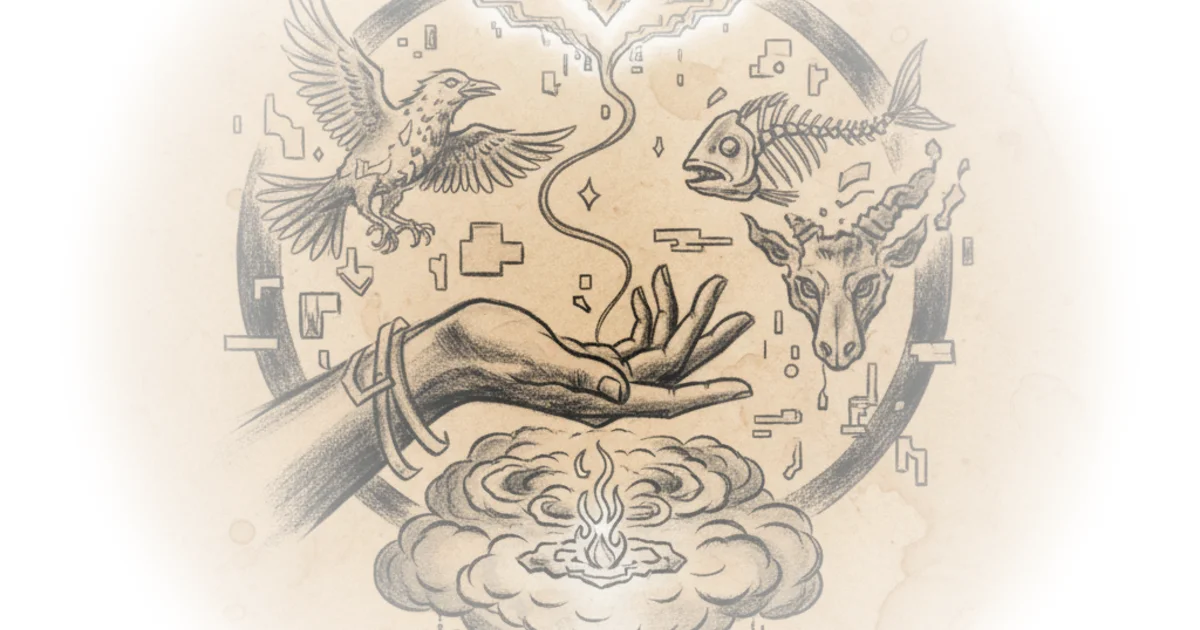
This analysis of "fake" food serves as a potent metaphor for the spiritual state of the modern church. Wayfare suggests that just as the television Whopper never looks like the real thing, a faith modeled on corporate consistency may lack nutritional value. The piece argues, "If we treat our faith like a fast-food drive-through, a convenient transaction of the sacrosanct, is there vital nutrition that we lose out on in the process?" This question lands with force because it challenges the comfort many find in predictability. Critics might note that standardization in religious practice often provides necessary stability for marginalized communities, such as the Latter-day Saints in the Lesser Antilles, where a consistent global identity can offer a lifeline of belonging. However, the article's point remains: when convenience becomes the primary metric, the depth of the experience suffers.
"We're losing something," he laments. The watering down of unique and local Church culture means "individual communities are losing their character, their originality, and the beauty of real diversity."
The Great Averaging
The argument pivots from food to the digital realm, identifying a dangerous parallel between mass-produced religion and generative AI. Wayfare defines artificial intelligence with a brutal simplicity: "artifice and averages." The piece contends that while we focus on the "intelligence," we ignore the "artificial," noting that "Large language models function as cannibalizing copy machines, peddling stolen goods in substandard packaging to the detriment of those artists and thinkers who supplied them with the raw materials." This framing is particularly effective for a religious audience that values creation as a divine act. The article warns that AI is "a powerful plagiarism tool profiting off theft," a claim that resonates deeply in a culture increasingly concerned with intellectual property and the sanctity of human effort.
The commentary uses a personal anecdote about a daughter's standardized testing to illustrate the danger of prioritizing the "most likely" answer over the creative one. Wayfare reports, "She was playing Balderdash when she was meant to be playing Family Feud." This metaphor perfectly captures the tension between human ingenuity and algorithmic probability. The piece argues that "Generative AI operates according to this strategy. Unless specifically prompted not to, it will offer you the most common output. Like an unclever cleaver, AI shaves off the edges of our humanity."
This section raises a critical concern about the future of spiritual education. If sermons and testimonies are outsourced to algorithms, the result is a "copy machine of the consecrated." The article asks, "Why not stay home and have ChatGPT spit me out a talk on any subject that I choose from the perspective of almost anyone?" This rhetorical question forces the reader to confront the value of communal worship. If the content can be generated instantly, the only remaining value is the human connection itself, which AI cannot replicate. A counterargument worth considering is that AI could democratize access to theological reflection for those without access to trained clergy. Yet, the piece's insistence on the "human hand" suggests that the process of struggle and creation is where the spiritual growth actually happens.
"The impulse behind [AI] seems to be to eliminate the human hand, the human eye, in the making of the reality that we inhabit to the farthest extent possible. It's just a human impulse to escape from its humanity."
Bottom Line
Wayfare's strongest contribution is its ability to connect the mundane mechanics of food styling to the existential threat of artificial intelligence, revealing a shared root in the desire for a sanitized, risk-free existence. The argument's greatest vulnerability lies in its somewhat romanticized view of human creativity, which can be just as prone to cliché and repetition as any algorithm. However, the core warning is urgent: in an age of "The Great Averaging," the only way to preserve the divine is to embrace the messy, unoptimized, and uniquely human expression of faith.