In an era where architectural discourse often retreats into abstract theory or sterile digital rendering, this interview offers a startlingly human origin story for a practice that reshaped the global skyline. Louisiana Channel captures a rare moment where the architect admits that their most radical work began not with a grand vision, but with a desperate, self-taught curriculum born from a broken educational system. The piece argues that true innovation often emerges from the friction between rigid institutional expectations and the messy, unstructured curiosity of the individual.
The Architecture of Self-Education
The narrative begins with a reflection on early talent, where the subject recalls being the designated "artist" in a family of siblings, each with distinct superpowers. Louisiana Channel writes, "I always knew that I was going to be doing something with drawing... I somehow knew that it would be a waste if I didn't do something that I had to do with drawing." This early certainty sets the stage for a journey that defies the standard professional pipeline. Instead of following a clear path, the architect enrolled in the Royal Danish Academy of Architecture with no preconceptions, viewing it merely as a way to master the missing piece of their skillset: drawing buildings.
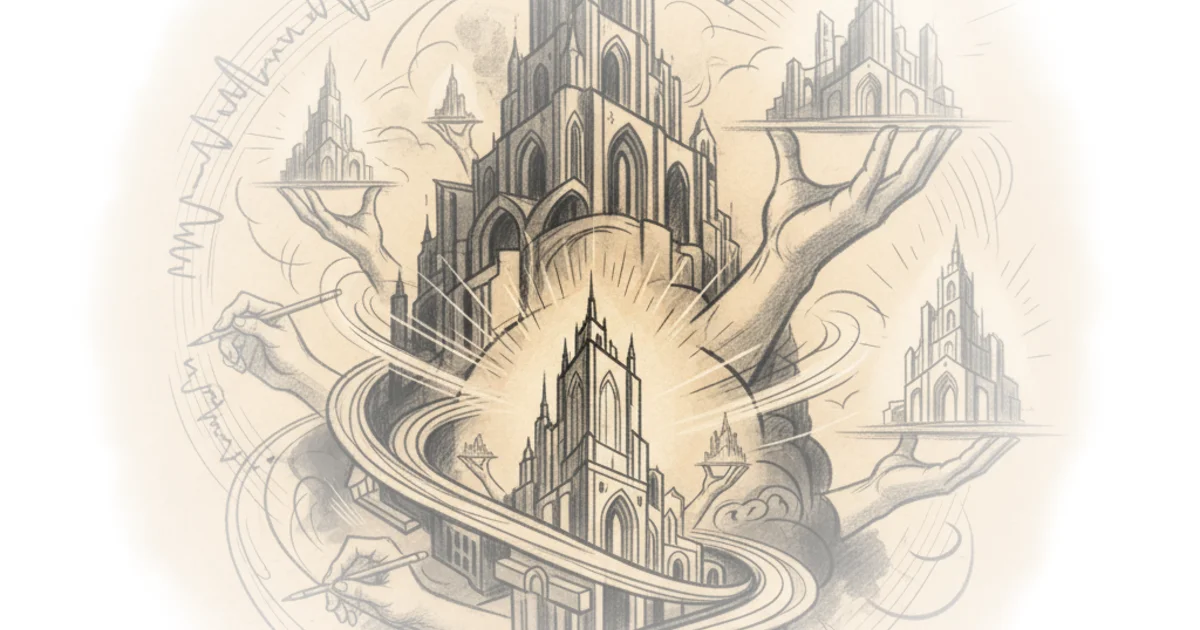
The interview reveals a profound disconnect between the institution's reputation and its reality. Louisiana Channel notes that when the architect arrived in 1993, "everybody was taking themselves like incredibly serious there was like not another inkling of self-irony and like a lot of pretension and then but with very little evidence to back it up." The school was fragmented, siloed, and suspicious of formal learning. In response, the architect and a friend engaged in a form of intellectual rebellion. "Me and a friend... ended up spending the first two or three years in the library because like nobody taught us anything there was no curriculum," Louisiana Channel reports. They essentially reverse-engineered their own education, following footnotes from Frank Gehry to Rem Koolhaas, treating the library as a laboratory for investigative journalism rather than a place of passive instruction.
"We basically just went to the library and started pulling out random books from the shelves... in a way we even see like almost like reversed engineered our own curriculum."
This anecdote is powerful because it reframes the "self-taught" myth not as a lack of discipline, but as a rigorous, active pursuit of knowledge that the institution failed to provide. Critics might argue that this romanticizes the lack of mentorship, suggesting that a structured curriculum could have accelerated the learning process. However, the architect's point stands: the autonomy to follow one's own intellectual curiosity was the catalyst for a unique design philosophy that would later challenge the status quo.
From Digital Models to Physical Truth
As the conversation shifts to the tools of the trade, the architect challenges the modern obsession with digital precision. While acknowledging the scalability of 3D modeling and the immediacy of virtual reality, Louisiana Channel captures a crucial distinction: "the pain is to depend on the paper as a tool to make the world see what you see or for you to see what you think before you've even seen it." The argument here is that digital tools, while efficient, can obscure the physical realities of construction.
The architect insists that physical models remain indispensable. "Even the way you put it together it could be that it's easy to model something in 3d that's like incredibly complicated but it's easy to do it but then once you have to manufacture it if you haven't tried building it by putting things together it's going to be hard to achieve the technical refinement," Louisiana Channel writes. This is a vital counter-narrative to the industry's rush toward full digitization. The tactile feedback of building a model reveals problems and potentials that a screen simply cannot simulate.
"There's no better way than in one-to-one scale stacking real bricks and pouring real concrete."
This emphasis on materiality grounds the architect's work in a tangible reality that often gets lost in the abstract. It suggests that the "essence" of a building is not just in its form, but in the friction and resistance of its materials. The argument holds up well against the backdrop of contemporary architecture, where the gap between the digital render and the built reality is often a source of failure.
Breaking the Paradigm
The final section of the interview addresses the challenge of entering a closed market. When the architect returned to Copenhagen, the prevailing wisdom was that new practices could not survive against established giants. The traditional catch-22 was clear: you need a building to get a commission, but you need a commission to get a building. Louisiana Channel describes how the architect and their partner bypassed this by adopting a radically different approach: "instead of like starting with the answer because we already know the answer let's let's start with all the questions and then answer those questions as carefully and rationally as we can."
This method allowed them to embrace unexpected answers and consequences, leading to designs that looked different but were logically sound. The architect compares the rigid rules of the architectural world to a song about a park where "nobody was supposed to play," suggesting that the profession had become overly restrictive. "Maybe the world of architecture was a little bit like that at the time and I think we just felt that there was there was a lot of missed opportunities that could be embraced," Louisiana Channel writes.
"Great buildings express their true essence to the world."
This closing sentiment encapsulates the entire argument: authenticity and rigor, not adherence to tradition, are what allow a building to speak. The architect's journey from a frustrated student to a paradigm-shifting practitioner serves as a testament to the power of questioning established norms. While some might argue that this approach is difficult to replicate without the specific conditions of that time and place, the underlying principle—starting with questions rather than answers—remains universally applicable.
Bottom Line
The strongest part of this piece is its unflinching critique of institutional pretension and its celebration of self-directed learning as a valid, even superior, path to expertise. Its biggest vulnerability lies in its romanticization of the "struggle," which may not translate easily to a modern educational landscape that demands more structure. However, the core message—that true innovation requires the bravery to embrace the unexpected and the discipline to engage with physical reality—remains a vital lesson for anyone in the creative fields.