In a landscape saturated with AI evangelism, The Hated One dares to ask the question Silicon Valley refuses to answer: what happens when the hype collides with reality? The piece argues that the current artificial intelligence boom is not a technological renaissance but a catastrophic bubble poised to erase the working class and crash the global economy. This is not a standard tech critique; it is a financial doomsday scenario built on the premise that the very people building the machines are the ones most invested in selling the lie of their own inevitability.
The Myth of Mass Unemployment
The Hated One opens with a stark prediction that contradicts the narrative of "augmentation" favored by tech CEOs. "AI is hyped to be able to do all of our tasks much more efficiently than most humans could," the author writes, "thus, very rapidly erasing the need for human labor and spike unemployment to 10 to 20%." This framing is designed to shock, but it rests on a specific interpretation of recent corporate behavior. The author points to mass layoffs at Microsoft, Meta, and Intel, suggesting these are not cost-cutting measures but the first dominoes of a systemic replacement.
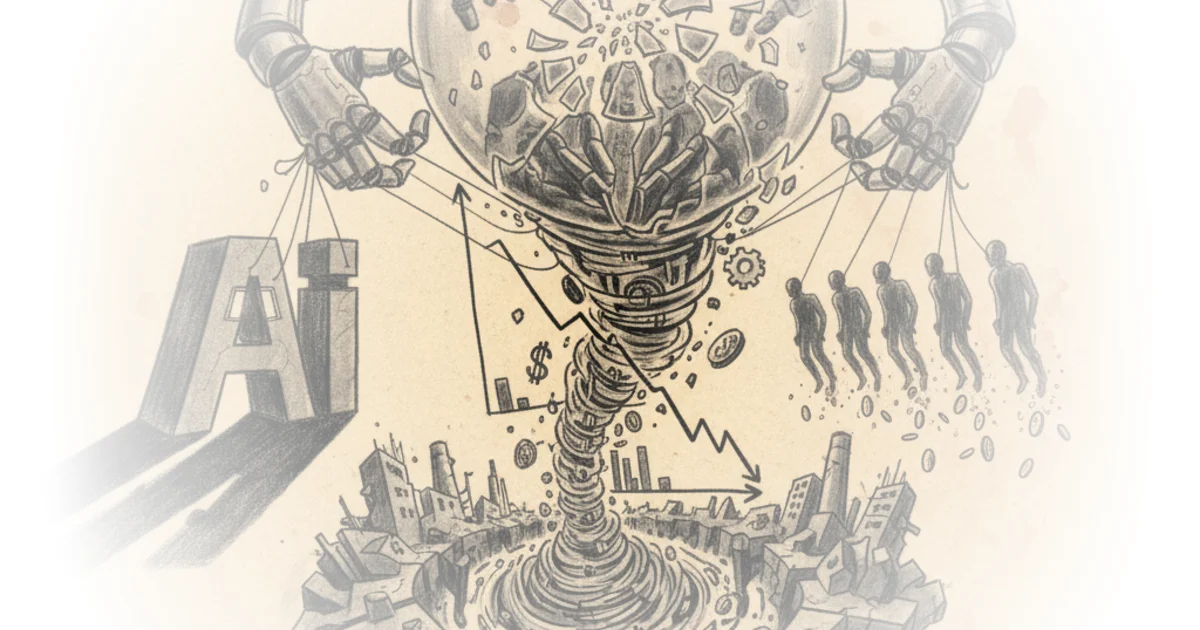
The argument gains traction by citing industry insiders who seem to agree with the grim outlook. The Hated One notes that "this argument isn't coming from overzealous regulators. It's coming directly from AI makers themselves," quoting Dario Amodei of Anthropic on the potential for "great depression levels of bad extreme poverty." This is a powerful rhetorical move, using the voices of the architects to dismantle the foundation of their own industry. However, critics might note that CEOs often use fear to justify stock buybacks or to pressure governments for favorable regulations, meaning their dire predictions may be strategic rather than predictive.
"This is like the end of capitalism. The economy as we've known it for decades will be destroyed."
The Flaw in the Data
The commentary then pivots to a forensic dismantling of the evidence used to support the doomsday scenario. The Hated One exposes a critical methodological failure in a recent Congressional report that predicted 97 million job losses. The author explains that the committee "asked ChatGPT to analyze job descriptions for the whole US economy and then predict which tasks could be performed by AI." The result, The Hated One argues, is a fundamental confusion of tasks with roles. "If ChatGPT had a PhD, it would never equate tasks with jobs because jobs are comprised of many tasks," the author writes. This distinction is crucial; automating a single task does not necessarily eliminate the entire position.
To counter the panic, the author leans on more rigorous academic research. A Stanford study is cited to show that while employment for young workers in AI-exposed fields dipped by 6%, employment for older workers actually increased by 9%. The Hated One clarifies the mechanism: "The difference is between jobs that AI automates and jobs that it augments." Where AI complements human labor, employment grows; where it substitutes, it shrinks. This nuance is often lost in sensational headlines, but the author insists it is the key to understanding the actual risk.
The Performance Gap
The piece takes a hard turn against the current capabilities of "agentic" AI—systems designed to perform complex tasks autonomously. The Hated One highlights a Salesforce case where customer support roles were replaced by AI agents, only to find the technology failing at scale. "Their single turn performance had only 58% success rate," the author notes, adding that for complex, multi-step tasks, the success rate collapsed to 35%. This evidence suggests that companies are firing humans to replace them with inferior products.
The author questions the logic of this strategy: "Companies that are replacing their workers with AI must be comfortable with the fact that their product is going to be worse and probably even cost more." This is a damning indictment of the current rush to automate. The Hated One points out that the training costs for these models are ballooning, with GPT-5 costing $5 billion and OpenAI seeking $1 trillion in investment. "Every 10 months, the big tech is spending money equivalent of an Apollo space mission," the author writes, contrasting this with the trivial utility of many current AI applications.
"The AI industry has consumed all of it. It is responsible for 75% of all gains, 80% of all profits, and 90% of all capital expenditure."
The Bubble and the Burst
Finally, The Hated One contextualizes the AI boom as the largest financial bubble in history, dwarfing both the Dot-com crash and the 2008 financial crisis. The author describes a "circular deal" ecosystem where Nvidia lends money to OpenAI, which uses it to buy chips from Nvidia, which then funds data centers that rent power back to OpenAI. "In the AI industry, everybody is Nvidia's customer and Nvidia is everybody's investor," the author observes. This circular financing creates an illusion of growth that is entirely dependent on continuous capital injection.
The conclusion is a warning of the inevitable correction. The Hated One predicts that when the bubble bursts, "tens of millions of workers and retail investors will lose their jobs and savings," while the government bails out the tech giants with taxpayer money. The author suggests a cynical political outcome: "And then they will all blame immigrants and poor people for all of this." This final point shifts the critique from economics to sociology, arguing that the fallout of the bubble will be weaponized against the most vulnerable.
Bottom Line
The Hated One's strongest contribution is the forensic exposure of the "task vs. job" fallacy, effectively debunking the most alarmist employment statistics by revealing their reliance on AI-generated analysis. However, the piece's biggest vulnerability is its reliance on a binary outcome where the bubble bursts catastrophically, potentially underestimating the economy's ability to adapt or the possibility of a slower, more managed transition. Readers should watch for the next quarter's earnings reports from Nvidia and OpenAI, as they will be the first true indicators of whether this circular financing model can sustain itself without new capital.
The myth of all powerful AI that will replace us within a decade is the biggest driver behind this hype. But the truth is AI is not ready to replace humans while keeping the same output and success rate.