This piece cuts through the noise of standard diplomatic analysis to deliver a stark, unsettling thesis: the transatlantic alliance is not merely fraying; it is dissolving because the ideological glue that held it together has rotted away. Noah Smith argues that the United States is no longer a reluctant protector but an active adversary to the European project, driven by a specific, culturally rooted hostility that makes traditional appeals to democracy or shared values not just ineffective, but counterproductive. For the busy reader, this is a necessary correction to the comforting assumption that America will eventually "come to its senses" and return to the fold.
The End of the Civilizational Pact
Smith's most provocative claim is that the American right's abandonment of Europe is not a policy error, but a feature of their worldview. He posits that for decades, the U.S. supported Europe not out of altruism, but because conservatives viewed the Old World as a "White Christian homeland" and a reservoir of identity. Now that Europe has diversified and secularized, that psychological contract is broken.
"The American right values Europe because they think of it as a White Christian homeland — the source and font of Western civilization," Smith writes. He traces this sentiment back to the Cold War era, noting that for groups like the John Birch Society, the struggle was about "preserving Christendom from the threat of godless communism." This historical lens is crucial; it reframes the current geopolitical chill not as a temporary dispute over trade tariffs, but as a fundamental identity crisis.
Smith argues that the perception of Europe has shifted from a refuge to a warning. He notes that "in the 2010s, it dawned on those Americans that this hallowed image of Europe was no longer accurate," citing the influx of refugees and the perceived erosion of traditional values. The result, he suggests, is a strategic withdrawal where the U.S. no longer sees Europe as a partner. "Unless Europe expels Muslim immigrants en masse and starts talking about its Christian heritage, the Republican Party is unlikely to lift a hand to help Europe with any of its problems."
America is not riding to the rescue this time, or for the foreseeable future.
This framing is powerful because it explains why moral suasion fails. Smith points out that "no amount of European shaming or moral persuasion can have any effect on the Trump administration." He suggests that the current U.S. strategy, which elevates immigration to a national security threat, is a direct rejection of the European model. "The text declares, bluntly, that 'the era of mass migration must end,' and that 'border security is the primary element of national security.'"
Critics might argue that this view overstates the homogeneity of the American right or ignores the enduring strategic interests that transcend cultural grievances. However, Smith's evidence from the administration's own National Security Strategy documents suggests that cultural alignment is now a prerequisite for strategic partnership, a shift that renders traditional diplomatic channels obsolete.
The Deluge and the Ponzi Empire
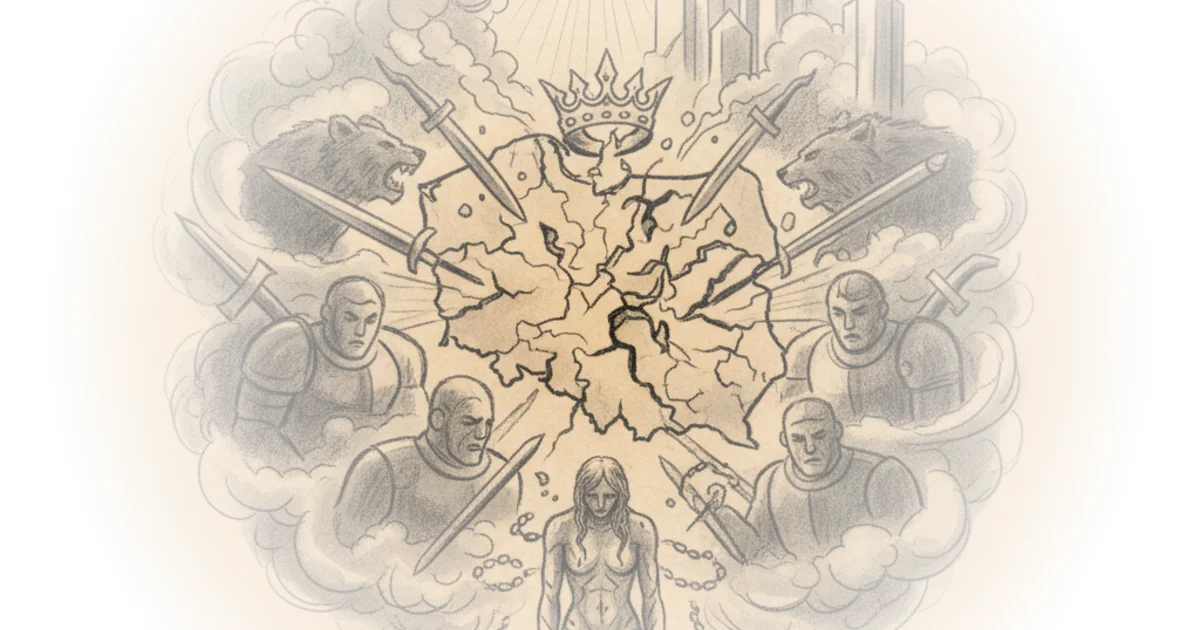
The article's title, "Europe is under siege," is not hyperbole but a historical warning. Smith invokes the 17th-century "Deluge," a period when the Polish-Lithuanian Commonwealth was destroyed by combined assaults from Russia and Sweden. "The Deluge shows that power and independence are not permanent," Smith writes. "If you are surrounded by hostile powers, and if you don't have the ability to guard yourself against those powers, no amount of historical greatness can save you from being subjugated."
This historical parallel is chillingly apt. Smith argues that Europe faces a "Ponzi empire" strategy from Russia, where conquered populations are enslaved and forced to fight their former neighbors. "If Russia conquers the rest of Ukraine, it will similarly enslave the rest of the country's population, and send them to fight against Poland, the Baltics, and Moldova." This echoes the tactics of the Tsarist empire and the Warsaw Pact, where "enslaved Poles were forced to fight Russia's wars."
The threat is compounded by China, which Smith describes as the industrial engine keeping the Russian war machine alive. He cites reports that "Chinese components have been detected in Russian drones and missiles, often shipped via front companies disguised as suppliers of industrial cooling equipment." The scale of this support is staggering: "In August 2025 alone, China exported a record 328,000 miles of fiber-optic cable and nearly $50 million worth of lithium-ion batteries to Russia."
Smith highlights that this is not just about military hardware but about a coordinated effort to deindustrialize Europe economically. He points to Germany, once the continent's economic anchor, as the primary casualty. "Germany's trade deficit with China stood at €66bn ($76bn); this year it could widen to over €85bn, around 2% of GDP." The consequence is a potential collapse of the European manufacturing base. "China is not just dumping exports and subsidising its companies, it is also out-competing and out-innovating big European industries, including carmaking."
China is supporting Russia's war against Ukraine, and will likely support Russia in any further wars it undertakes against the rest of Europe.
The convergence of Russian military aggression and Chinese economic warfare creates a pincer movement that Europe is ill-equipped to handle alone. Smith notes that "China's new economic strategy — a combination of shutting out European products, sending out a massive wave of subsidized exports, and putting export controls on rare earths — threatens to forcibly deindustrialize Europe." This is a threat that goes beyond GDP; it strikes at the heart of European sovereignty and the ability to defend itself.
The Bottom Line
Noah Smith's analysis is a sobering reminder that the era of automatic American protection is over, replaced by a reality where cultural grievances drive foreign policy and great power competition is existential. The argument's greatest strength is its refusal to sugarcoat the ideological rift between Washington and Brussels, but its vulnerability lies in assuming that European political will can match the scale of the threat without a fundamental rearmament and economic restructuring that may be politically impossible to achieve. The reader must watch for whether Europe can forge a unified defense strategy before the "Deluge" becomes a reality.