Sarah Orman dismantles the comforting myth of Austin as a quirky, race-free utopia by revealing how its most cherished local traditions—from the name of its river to a childhood tug-of-war—masked deep-seated segregation. This is not a nostalgic travelogue; it is a forensic examination of how white liberals curate their own history to avoid confronting the reality of racial homogeneity. Orman argues that the city's obsession with being "weird" served as a shield, allowing residents to ignore the systematic exclusion of Black and Brown communities while celebrating a superficial diversity of lifestyle choices.
The River That Wasn't a Lake
Orman begins by deconstructing the geography of her hometown, noting that the body of water dividing the city is technically a dammed river, yet locals insist on calling it a lake. "Perhaps we call it a lake to shield our local water from the inferiority complex that might result from being compared to its bigger riparian cousin," she writes. This linguistic sleight of hand, she suggests, is symptomatic of a broader Texas refusal to acknowledge anything as "smaller" or less significant than its neighbors. The argument holds weight because it connects a trivial naming convention to a psychological need for superiority that permeates the city's identity.
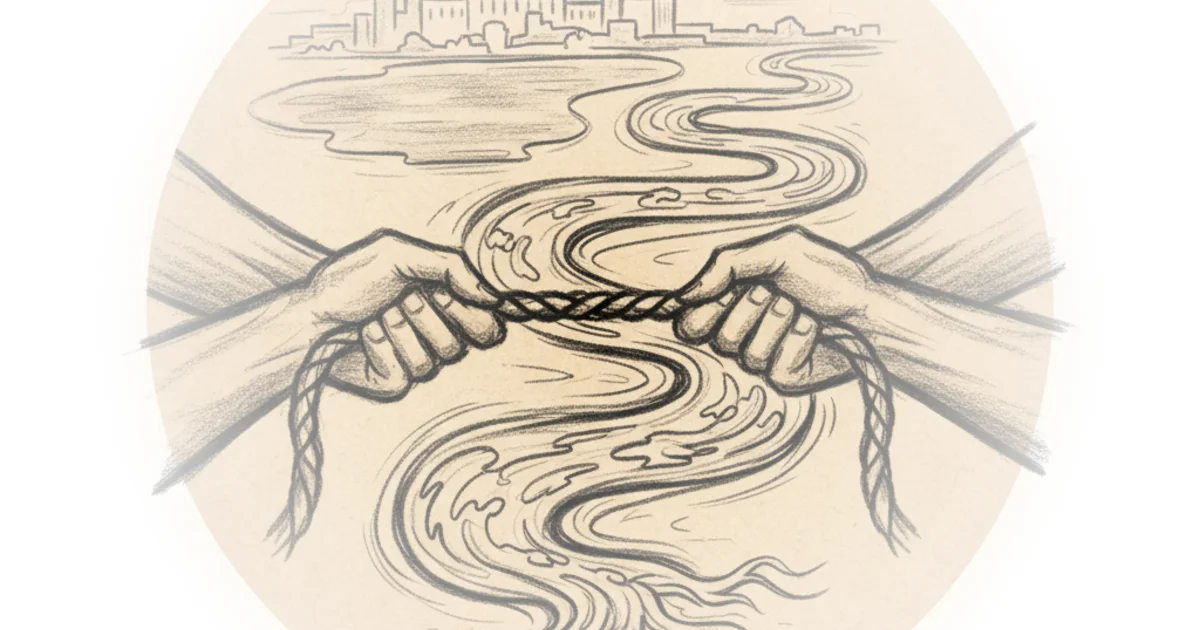
The author then pivots to a specific childhood memory: the "Great North vs. South Austin Tug-of-War," a fundraiser that pitted "Yuppies" against "Bubbas." Orman recalls the stark visual contrast: "On the north shore, the Yuppies ate quiche, drank chardonnay, and braved the river mud in their white Keds, khaki shorts, and tucked-in Izods, while the Bubbas on the south side drank Lone Star and ate hot dogs and BBQ in their cutoff jeans and muscle shirts." While this event seemed to celebrate class differences, Orman now sees it as a distraction. The rivalry between these two white subcultures created a false sense of diversity, masking the fact that the city was racially monolithic. Critics might argue that focusing on a single, decades-old event oversimplifies the complex history of Austin's development, but Orman uses it effectively as a metaphor for a city that preferred to fight over quiche rather than confront race.
Around here, it is often said that you fall in love with the version of Austin that you first knew. But what if that version was a lie?
The Myth of the Race-Free Vacuum
The core of Orman's critique targets the "supposed race-free vacuum" created by well-meaning white parents. She draws on sociological studies to illustrate how avoiding conversations about race actually empowers children to construct their own, often abhorrent, conclusions. "In this supposed race-free vacuum being created by parents, kids were left to improvise their own conclusions—many of which would be abhorrent to their parents," she notes, citing a study summarized in Newsweek. This observation is particularly potent because it shifts the blame from overt racism to the silence of the liberal elite. Orman admits her own complicity, recounting how she once told a Jewish classmate she must be mistaken about her identity because her encyclopedia only showed Jews in Israel.
This personal confession grounds the sociological argument, making the abstract tangible. Orman explains that she only began to see the city's true demographic reality after converting to Judaism and raising Jewish children in a system where their identity separated them from the dominant norm. "I didn't want my children to grow up with the same myth about Austin, and in a certain way, they couldn't grow up with that myth because their identity separates them from the norm," she writes. The strength of this section lies in its vulnerability; it challenges the reader to consider how their own "colorblind" upbringing might have blinded them to the realities of others.
Literature as a Mirror
To bridge the gap between her personal awakening and the broader cultural narrative, Orman turns to Lucas Schaefer's debut novel, The Slip. She argues that this book succeeds where Austin's self-mythology fails by presenting an "ensemble cast of characters navigating racial, religious, sexual and gender identities." Orman highlights a scene where a white teenager, Nathaniel, feels intimidated by his Black boss, David, noting that Nathaniel "pretty sure this thought wasn't racist" despite his internalized stereotypes about Black coolness. This moment captures the insidious nature of casual prejudice that Orman feels Austin often ignores.
Furthermore, Orman praises Schaefer for exposing the hypocrisy of the city's liberal elite. She quotes the novel's depiction of a nursing home where "Austin's moneyed liberals hid their most embarrassing relations: Red Scared grand-thises and sodomy-fixated great-thats." This passage, according to Orman, lays bare the "cloying forms of white supremacy" that persist beneath the surface of progressive politics. The argument is compelling because it refuses to let the reader off the hook; it suggests that the "weirdness" of Austin is often just a performance that hides deep-seated intolerance.
Schaefer takes on a dizzying array of perspectives in this book, including, in one of my favorite chapters, the well-meaning Jewish mothers who want to talk about race.
Bottom Line
Sarah Orman's commentary is a necessary corrective to Austin's self-congratulatory narrative, effectively using personal memoir and literary analysis to expose the city's racial blind spots. While some might argue that focusing on the 1990s and early 2000s misses the rapid demographic shifts of the present day, the piece's enduring value lies in its diagnosis of the mechanism of denial rather than just the statistics of exclusion. The strongest takeaway is that a city cannot claim to be diverse if its history is curated to hide the people who were never invited to the tug-of-war.