What Infinity Actually Is — And Why Mathematicians Still Can't Agree
For two millennia, the greatest minds in Western civilization agreed on one thing about infinity: it was something you could approach but never hold. Then Georg Cantor came along, treated the infinite as a finished object you could put under a microscope, and got called a corrupter of youth for his trouble. Curt Jaimungal's piece walks readers through that intellectual insurrection — and the unsettling consequences that followed.
Potential vs. Actual: The Heresy
The distinction Jaimungal draws is sharper than most people realize. A potential infinity is a process — you count 1, 2, 3, and you never stop. At no point do you possess "all the natural numbers" as a single thing you can examine. An actual infinity says: that collection exists, right now. You can compare it to other collections. You can ask how big it is.
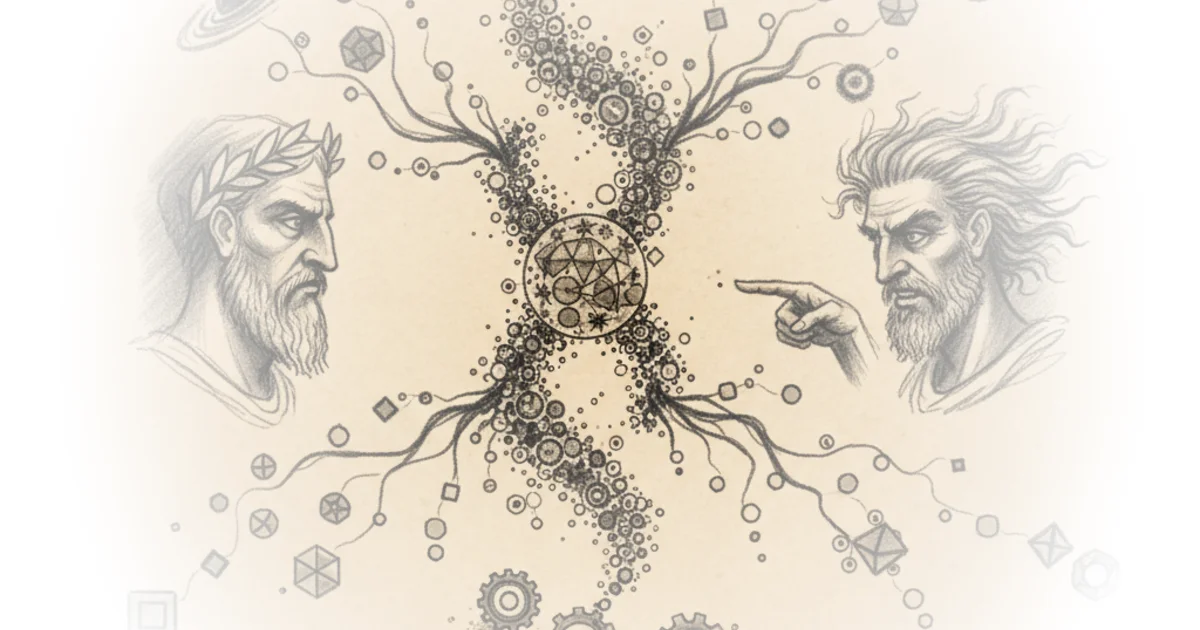
Curt Jaimungal writes, "Cantor's great heresy was insisting on the latter, and then doing some math with it."
The early resistance was visceral. Leopold Kronecker called Cantor a corrupter of youth. Henri Poincaré described his work as a disease. Cantor died in a sanatorium. The emotional violence of that reception tells you something: this wasn't a polite disagreement about notation. It was a fight over what mathematics is allowed to talk about.
All Countable Infinities Are Secretly the Same Size
Here's where things get strange. Cantor's first discovery was that there are just as many even numbers as there are natural numbers. Pair 1 with 2, 2 with 4, 3 with 6 — nothing is left over on either side. The same trick works for integers. It works for rational numbers, which seems absurd since rationals are dense — between any two of them, there's always another.
As Curt Jaimungal puts it, "Two sets are of the same 'size' if you can pair them up exactly."
That pairing — a bijection — becomes the definition of size when you're dealing with infinite collections. And once you accept it, every countably infinite set collapses into the same cardinality. Cantor stopped using the infinity symbol (too vague) and named this size aleph-null, written ℵ₀. It was the first aleph number in what would become an entire hierarchy of infinities.
"Something is infinite if you can take a finite amount away from it and it doesn't change size."
Jaimungal calls this the defining property of infinity, and it is genuinely elegant. It's the kind of definition that makes you pause and reconsider what you thought the word meant.
The Real Numbers Break the Pattern
Not every infinity is countable. Cantor proved this with his famous diagonal argument — a proof by contradiction so compact it fits on a napkin. Suppose you've listed every real number between 0 and 1. Now construct a new number that differs from the first entry in its first decimal place, from the second entry in its second decimal place, and so on. The new number cannot appear anywhere on your list. Your list was never complete.
Curt Jaimungal writes, "The cardinality of the reals is written 2 to the power of ℵ₀. It's quite wonky."
The notation looks arbitrary but isn't. Each real number, written in binary, is an infinite sequence of 0s and 1s. The collection of all such sequences has cardinality 2^ℵ₀. The base doesn't matter — 2^ℵ₀ equals 3^ℵ₀ equals 7^ℵ₀. Any finite alphabet produces the same size infinity when you allow infinitely long strings.
Even more disturbing: the real line has exactly as many points as the complex plane. The plane has as many points as a hundred-dimensional space. Dimension — the thing geometric intuition says must matter — is completely invisible to cardinality. Cantor himself wrote to his colleague Richard Dedekind: "I see it, but I don't believe it."
Two Machines for Manufacturing Bigger Infinities
Once you've established that not all infinities are equal, the question becomes: how do you make bigger ones? Jaimungal identifies exactly two mechanisms.
Machine one is the power set. For any set, form the set of all its subsets. Cantor proved that this new set is always strictly larger than the original. Apply it repeatedly to the natural numbers and you get an endless tower: 2^ℵ₀, then 2 raised to 2^ℵ₀, and so on. You never run out.
Machine two is the successor cardinal. Define aleph-one as the smallest cardinality strictly greater than aleph-null. Then aleph-two as the next one after that. The aleph hierarchy stretches upward forever.
Critics might note that "smallest cardinality strictly greater than" sounds circular when you're already working in the infinite domain. Jaimungal addresses this with Hartogs' theorem, which explicitly constructs an ordinal that cannot be injected into the natural numbers — no leap of faith required. The next infinity isn't assumed. It's built.
There's a useful distinction here between ordinals and cardinals that Jaimungal spells out clearly. Ordinals describe arrangement — a specific ordering where every element has a definite successor. Cardinals describe pure size, a headcount. Many different ordinals can share the same cardinality, the way many different seating arrangements can fill the same number of seats.
The Continuum Hypothesis: Where the Machines Disagree
The obvious question is whether these two machines produce the same output at the first step. Is 2^ℵ₀ equal to ℵ₁? This is the continuum hypothesis — the first problem on David Hilbert's famous 1900 list of unsolved mathematical problems.
Kurt Gödel showed in 1931 that you cannot disprove the continuum hypothesis from the standard axioms of set theory. Paul Cohen showed in 1963 that you cannot prove it either. The statement is independent of the axioms. Neither true nor false within the system. You can choose to accept it or reject it, and either choice is consistent.
Curt Jaimungal writes, "How wild it is that there exist statements that are 'independent.' This is worth a post of its own."
He's right. The existence of independent statements means there are mathematical truths the standard axioms simply cannot reach. It's the mathematical equivalent of discovering that your map has blank patches — not because the territory doesn't exist, but because the projection you chose can't represent it.
The Finitist Pushback
Not everyone accepts any of this. Finitists reject actual infinity entirely. To them, aleph-null isn't a mathematical object — it's a useful fiction at best, and at worst a symbol pointing at nothing. A more extreme position, ultrafinitism, goes further: even very large finite numbers like 10 raised to 10 raised to 10 are suspect, because no physical process could ever instantiate them.
As Curt Jaimungal puts it, asking an ultrafinitist "what is 2 to the power of ℵ₀?" is like asking "what's orange about the jumping?" — a question of nonsense.
Most working mathematicians find infinity indispensable. Hugh Woodin, one of the most important living set theorists, has spent decades arguing that the continuum hypothesis does have a definite answer — it's just that the standard axioms of set theory (formally known as Zermelo-Fraenkel set theory with the axiom of choice, or ZFC) are too weak to detect it. His position is that stronger axioms, so-called large cardinal axioms, can settle the question.
The debate is alive. Critics might note that a disagreement this fundamental — not about whether a proof is valid, but about whether the objects the proof discusses exist — suggests the foundations of mathematics are less settled than most people assume. That's either exciting or unsettling, depending on whether you trust the ground beneath your feet.
The Paradox of Finite Reasoning About Infinite Objects
What makes Jaimungal's piece especially effective is his closing observation: every construction here is a specific, finite, checkable procedure. Cantor's diagonal argument fits on a napkin. Hartogs' construction is an explicit recipe. Cohen's forcing method is a technique you can sit down and execute. The objects being discussed are infinite, but the reasoning about them is entirely finite. Even mechanical.
Curt Jaimungal writes, "Infinity is where the abstract and concrete meet."
That's the real achievement. Not the infinity itself — the scaffolding we build to reach it.
Bottom Line
Cantor was right that there are different sizes of infinity, and the mathematics he invented to prove it remains one of the most elegant constructions in human thought. But the continuum hypothesis remains unresolvable within standard axioms, which means the question of exactly how many sizes of infinity exist is still, after more than a century, a matter of philosophical choice rather than mathematical proof.