Mick Ryan delivers a stark reminder that the war in Ukraine is not a static stalemate but a rapidly evolving contest of adaptation, where the human cost of strategic decisions is measured in blackouts and burning cities. While the geopolitical chessboard shifts with new sanctions and aircraft deals, Ryan anchors the week's chaos in the grim reality of Russian aerial assaults designed to break the spirit of the civilian population. This is not merely a report on weapons; it is a forensic look at how the executive branch's policy pivots ripple through the trenches and the power grid.
The Human Cost of Strategic Whiplash
Ryan opens with a visceral image of a warehouse burning in Kyiv, immediately grounding the high-level diplomatic maneuvering in the suffering of the Ukrainian people. He quotes General Budanov, who notes that "in their opinion, these attacks have an impact on socially vulnerable segments of the Ukrainian population." This framing is crucial; it refuses to let the reader view the destruction of infrastructure as an abstract military objective. Instead, it highlights a deliberate strategy to target the most defenseless.
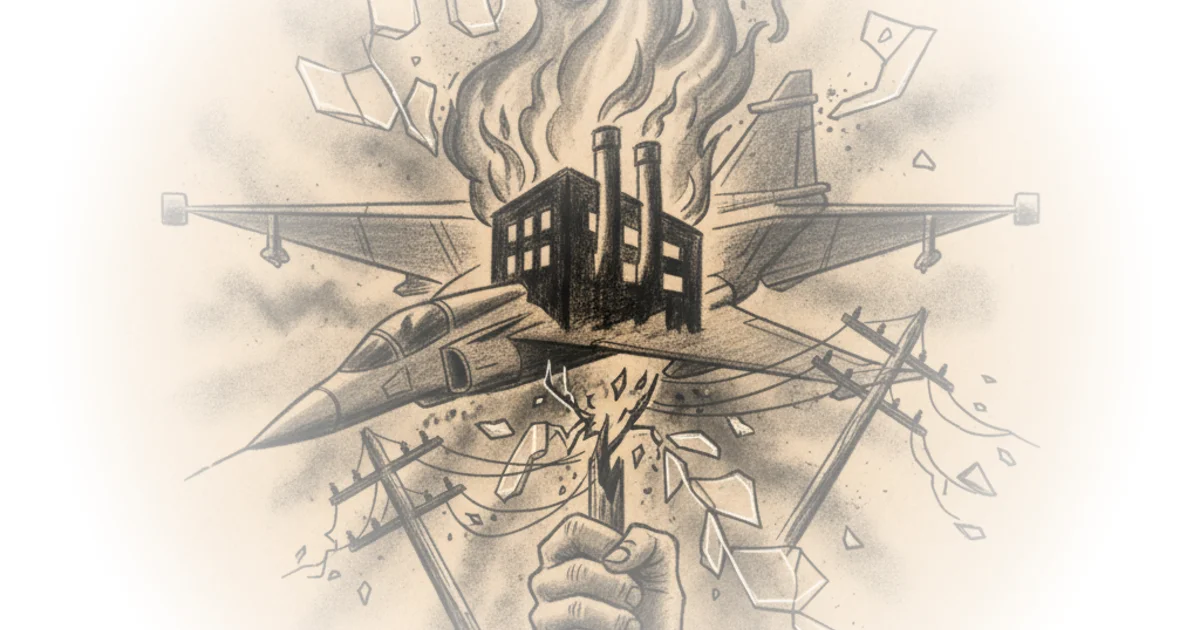
The author describes the week as one of "strategic whiplash," noting how the administration announced new sanctions on Russian energy while simultaneously removing restrictions on long-range missile strikes. Ryan writes, "Every time I speak to Vladimir, I have good conversations and then they don't go anywhere," quoting the President's frustration with the lack of progress in negotiations. This quote reveals a transactional view of diplomacy that contrasts sharply with the escalating violence on the ground. While the administration frames these moves as pressure tactics, the result is a cycle of escalation where Russian retaliation becomes more severe.
Critics might argue that focusing on the delay of a potential summit distracts from the tangible military aid being delivered. However, Ryan's inclusion of the summit delay serves to illustrate the volatility of the current diplomatic landscape, where personal rapport between leaders is treated as a primary variable in statecraft.
"Russia is a self-respecting country. [The sanctions are] serious for us and will have certain consequences. But they will not significantly impact our economic well-being."
This quote from Putin, cited by Ryan, underscores the resilience of the Russian war machine despite Western pressure. Ryan's analysis suggests that while sanctions are "serious," the Kremlin has successfully insulated its core economy, forcing the West to consider more direct military interventions. The author notes that the authority for strikes deep inside Russia has shifted from the Pentagon to the Supreme Allied Commander Europe (SACEUR), a move Ryan speculates might indicate "displeasure with anyone in the Pentagon." This bureaucratic reshuffling, while seemingly internal, has profound implications for the speed and scope of the war.
The Logistics of Air Power and the Transition Trap
The piece takes a sobering look at Ukraine's acquisition of Swedish Gripen fighters. Ryan reports that President Zelenskyy signed an agreement to purchase over 100 aircraft, with the first expected in 2026. Zelenskyy is quoted calling them "great aircraft, strong aviation platforms capable of performing a wide range of missions." Yet, Ryan immediately tempers this optimism with logistical reality. He argues that the transition from Soviet-era hardware to a mix of American F-16s, French Mirages, and Swedish Gripens creates a "steep hill to climb" for Ukrainian forces.
The author points out that while the aircraft are capable, the timeline is uncertain and the maintenance burden is immense. This is a critical insight often missed in headlines celebrating new deliveries. Ryan writes, "The Ukrainian's are clever and resourceful, but this will be a steep hill to climb," emphasizing that the introduction of new technology does not guarantee immediate combat superiority. A counterargument worth considering is that the mere presence of these advanced systems could deter Russian air operations, even before they are fully operational. However, Ryan's focus on the complexity of integrating disparate Western systems highlights the long-term challenges of modernization.
The Pacific Front: Purges and Posturing
Shifting focus to the Indo-Pacific, Ryan details a series of aggressive moves by China and a corresponding hardening of defenses by Japan and Australia. He notes that the Chinese Communist Party has purged nine senior generals, including commanders of the Rocket Force and the Eastern Theatre Command. Ryan observes that the "apparent crime of all these PLA officers was to undermine the authority of President Xi." He questions the impact of these purges on warfighting capabilities, suggesting that while military organizations are designed to replace leaders, the "chilling effect" on innovation and risk-taking is the real danger.
This analysis is particularly astute. By focusing on the internal culture of the Chinese military rather than just the number of troops, Ryan identifies a potential vulnerability in the PLA's modernization efforts. He writes, "I think the real impact is the chilling effect it could have on the remainder of the institution, and the willingness of other military officers to innovate, take risk or in any way question CCP dogma." This reframes the purges not as a sign of strength, but as a symptom of systemic fragility.
Meanwhile, Japan has accelerated its defense spending plans, aiming to reach 2% of GDP by 2025, two years ahead of schedule. Ryan quotes Chief Cabinet Secretary Minoru Kihara, who stated that boosting intelligence capabilities is a "pressing issue" given the "harshest and most complicated security environment since the end of World War II." This declaration signals a fundamental shift in Japan's post-war security posture, driven by the perceived threat from both Russia and China.
The Illusion of Stability
The commentary concludes with a sharp critique of the notion that the threat to Taiwan is diminishing. Ryan highlights comments from the President, who stated, "China doesn't want to do that. I don't see that at all with President Xi." Ryan challenges this assessment directly, asking, "Given Trump's tendency to admire authoritarians, and his continuous misjudgment about Russia's president over the war in Ukraine, is the government of Taiwan likely to bet the survival of its vibrant and prosperous democracy on such comments? Unlikely."
This section serves as a vital corrective to the optimism of the summit delay and the new trade deals. Ryan's argument is that relying on the personal assurances of an authoritarian leader is a dangerous gamble for a democracy facing an existential threat. The author's tone here is one of urgent caution, urging readers to look past the diplomatic pleasantries and focus on the hardening of military postures in the region.
"It's too easy to push it out of our minds. It's too easy to ignore it because it feels abstract. But it's a calamity that could unfold at any moment."
Ryan ends his week's update by recommending the film A House of Dynamite, quoting the scriptwriter Noah Oppenheimer on the ease of ignoring the nuclear threat. This recommendation is not merely a cultural aside; it is a thematic bookend to the week's events, reminding the reader that the strategic games being played by the administration and foreign powers carry the potential for catastrophic, irreversible consequences.
Bottom Line
Ryan's strongest contribution this week is his refusal to separate the high-level diplomatic maneuvering from the brutal reality of civilian suffering and the logistical nightmares of military modernization. The piece's greatest vulnerability lies in its heavy reliance on the President's personal diplomatic style as a primary driver of events, which may obscure deeper structural shifts in global power. Readers should watch for the tangible impact of the new missile authorization rules and the actual timeline for the Gripen deliveries, as these will determine whether the West's strategy is one of genuine deterrence or merely symbolic pressure.