Monica Miller transforms a simple album anniversary into a profound meditation on how art anchors us during life's most disorienting fractures. Rather than offering a standard music review, she uses the thirty-ninth anniversary of R.E.M.'s Fables of the Reconstruction to dissect the visceral reality of adolescent anxiety and family collapse. This is not a nostalgia trip; it is a forensic examination of how a specific set of lyrics provided a lifeline when the map of a young life was being redrawn by forces beyond her control.
The Geography of Displacement
Miller begins by grounding the reader in the specific, suffocating atmosphere of her sixteen-year-old self. She describes a family in freefall, where her father's professional failure manifested as a sudden, zealous religious conversion that threatened to uproot them from their home in Georgia. "He had an entire shelf of Bible concordances and guidebooks he used to prepare for the one hour each week when he was the star," Miller writes, capturing the performative nature of her father's crisis. The family's eventual move to a "fading midwestern steel town" in Ohio served as a catalyst for their dissolution, leaving the author feeling like an alien in her own home.
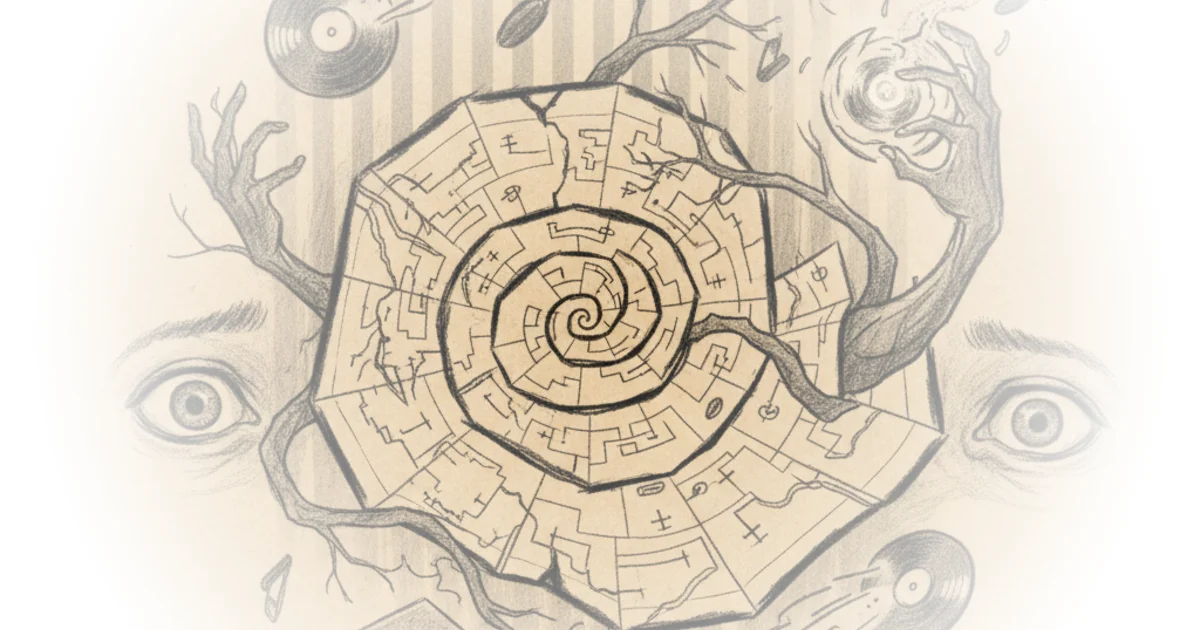
The author's framing of this period as a time of "existential illness" is particularly striking. She details the physiological toll of this displacement, noting how listening to the Twin Peaks soundtrack would trigger waves of "adrenaline-heavy nausea" and a sense of disconnection. This is not merely teenage angst; it is a description of panic attacks that she lacked the vocabulary to name at the time. Miller argues that the isolation she felt was compounded by a cultural mismatch, where the "cold, snowy winter" and the local pastimes of card-playing and bowling felt like a foreign language.
"My sense of isolation at a new school, trapped in a culturally and geographically unfamiliar region, feeling lost amid my disintegrating family structure, I felt seen and validated by the song's opening lyrics."
This connection to the music is the piece's emotional core. Miller explains that while the band's other songs spoke to her, it was the enigmatic lyrics of "Maps and Legends" that offered a specific kind of solace. The song's protagonist, described as someone who "sees what you can't see," mirrored her own feeling of being trapped in a reality that others couldn't comprehend. Critics might argue that attributing such profound healing to a pop song risks romanticizing mental health struggles, but Miller is careful to distinguish between the song as a cure and the song as a companion. She writes, "I wasn't so far gone as to think that Michael Stipe was sending a message directly to me," acknowledging the subjective nature of the connection while insisting on its power.
Decoding the Legend
The essay's central thesis revolves around the song's chorus: "Maybe these maps and legends have been misunderstood." Miller posits that this refrain became a mantra for her questioning of the foundational structures of her life—religion, politics, and the very concept of "home." As her parents' marriage crumbled, with her mother eventually leaving her father for a sixth-grade teacher, the song provided a framework for understanding that the chaos she was experiencing might not be a personal failure, but a misinterpretation of the world's rules.
Miller's analysis of the lyrics as a tool for cognitive reframing is compelling. She suggests that the song reassured her that "there might be different explanations for and ways of living in the world." This perspective allowed her to endure the "clouds of unhappiness that pervaded the entire house" without losing her grip on reality. The author's choice to focus on the "minor chord melancholy" of the album highlights how art can validate negative emotions rather than trying to fix them immediately.
"The song seemed to reassure me that there might be different explanations for and ways of living in the world–I just needed to keep looking for them."
This section effectively bridges the gap between personal memoir and cultural criticism. Miller does not shy away from the rawness of her teenage experience, describing how she would "vent to the page about how much I hated everything." By juxtaposing her hatred for her new environment with the comfort found in the music, she illustrates the dual nature of adolescence: a time of intense rejection of the present and a desperate search for a future self.
The Tether in Time
The narrative arc concludes with a powerful reunion three decades later. Miller, now a college English professor living in Georgia, attends a tribute concert in Athens. The setting—a "mythic dive bar" known as the 40 Watt Club—serves as a physical manifestation of the journey she has taken. When the band plays "Maps and Legends," the author experiences a profound moment of catharsis, weeping as she sings along to the lyrics that once saved her.
Miller describes this moment as sending a "hopeful lifeline to my sad, teenage self." She shouts back to her younger self, "Hey, hang in there! It's going to suck for a while, but you will get past it all." This is the essay's most potent argument: that art creates a continuity of self that can survive even the most traumatic disruptions. The presence of R.E.M. members Peter Buck and Mike Mills on stage adds a layer of historical weight, but the true focus remains on the internal transformation of the listener.
"I was a 48-year-old woman with a Ph.D., who'd driven myself from my happy home... As that song took me back thirty years to the anxiety and uncertainty of my Midwestern bedroom, I felt myself sending back a hopeful lifeline to my sad, teenage self."
A counterargument worth considering is whether this narrative relies too heavily on the privilege of having the resources to eventually escape the circumstances that caused the trauma. Miller acknowledges her current stability—her husband, her degree, her home—but she does not gloss over the fact that the song was a necessary survival tool during the years when she had no such safety net. The piece succeeds because it validates the struggle without promising that every listener will achieve the same happy ending, only that the art remains a constant companion.
Bottom Line
Monica Miller's essay is a masterclass in using personal narrative to illuminate the universal power of art. Its strongest asset is the unflinching honesty with which it treats the physical and emotional toll of family collapse, refusing to sanitize the memory of those "yellow-wallpapered" days of panic. The piece's vulnerability lies in its reliance on a singular, serendipitous connection between a specific song and a specific listener, yet it transcends this limitation by articulating a broader truth about how we use culture to navigate the unknown. Readers should watch for how this framework of "misunderstood maps" applies to other moments of personal and collective disorientation, where the only way forward is to trust that the legend is not broken, but merely waiting to be read correctly.