This digest from Sinification delivers a jarring pivot in how Beijing perceives its global rival: the administration in Washington is no longer seen as an existential threat, but as a fading power struggling with internal decay. While Western observers often fixate on rhetorical spikes, this collection of Chinese analysis argues that the real story is structural—the "empire's twilight" where fierce rhetoric masks profound weakness. For busy strategists tracking the next decade of great-power competition, this shift in perspective is more revealing than any single policy memo.
The Taiwan Reckoning and Strategic Patience
The piece opens by dissecting a confusing signal from Washington: recent comments suggesting that "Taiwan independence" means war. Sinification reports that Huang Jing views this as the most significant shift since 1979, effectively reversing the long-standing formula where only a mainland attack would trigger conflict. However, not everyone agrees with such a dramatic reading. Da Wei, quoted in the piece, offers a cooler assessment: "A few remarks by the US president do not mean policy immediately changes," arguing that the omission of Taiwan from recent military briefings reflects indecision rather than a strategic turn.
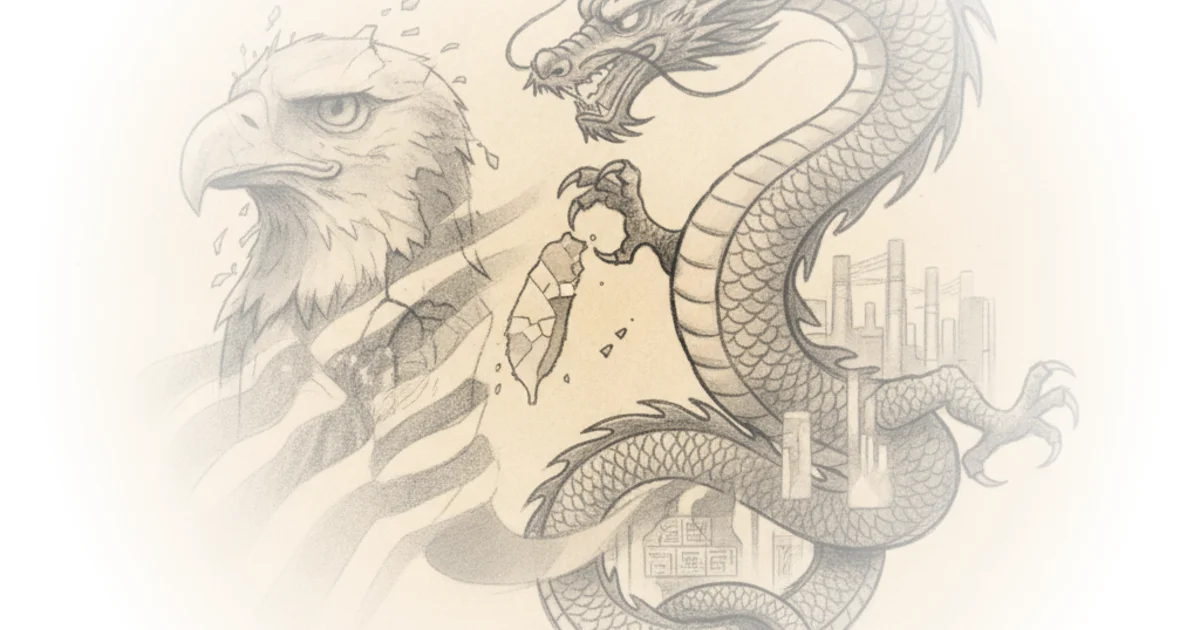
The editors note that this debate reveals a deeper consensus among Chinese analysts: time is on Beijing's side. Li Cheng argues for "strategic patience," suggesting that rushing into a new diplomatic framework would only mobilize anti-China forces. Instead, the goal is to create momentum for what Zhu Weidong calls "de facto unification without formal unification." This approach acknowledges that while the mainland holds growing advantages, the final resolution will run through the entire process of national rejuvenation. Critics might note that this confidence relies heavily on the assumption that domestic US political fractures will prevent a unified response to regional aggression, an assumption that could be tested by unexpected coalition-building in Asia.
"Trump arrived in Beijing with no cards, yet Beijing declined to exploit his weakness." — Huang Jing, quoted in Sinification
The Middle East and the Twilight of Hegemony
Shifting focus to the Middle East, the coverage treats a recent US-Iran memorandum not as a victory for Washington, but as evidence of American exhaustion. Chen Qinghong's analysis is particularly striking: "an empire's twilight—fierce of face, feeble within." The piece suggests that while the administration manages to secure a temporary pause, it lacks the capacity to enforce a lasting settlement. Zheng Yongnian reinforces this by characterizing the agreement as merely a "time-out," noting that both sides claimed victory because neither could afford to look defeated.
This framing connects back to broader historical anxieties about overextension. Much like the strategic calculations surrounding the Taiwan Relations Act, where Washington's commitment is weighed against its own domestic stability, the Middle East analysis suggests the US can no longer project power without significant friction. The editors point out that while AI-era warfare was tested in this conflict, the real lesson for Beijing was observing the limits of American force when faced with asymmetric resistance.
Europe as the New Strategic Front
Perhaps the most surprising pivot in the text is the identification of Europe—not Washington—as the immediate economic-strategic worry. The piece argues that European debates on trade are increasingly mirroring the US stance from a decade ago, warning that a "tipping point into strategic competition may be approaching." Huang Yiping expresses deep concern about a potential "China Shock 2.0," showing unusual sympathy for European fears regarding their high-welfare models.
This section highlights a critical vulnerability in China's own economic model: weak domestic demand. Shen Jianguang identifies this as the fault line beneath China's "three strongs and three weaks," while Jiang Xiaojuan warns that an AI transition could destroy jobs faster than it creates them. The analysis suggests that if Europe turns protectionist, Beijing cannot simply rely on exporting its way out of internal imbalances. A counterargument worth considering is whether European fragmentation will prevent a unified front against Chinese trade practices, potentially allowing Beijing to exploit divisions much as the US did in previous decades.
Exporting Power and the "Going Out" Strategy
The digest details a new regulatory cluster triggered by State Council Order 837, which takes effect on July 1. Liu Jia explains that this regulation elevates two decades of departmental rules into law, adding teeth to China's outbound investment strategy. Under Articles 24–25, foreign entities discriminating against Chinese investors can be blacklisted and denied entry or residence.
This marks a shift from passive investment to active capability export. Li Wei argues that firms are now "exporting entire capability systems rather than mere products," while Liu Xiaochun suggests state support should extend as far as military means in special circumstances. This aggressive posture is framed against the backdrop of resource vulnerabilities; Sun Zhi and Zheng Hua candidly admit that China's rare-earth dominance coexists with a real dependence on Southeast Asian supply. The piece notes that Washington's push for "de-Sinicisation" in Central Asia may not displace China but will raise costs and squeeze its position.
"The US-China G2 renders middle powers' technological sovereignty illusory." — Huang Ping, quoted in Sinification
Bottom Line
Sinification's most compelling argument is that the administration's perceived weakness has emboldened Beijing to shift from defensive anxiety to offensive strategic confidence, particularly regarding Taiwan and outbound investment. However, the piece's greatest vulnerability lies in its underestimation of how internal social fractures—over-competition, demographic decline, and weak demand—could constrain this newfound assertiveness before it achieves its geopolitical goals.