This piece dismantles one of science's most cherished origin stories, arguing that the "happy accident" of penicillin's discovery is likely a fabrication. Asimov Press doesn't just question the timeline; they deploy hard biology to prove that the famous story of a moldy petri dish left on a bench is scientifically impossible. For a generation raised on the myth of the lone genius stumbling upon greatness, this is a necessary, if unsettling, correction.
The Biology of the Lie
The core of the argument rests on a fundamental biological constraint that the popular narrative ignores. Asimov Press writes, "Penicillin only works if it's present before the staphylococci. Fleming did not know it at the time, but penicillin interferes with bacterial cell wall synthesis, which only happens when bacteria are actively growing." This is the crux of the issue: visible colonies are composed of mature or dead cells that are no longer dividing. If the bacteria are already grown, the drug cannot kill them.
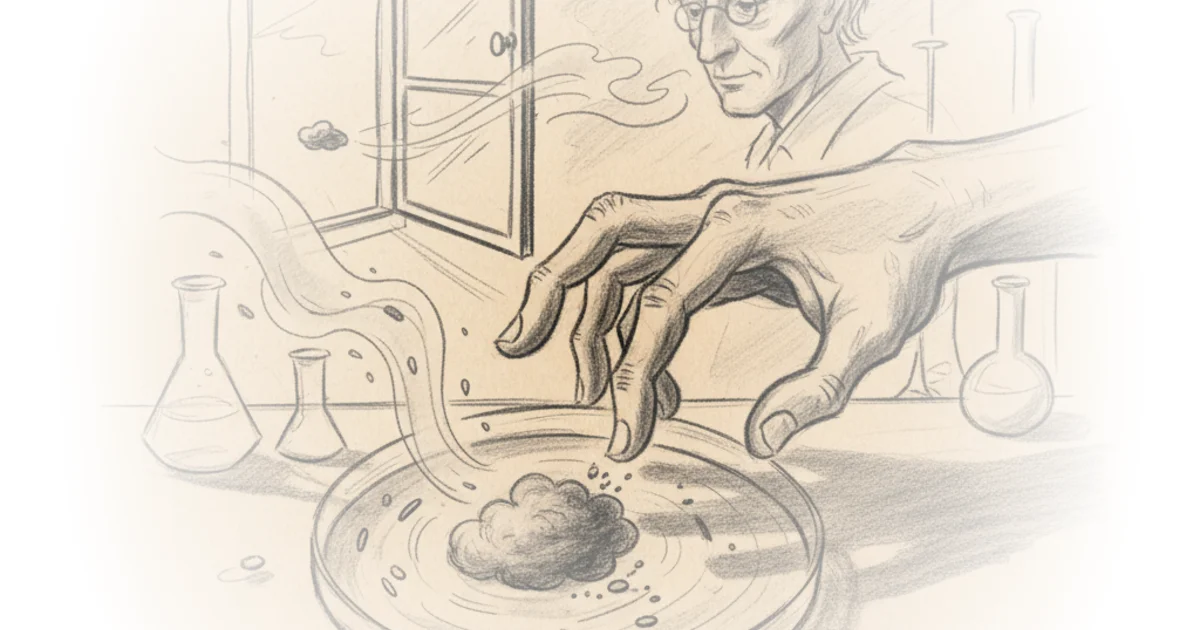
The author highlights that the "ring of death" Fleming described around a mold colony on a plate full of bacteria defies the known mechanics of how the drug functions. Asimov Press notes, "Visible colonies, however, are composed mostly of mature or dead cells. By the time a colony can be seen, it is often too late for penicillin to have any effect." This reframes the entire discovery not as a moment of observation, but as a moment of impossible physics.
Penicillin does not dissolve fully grown colonies, as Fleming had initially assumed, but inhibits their growth from the start.
The piece draws a sharp parallel to Fleming's earlier work on lysozyme, another antibacterial substance discovered via "lucky contamination from an open window." Asimov Press points out that the story is "strikingly similar" to the lysozyme discovery, suggesting a pattern of narrative construction rather than a unique historical event. This connection to the history of lysozyme adds a layer of psychological context: Fleming may have been retelling a familiar story of serendipity rather than recounting a specific, chaotic event.
Critics might argue that biological mechanisms can be complex and that exceptions to the rule of cell wall synthesis could exist in rare environmental conditions. However, the sheer volume of failed replication attempts by other scientists over decades suggests the rule is robust, not the exception.
The Missing Record
The investigation moves from the petri dish to the paper trail, revealing a gaping hole in the historical record. Asimov Press observes, "There are no contemporary records to corroborate the story that Fleming discovered the contaminated culture plate when he returned from holiday on September 3 rd: no lab notebook records, calendar notes, diary entries, or any letters." The first entry in Fleming's notebook appears nearly two months later, on October 30th, describing a deliberate experiment where the mold was grown first, followed by the bacteria.
This discrepancy is not merely a clerical error; it suggests a deliberate reconstruction of events. Asimov Press writes, "In the 1929 paper, the figure is simply labeled, 'Photograph of a culture-plate.' The only evidence we have stems from recollections by Fleming and colleagues years later, after penicillin was recognized as a runaway clinical success." The timing is suspicious. The story solidified only after the drug became a global hero, turning a messy lab reality into a clean, marketable myth.
The author highlights that even the famous photograph of the "original" plate shows a setup that looks more like a controlled experiment than a chaotic accident. The mold is large and central, surrounded by a perfect zone of inhibition. Asimov Press notes, "No trained scientist would intentionally use a culture plate visibly contaminated with a large mold — and certainly not an expert bacteriologist like Fleming." Yet, the photo looks exactly like the result of a deliberate test where the mold was allowed to establish itself before the bacteria were introduced.
The Mechanism of Action
To understand why the story is a myth, one must understand the mechanism of the drug. The piece provides a vivid explanation of the bacterial cell wall, describing it as a "rigid, mesh-like structure composed primarily of peptidoglycan." When bacteria divide, they must constantly rebuild this wall. Penicillin acts as a Trojan horse, binding to the enzymes responsible for this construction and stopping the process.
Asimov Press explains, "As it grows, the cell continues to disassemble its cell wall, but without the use of its transpeptidases, it can no longer rebuild it. Over time, the cell wall weakens and eventually bursts." This biological reality means that for penicillin to work, the bacteria must be in the active phase of growth. A plate with a fully formed colony of staphylococci is a graveyard of sorts for the drug's effectiveness. The mold would have to grow around the bacteria, or the bacteria would have to be introduced after the mold, to see the effect.
The piece references the work of bacteriologist J.P. Duguid in 1946, who noted that "the morphological changes... suggest that penicillin in these concentrations interferes specifically with the formation of the outer supporting cell wall." This scientific detail, often glossed over in popular retellings, is the smoking gun that invalidates the "accident" narrative. The drug doesn't eat existing colonies; it prevents them from forming.
The historical and scientific data are limited and often contradictory. Nevertheless, several scientists and historians have worked hard to piece together what facts are certain and fill the gaps with their most probable guesses.
The Human Cost of the Myth
Why does this distinction matter? It matters because it shifts the credit from a single "absent-minded professor" to the collaborative, rigorous work that actually made the drug usable. The piece notes that it took pharmacologist Howard Florey and biochemist Ernst Chain at Oxford, alongside a USDA lab in Peoria, Illinois, to turn the "mould juice" into a life-saving drug. Asimov Press writes, "For years, scientists have attempted to replicate Fleming's original discovery. All have met with failure." The myth of the accident obscures the decades of difficult, systematic research required to isolate, purify, and mass-produce the antibiotic.
The narrative of serendipity is comforting, but it is also dangerous. It implies that great scientific breakthroughs are random gifts rather than the result of sustained inquiry. Asimov Press concludes that "science is about evaluating evidence and moving closer to the 'truth.'" By clinging to the myth, we risk undervaluing the methodical, often unglamorous work that actually saves lives.
Bottom Line
Asimov Press delivers a compelling, evidence-based takedown of a scientific fairy tale, using the very biology of penicillin to prove the story cannot be true. The argument's strength lies in its refusal to accept the convenient narrative in the face of contradictory data, forcing a re-evaluation of how we celebrate scientific discovery. The biggest vulnerability is the lack of a definitive alternative "true" story, leaving us with a gap in the historical record that may never be fully filled, but the exposure of the myth itself is a victory for scientific integrity.