Greta Rainbow of The Walrus delivers a startling diagnosis for the current literary boom: the "cozy" books flooding our shelves are not an escape from the digital age, but its most sophisticated mimicry. While the genre promises a return to quiet and depth, the piece argues it actually replicates the hypnotic, frictionless passivity of scrolling through a feed, offering a "virtuous" wrapper for the same dopamine hit found on social media. This is a crucial intervention for anyone trying to reclaim their attention, suggesting that the solution to digital addiction might not be a paperback, but a fundamental shift in how we consume stories.
The Illusion of Antidote
Rainbow begins by dismantling the premise that cozy lit is a cure for our screen addiction. She describes the modern reader's cycle: feeling bad about time wasted on a phone, switching to a laptop for heavy news, and then retreating back to the phone for relief. Into this void steps a genre imported from Japan and Korea that prioritizes "feeling over meaning, setting over structure, and texture over depth." The Walrus writes, "I'm not convinced they're antidotes to the internet so much as replication of its hypnotic passivity. They are more akin to digital content than we know."
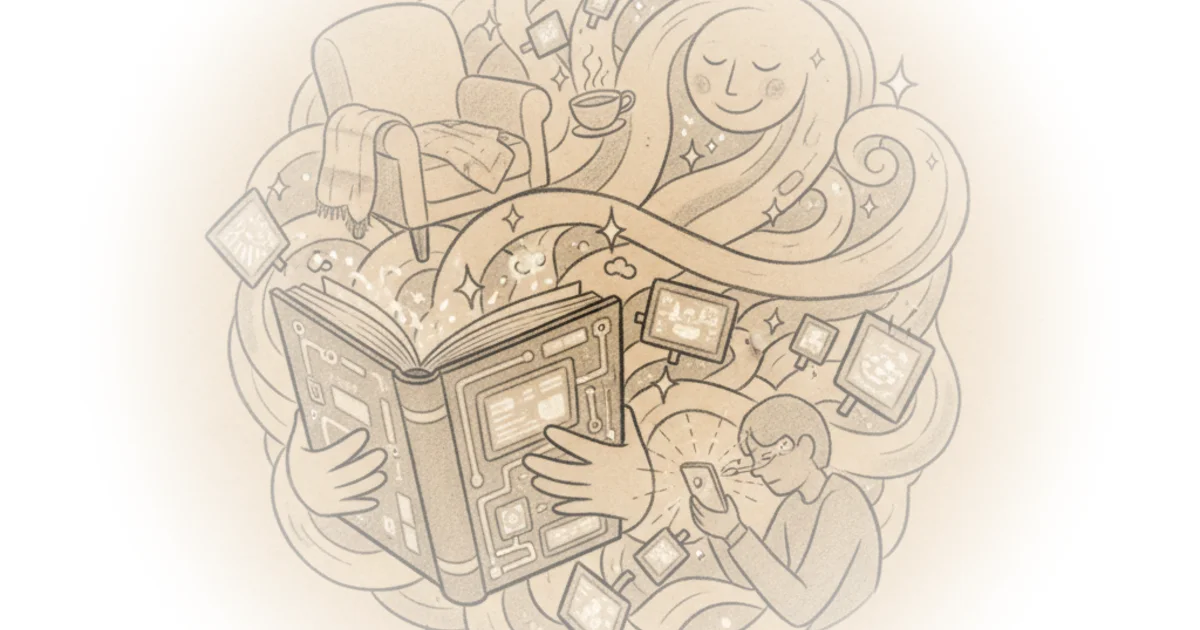
This framing is sharp because it challenges the cultural assumption that reading is inherently restorative. Rainbow points out that these stories are formulaic, filled with specific tropes like cats, tea, and rain, designed to be "episodic, formulaic, reliably satisfying." The argument holds weight when she notes that the genre's absorption by Western publishing is essentially a new frontier of "chick lit," co-opted to say nothing while appearing profound. Critics might argue that the comfort these books provide is genuine and that the demand for low-stakes narratives is a rational response to a chaotic world, but Rainbow insists the mechanism of consumption remains the same as doom-scrolling.
Cozy lit offers the image of a still life but basically feels like scrolling.
The Fetishization of the Foreign
The piece takes a critical turn by examining how Western audiences consume these Eastern narratives. Rainbow observes that the cozy genre is inextricable from a "digitally mediated experience of interacting with Asia from afar," where the textures of a Japanese convenience store feel like magic to the voyeur. She notes that while Japanese authors often craft moments of quiet reflection with open-ended conclusions, the Western reception transforms them into instant gratification. As The Walrus puts it, "what Japanese and Korean authors craft as moments of quiet reflection are consumed in the West as instant gratification."
Rainbow highlights a specific tension in translation and reception. She cites translator Ginny Tapley Takemori, who notes that Japanese novels often lack satisfying conclusions, leaving the reader to think for themselves. "Often Japanese novels don't have a satisfying conclusion. They're left much more open-ended... But it's actually fascinating that they're not telling me what to think. Instead, I have to think about it. That's much more like life," Takemori explains. However, the Anglo world has stripped away this ambiguity, adding sex and clear resolutions to create a product that fits the algorithmic demand for closure. This is not cross-cultural exchange; it is a "smart and cynical co-optation" where gentleness becomes a lifestyle product.
The Western Spin and the Shame Economy
When the genre migrated to the West, it mutated. Rainbow details how Anglo authors added explicit romance to the formula, riding the tidal wave of romance book sales which have doubled in recent years. She points to Laurie Gilmore's The Pumpkin Spice Café as a prime example of a book that functions like social media: "Short and digestible chapters, pleasingly pretty faces, a steady drip of serotonin disguised as sincerity." The Walrus argues that reading these books is a "near-equivalent experience to being on social media," yet it escapes the shame associated with digital waste because reading remains culturally coded as virtuous.
This distinction is vital. Rainbow quotes book scout Nina Reljić, who explains that the mainstream reader is now embracing "our most typically shameful curiosities and desires" without the literary world's usual judgment. "In the literary world, there's so much shame. It's what keeps us all very cool. That is the antithesis of the commercial romance ethos, which is just like, 'This is hot. This makes you feel good. This turns you on. And this makes me [the author] a lot of money,'" Reljić says. The piece suggests that this shift allows readers to indulge in numbing content without the guilt trip, effectively sanitizing the act of mental disengagement.
Bottom Line
Rainbow's most compelling contribution is exposing the "virtuous" veneer of cozy lit as a mask for the same algorithmic passivity that plagues our digital lives. The argument's greatest strength is its refusal to romanticize the genre, instead treating it as a symptom of a broader attention economy that has successfully colonized the book market. The biggest vulnerability lies in potentially underestimating the genuine human need for low-stakes comfort during times of global instability, but the warning remains clear: if a book feels exactly like scrolling, it may not be saving us from the screen at all.