In a world obsessed with the mechanics of artificial intelligence, Tom van der Linden turns the lens inward, arguing that the true horror of Blade Runner 2049 isn't the existence of machines, but our own desperate, often violent, need to claim a soul that may not exist. This piece moves beyond standard film criticism to offer a philosophical autopsy of the human condition, suggesting that our "spiritual" superiority is merely a linguistic trick we play on ourselves to justify the subjugation of everything we deem "other." For the busy professional navigating an increasingly synthetic reality, van der Linden's thesis is not just a movie review; it is a mirror held up to the very nature of meaning in a post-natural world.
The Architecture of the Soul
Van der Linden begins by dismantling the romantic notion of the soul as an innate, divine spark. Instead, he frames it as a psychological construction born from our ability to separate our inner thoughts from our physical bodies. "Ernest Becker explains how man discovered and elaborated it because of his own self reflexivity," van der Linden writes, noting that this split allowed us to "construct an inferiority unlike any other creature" and place ourselves above nature. This is a bold, counter-intuitive move: rather than celebrating human uniqueness, the author treats it as a symptom of alienation. The argument holds weight because it explains why the film's characters, both human and replicant, are so obsessed with proving their "realness"—it is a defense mechanism against the terrifying possibility that we are all just matter.
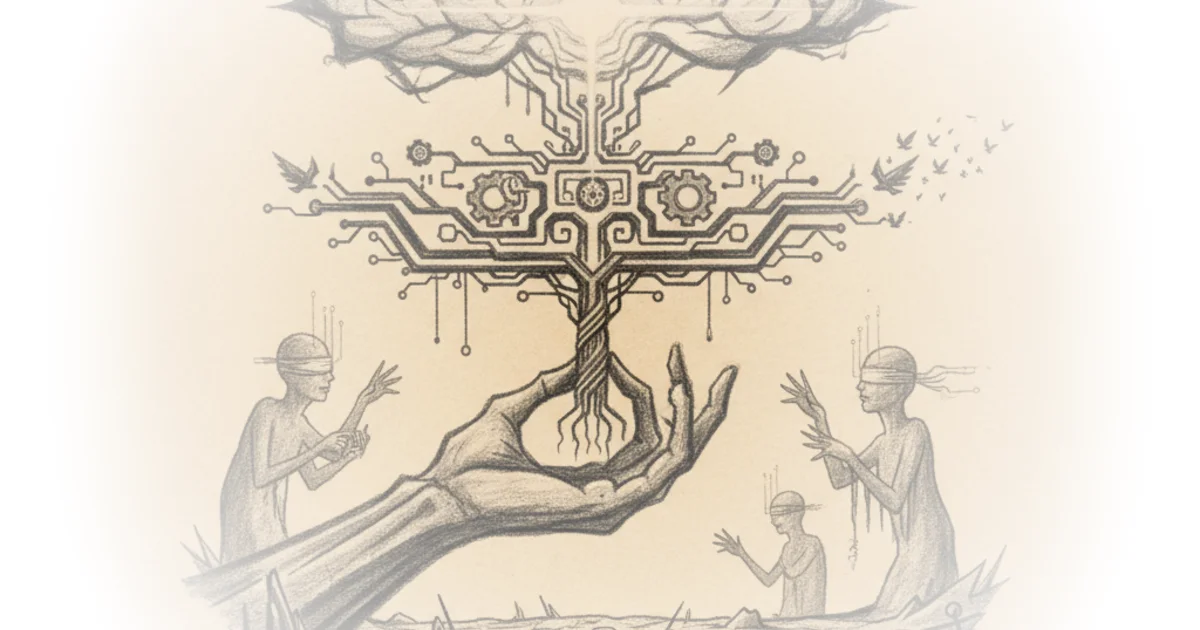
The piece posits that this constructed self creates a barrier, a "private self" that we cultivate to hide from the world's demands. Van der Linden observes that in the film's ecosystem, where nature has been conquered and replaced by plastic and metal, this duality becomes the only reality left. "The world is designed by a blind man who can perceive it only through his own technology," he notes, describing a creator who has lost the very miracle he sought to replicate. This framing is effective because it shifts the blame from the technology itself to the human desire to control it, suggesting that our loss of connection to nature is the root of our spiritual crisis.
"The soul in itself is nothing not a physical entity not a bridge to a higher more define realm that only we are worthy of it only became meaningful if the meaning was given to it."
Critics might argue that reducing the soul to a "linguistic reflex" strips humanity of its moral agency, but van der Linden anticipates this by suggesting that the act of construction is what gives us our humanity, not the result. The danger lies not in the fabrication, but in the refusal to acknowledge it, leading to the subjugation of those we decide lack this symbolic self.
The Illusion of Connection
The commentary then pivots to the tragic consequences of this internal split: the impossibility of true connection. Van der Linden uses the character of Joi, the artificial girlfriend, to illustrate how easily we are fooled by exteriors that mimic interiority. He argues that "people seem to keep bumping up each other with our exteriors and falling away from each other," a sentiment that resonates deeply in an era of curated digital personas. The author suggests that even the most intimate physical acts are often just "a joining of exteriors," failing to bridge the fundamental gap between two separate consciousnesses.
This is where the film's narrative becomes a philosophical case study. The protagonist, K, believes his implanted memories are real because they link him to a specific, tangible event—a "tall white fountain" witnessed by another. Van der Linden writes, "The situation resembles the beginning of K's favorite novel... the image is little more than a comforting presence in his mind until he reads about a woman who after her own near-death experience witnessed a similar tall white fountain." The revelation, however, is devastating: the woman saw a mountain, not a fountain. "You imagined it was you," the author paraphrases the film's lesson. "We all wish it was us."
This moment of deflation is the crux of van der Linden's argument. He suggests that our search for a "miracle child" or a special destiny is often a projection of our own need for significance. "Life everlasting based on a misprint," he muses, highlighting the absurdity of building a life on a coincidence. Yet, he doesn't leave the reader in despair. Instead, he argues that the texture of the experience, not the text, is what matters. "It is not the text but the texture that makes us human," van der Linden asserts, reframing the search for meaning as a creative act rather than a discovery of pre-existing truth.
The Ethics of Self-Transcendence
The final act of the commentary explores how this constructed self can be directed toward something greater than itself. Van der Linden draws on Viktor Frankl to argue that true meaning is found in "self-transcendence," or the act of giving oneself to a cause or another person. He writes, "The more one forgets himself by giving himself to a cause to serve or another person to love the more human years and the more he actualizes himself." This is the film's ultimate redemption arc: K realizes he is not the "miracle child" but chooses to die for the right course anyway.
The author contrasts K's noble sacrifice with the character of Luv, a replicant who seeks to prove her worth by destroying the very humans who created her. Van der Linden notes that Luv represents a darker reflection of our own humanity: "What if a replicant child existed that could finally unlock the secret to the liberation of the entire replicant species here only for us to count for fear of great change?" This raises a chilling question about the nature of rebellion and the exclusivity of human rights. If the soul is constructed, then the replicants have just as much right to construct their own meaning as humans do. "You are real for me," K tells Luv in a moment of tragic recognition, acknowledging that their struggle is not about biology but about the validity of their constructed selves.
"Dying for the right course is the most human thing we can do a noble cause it seems but in the finale of the film we encounter its implications for this new purpose leads him into a confrontation with love."
A counterargument worth considering is that van der Linden's reliance on Frankl's philosophy might be too idealistic for the brutal reality depicted in the film. If meaning is purely constructed, what prevents one group from constructing a narrative of superiority that justifies the extermination of another? The author hints at this tension but ultimately sides with the idea that the choice to connect is the defining human trait, regardless of the biological reality.
Bottom Line
Tom van der Linden's analysis succeeds by refusing to treat Blade Runner 2049 as a simple sci-fi thriller, instead treating it as a profound inquiry into the nature of the self. The strongest part of the argument is the reframing of the soul not as a gift from God, but as a burden and a project we must actively build. The biggest vulnerability lies in the potential for this view to justify moral relativism, yet the author navigates this by emphasizing that the act of self-transcendence is the only path to genuine humanity. For the reader, the takeaway is clear: in a world of artificiality, our humanity is not what we are born with, but what we choose to become for the sake of others.