Gold at $4,400: Safe Haven or Shiny FOMO?
Gold has surged past $4,400 an ounce in 2025, climbing more than 60% year to date and dragging silver along for the ride. Lines snake around the block at gold dealers in Australia and Vietnam. Google searches for "buy gold" have hit all-time highs. The Plain Bagel's Richard Coffin steps into this frenzy with a measured video that asks the question gold bugs would rather not hear: is the rally driven by fundamentals, or is the precious metal simply the latest beneficiary of collective anxiety?
The Debasement Narrative
The loudest story circulating in financial media right now is the so-called "debasement trade," the idea that ballooning government debt, political instability, and central bank gold purchases signal the slow-motion death of the US dollar. Coffin lays out the case fairly. The US government shutdown became the second longest in history. Trump has publicly pressured the Federal Reserve to cut rates. France has cycled through four prime ministers in under two years. Japan's new stimulus-friendly leadership has markets bracing for deeper deficits. Against that backdrop, it is not hard to see why investors reach for something that has served as a store of value for millennia.
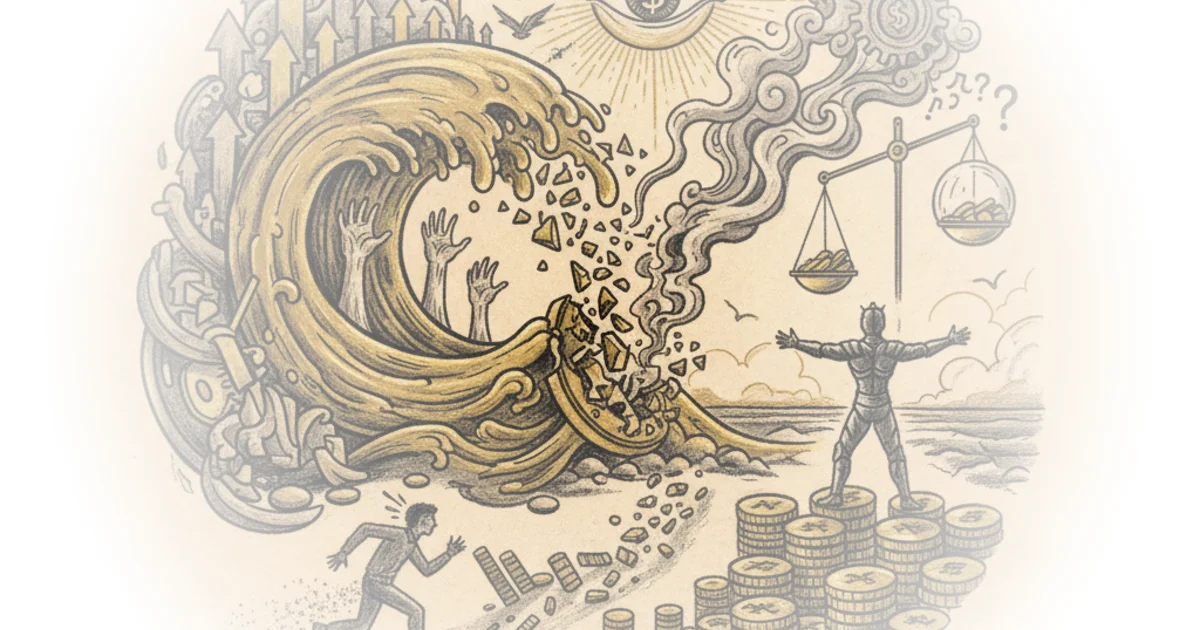
Currency debasement refers to the historical practice of rulers slowly eroding trust in their currency by mixing gold and silver coins with less valuable metals. Something that's argued to have contributed to the collapse of the Roman Empire in 476 AD.
The analogy is dramatic, and that is precisely the point. Debasement narratives thrive on historical parallels that sound compelling but flatten enormous complexity into a single morality tale. The Roman Empire did not fall because of debased coinage any more than it fell because of lead pipes or decadent banquets. As Coffin himself notes, the coins stopped having meaningful gold or silver content two hundred years before Rome's conventional fall date. The timeline does not cooperate with the narrative.
What the Data Actually Shows
The strongest section of the video is Coffin's systematic dismantling of the evidence most often cited for dollar collapse. He points out that the US dollar index has been roughly flat since April, a period during which gold posted roughly half of its total 2025 gains. If gold's rise were truly a referendum on the dollar, the two should move in tighter inverse correlation. They have not.
If you price gold in terms of oil barrels, you can see that even when you strip out the dollar, the metal's value has surged dramatically. We also haven't really seen any changes in inflation expectations, suggesting that gold's surge in price doesn't really reflect a base-case scenario of runaway prices.
This is an underappreciated point. Gold priced in oil, in euros, or in yen has also spiked. That pattern is more consistent with a demand-driven rally than with a dollar-specific crisis. If the dollar were truly being abandoned, one would expect Treasury yields to blow out and inflation expectations to climb. Neither has happened. Treasury bonds have actually increased in price since May.
The headline that central banks now hold more gold than US Treasuries by value also deserves scrutiny. Coffin correctly notes that this milestone is largely an artifact of gold's price doubling rather than a massive shift in holdings. Central banks have not dumped Treasuries en masse. The dollar still accounts for roughly $7 trillion in foreign reserves compared to about $5 trillion in gold. The shift is real but far less dramatic than the headlines suggest.
Which Central Banks Are Actually Buying?
One of the video's most useful contributions is its breakdown of which countries are driving central bank gold demand. The biggest buyers in 2025 have been Poland, Kazakhstan, and Turkey, with China, India, and Russia as notable accumulators over recent years. These are not the world's largest reserve holders acting in concert to dethrone the dollar. They are a mix of emerging markets with specific geopolitical motivations and countries that have historically maintained higher gold allocations.
According to a World Gold Council survey, while the percentage of countries looking to increase their gold reserves has been on the rise, most central banks aren't planning to increase their gold allocation. And those that are tend to be from emerging markets and developing economies.
The distinction matters. A world in which every major central bank is scrambling to replace dollar reserves with gold would be genuinely alarming. A world in which Poland and Kazakhstan are topping up their gold vaults while the Federal Reserve, the ECB, and the Bank of Japan stand pat is considerably less so. Coffin adds a wry observation that gets too little attention: the US Federal Reserve itself owns the largest gold stockpile on the planet, meaning it stands to benefit enormously from gold appreciation. Dollar debasement narratives rarely account for the fact that the dollar's issuer is also the world's biggest gold holder.
The Counterpoint: Dismissal Has Its Own Risks
Where the analysis could push further is in acknowledging that the absence of a dollar crisis today does not mean structural risks are absent. The US debt-to-GDP ratio continues to climb. Interest payments on federal debt are now among the government's largest expenditures. The weaponization of the dollar against Russia in 2022, through the freezing of central bank reserves, was a genuine inflection point that gave non-allied nations a concrete reason to diversify. The trend toward de-dollarization is slow, but it is not imaginary.
Prominent voices like Ray Dalio, Ken Griffin, and Jamie Dimon have all flagged the US debt situation as a serious concern. These are not fringe commentators. Their warnings may not validate the most extreme gold-to-the-moon predictions, but they do suggest that the structural tailwinds for gold are not purely speculative.
There is also a reflexivity problem with gold that the video touches on but does not fully develop. When enough market participants believe gold is a hedge against systemic risk, capital flows into gold become self-reinforcing. The asset appreciates, which validates the thesis, which attracts more capital. This dynamic can persist far longer than skeptics expect, even if the underlying macro thesis is overstated.
History's Uncomfortable Lesson
Coffin provides a useful historical corrective for anyone who believes gold is a one-way bet. Between the early 1980s and the early 2000s, gold endured a two-decade decline in real terms. Platinum, thirty times rarer than gold, trades at a third of its price. Scarcity alone does not determine value; demand driven by historical inertia does.
Bank of America analysts have highlighted that this sort of price movement has only occurred three times before historically, each of which were followed by 20 to 33% declines.
That statistic deserves attention from anyone contemplating a large gold allocation at current prices. Parabolic moves in any asset class, whether tech stocks, real estate, or precious metals, tend to correct. The question is never whether a correction will come but whether buyers at these levels have the conviction and the time horizon to ride it out.
Bottom Line
The Plain Bagel delivers exactly the kind of analysis the current gold frenzy needs: skeptical without being dismissive, thorough without being tedious. The debasement narrative makes for compelling content, but the data does not yet support the conclusion that the dollar is in terminal decline. Gold's rally is better explained by a confluence of geopolitical anxiety, momentum-driven retail buying, and targeted central bank accumulation from a handful of emerging markets. None of those factors are permanent. At the same time, the structural concerns about US debt and political dysfunction are real enough that some portfolio allocation to gold remains defensible as insurance, not prophecy. The danger, as always, is in mistaking a hedge for a thesis and a price chart for proof.