People said this experiment was impossible, so I tried it - Thermite Part 1What if you could watch a chemical reaction that releases heat hot enough to melt steel — from inside the crucible? Derek Muller attempts an experiment nobody had ever filmed before.", ## The Birth of Thermite
In the late 1800s, two brothers named Carl and Hans Goldschmidt were preparing to join their father's dye factory in Germany. Their father had passed away unexpectedly, and Carl took over management of the company. Hans, the younger brother, began researching ways to produce pure metals — essential for making dyes that wouldn't fade.
At the time, good dyes were hard to come by. Some required collecting large quantities of exotic insects. People would pay handsomely for colorfast dyes. One such dye was Schilt's Green, a copper arsenite that was toxic but produced an unbeatable color.
The demand for pure metals was strong. But separating metals from each other had proven notoriously difficult. They form mixed crystals like alloys with a single melting point, making separation nearly impossible through conventional methods.
Hans came up with a novel idea: react a metal oxide like chromium oxide with aluminum powder. The oxygen would swap partners, forming aluminum oxide and pure chromium. This reaction is now known as an aluminothermic or thermite reaction.
How Thermite Works
Thermite reactions typically exceed 2000 degrees Celsius and can reach as much as 2500 degrees. The reason is simple: aluminum forms very strong bonds with oxygen. When those bonds form, they release far more energy than is required to break the metal oxide bonds we started with.
This energy melts everything in the reaction — the products glow hot enough to look like staring at the sun. The reaction proceeds in bursts: it reacts fast, then pauses for a moment before advancing again.
One explanation involves pockets of unreacted material where the ratio is slightly less ideal until heat builds up enough to trigger the next pocket. Another possibility: air between the grains heats up and expands, increasing pressure that pushes some unreacted material away from the reaction front. Once that air escapes, the next patch can ignite.
When all the thermite has reacted, things get violent. Molten metal is ejected outwards. The liquid iron inside settles down after boiling — iron boils above 2800 degrees Celsius, while aluminum boils around 2500. Some materials in the mixture boil away first, creating this explosive ejection effect.
The key to producing pure metal lies in density differences. Liquid iron is more than twice as dense as liquid aluminum oxide. Iron settles to the bottom as aluminum oxide floats to the top. When the crucible drains, the first liquid out is iron only — then the slag follows.
The Impossible Experiment
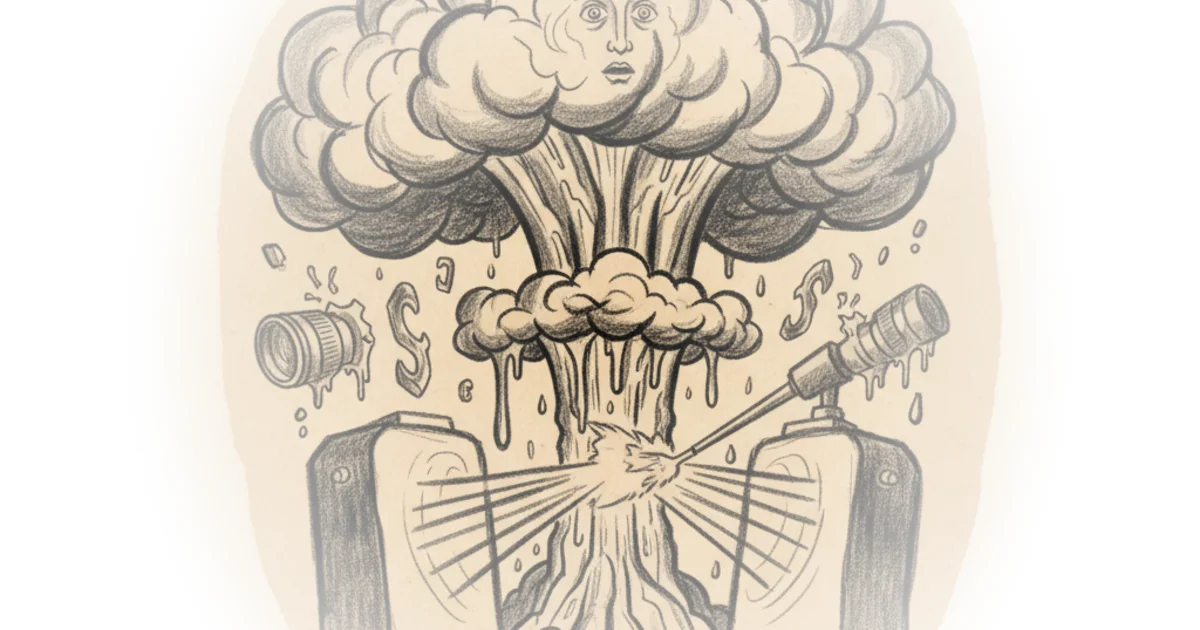
Muller wanted to see inside the reaction like never before. He cut the crucible in half and attached two pieces of specially treated glass, each four millimeters thick, as windows into the reaction. People said this would be impossible — that you wouldn't be able to see anything or the glass would just break.
The glass has a melting temperature around 1700 degrees Celsius, which is definitely lower than the temperature of the reaction. The hope was it would melt slowly enough to contain the reaction and provide a view.
For this experiment, Muller used iron thermite: a combination of iron oxide and aluminum metal. He poured roughly 300 grams into the crucible and ignited it.
The reaction starts at the igniter and expands outwards in all directions. To observers, it almost looks like ants or mold spreading organically. There's pulsing — boom, boom — like something alive.
This was the closest anyone had ever filmed a thermite reaction. The exposure is almost always brighter than you expect, which makes it hard to judge how bright the reaction will be.
Modern Applications
One of the first applications of thermite was welding metal parts in remote locations. Shipping companies used it when shafts broke in the middle of the ocean — a way to get home safely despite being stranded. It could fix cracks in engine blocks quickly, with just two guys and a bucket.
Today, most thermite produced is steel thermite rather than pure iron. Pure iron is actually useless — it's very soft and corrodes immediately, even in dry air. Steel requires carbon and alloying elements to be useful.
A more modern application uses the heat generated to destroy information past a certain temperature. The Curie temperature is when magnets lose their magnetism. Information stored on magnetic hard drives becomes unrecoverable at high enough temperatures.
When Muller ignites thermite tiles in all four corners, it generates heat for about ten minutes. Everything on the laptop is destroyed — completely unrecoverable data.
"The procedure is so extraordinarily simple that I could hardly have undertaken to present it if not for its surprising and extraordinary effects."
Hans Goldschmidt patented this process in 1895 and wrote it up for publication. Thermite was a solution looking for problems, and it found them everywhere.", "counterpoints": "Critics might note that the pulsing explanation remains speculative — the exact cause of the burst reaction pattern is still debated among chemists. The experiment provides visual evidence but doesn't definitively prove either theory.", "bottom_line": "Muller delivers something rare: an experiment nobody had ever filmed before, giving us our first real view inside a thermite reaction. His biggest vulnerability is that this is Part 1 — we're left wanting to see what comes next. The historical context and modern applications are compelling, but the visual payoff of actually seeing the reaction through specially treated glass is the kind of thing that makes you wish more scientists brought cameras.