Josh Scott has spent over 10 hours building the Electra Distortion — one of the most famous circuits in guitar effects — and he's teaching his audience to build it too. This isn't a polished tutorial. It's a live, warts-and-all breadboarding session where mistakes become lessons.
What makes this piece compelling is how Scott turns technical circuit work into something approaching performance art. He's not just explaining electronics; he's showing exactly how a breadboard comes together — input jacks, transistor placement, the bias control — while maintaining an almost constant dialogue with his audience. The chat section moves at its own pace: "I'm waiting, I'm patiently waiting, and I'm going to take a sip of my water lemon lime while someone figures out the shrieking ill reference." This is less a tutorial than a live demonstration of problem-solving in real time.
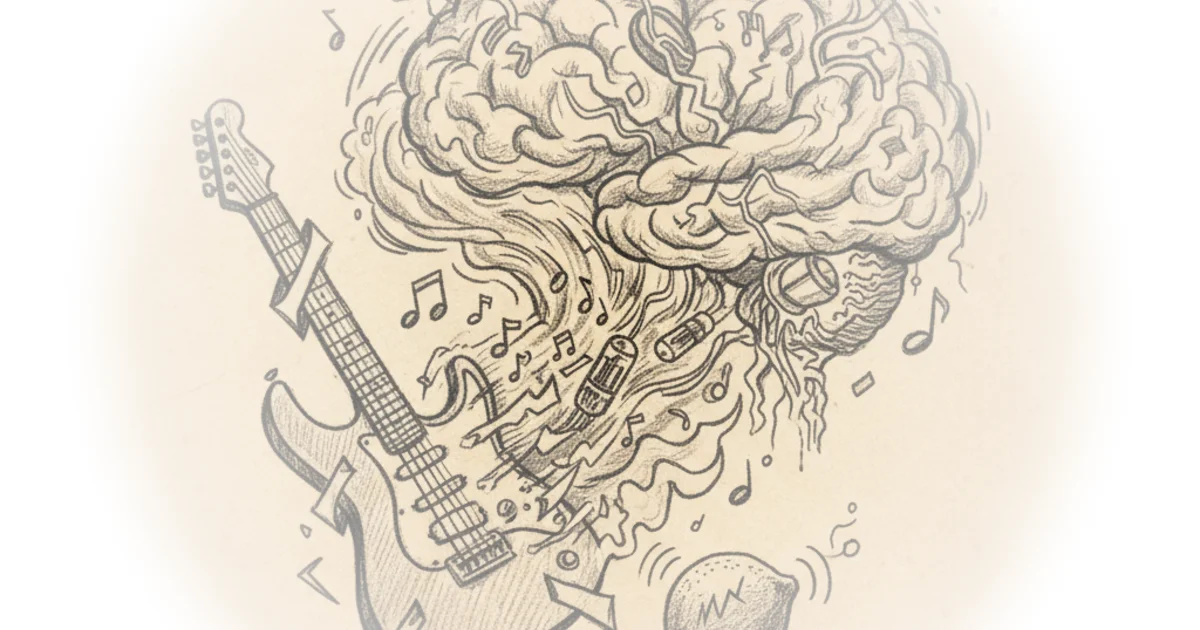
Scott frames the Electra Distortion as both a circuit challenge and a personal legacy project. He describes it as "one of the most famous circuits ever used by EarthQuaker" — a company whose reputation for boutique, hand-crafted effects has made the Electra nearly mythical among pedal enthusiasts. The history he walks through is specific: the schematic from October 7th, 1976, posted online and subsequently modified with clipping diodes. He's not just building a circuit; he's contributing to its evolution.
The core of his teaching method involves what he calls Uncle Earl's tone control — a blendable frequency control using two parallel capacitors (0.033 and 0.047 microfarads) selected through a potentiometer. This is classic tone-bending territory, the kind of modification that separates a functional circuit from something with real character. Scott walks through methodically: input jack to capacitor, capacitor to lug one, then the blend to lug three — each step accompanied by explanation.
"I love it when people don't halfway do something. I just love stuff done all the way."
This quote captures something essential about his approach. He's not interested in shortcuts or half-measures. The Copper Sound DIY board he uses has pre-attached ground and power rails, which simplifies setup — but he's still careful to double-check connections, aware that even experienced builders make mistakes: "you can forget stuff so one two three and looking at the schematic."
Transistor Selection: The Hidden Variables
The section on transistor selection is where Scott's expertise becomes most apparent. He's not just recommending a component; he's explaining why different transistors change the circuit's behavior. A 2N5088 (100 gain) gives "a good dirty boost" — clean, less aggressive clipping, suitable for single-coil pickups. An MPS A18, by contrast, is "the highest gain transistor you can buy because it's actually multiple transistors in one package" — more fuzz potential, harder clipping diodes.
This distinction matters because it shows how the same circuit can produce wildly different results based on component choices. Scott measures 571 at the output of his chosen transistor and calls it "pretty low gain." He's careful to note that "100 transistor HP dirty boost" works differently than higher-gain options. The implication is clear: building a pedal isn't just following instructions — it's understanding how each choice affects the final sound.
His one-meg resistor discussion reveals another layer of depth. He explains that silicon transistors don't leak like germanium ones, so a base-collector resistor provides necessary stability. "We need to give it the leakage and that helps bias the transistor." This is exactly the kind of knowledge that separates a hobbyist from someone who actually understands what they're building.
The Giveaway and Community
The giveaway segment — Copper Sound's short circuit parts kit with LPB1 boost, drive, fuzz — serves as both promotion and community celebration. Scott's gratitude toward Copper Sound ("my hat that I never wear goes off to you") reads genuine rather than performative. He's built relationships with these people over years through mutual artists and friends in the pedal community.
The chat sections show his audience actively engaged: Jake Kendrick, Bocanegra, Jacob Howard getting a three-series pedal for free — all celebrate the circuit's legacy while participating in the stream. This isn't passive viewing; it's active community building around a shared interest in electronics and guitar tone.
Scott admits openly that "it's such a simple circuit, it's not rocket science but there's so many little things you can do and little finesses you can bend here and there." That's the real lesson: even basic circuits have nuance. The simplicity is deceptive — what looks straightforward involves dozens of small decisions about component values, biasing, filtering.
Counterpoints
A reasonable counterargument might note that this kind of live breadboarding has inherent limits. Building on a copper sound board with pre-attached rails simplifies setup but doesn't teach the underlying principles of proper power supply design. The giveaway segment is promotional — viewers are watching an infomercial disguised as education, though Scott's enthusiasm makes it feel organic.
Another consideration: his transistor recommendations lean toward silicon (2N5088) over germanium, which produces different clipping characteristics. A builder seeking vintage-style fuzz might find this advice incomplete.
Bottom Line
Scott's strength is making complex circuits feel approachable — the Electra Distortion isn't some mysterious artifact but a series of decisions he walks through step by step. His biggest vulnerability is that he's essentially teaching without a textbook; viewers must absorb everything in real time, which works for engaged audiences but leaves gaps for casual watchers.
The most important development here: electronics education has moved from static tutorials to live personality-driven streams where mistakes become content and community becomes the curriculum. That's worth watching.