The Numbers Tell the Story
William Kristol opens his State of the Union preview with a blunt admission: watching Donald Trump address Congress will be depressing. But the longtime conservative commentator, writing in The Bulwark on the morning of the February 2026 address, argues that the polling trajectory should provide some consolation to the president's critics.
The numbers are stark. When Trump last spoke before a joint session of Congress in March 2025, he sat at 49 percent approval against 48 percent disapproval. A year later, the New York Times polling average has him at 41 percent approval and 56 percent disapproval. A CNN poll puts it even worse: 36 percent, down from 48 percent a year earlier.
Trump has lost about one sixth of his approval in the last year. A new poll from CNN is even more dramatic, showing Trump at 36 percent approval today, down from 48 percent in that same poll a year ago. That suggests one in four of his original supporters deserting him.
Kristol grounds his analysis in a G. Elliott Morris poll showing Trump at 37 percent approval and 59 percent disapproval, with Democrats leading the congressional generic ballot by ten points. These are the kinds of numbers that precede wave elections.
The Declaration as Political Framework
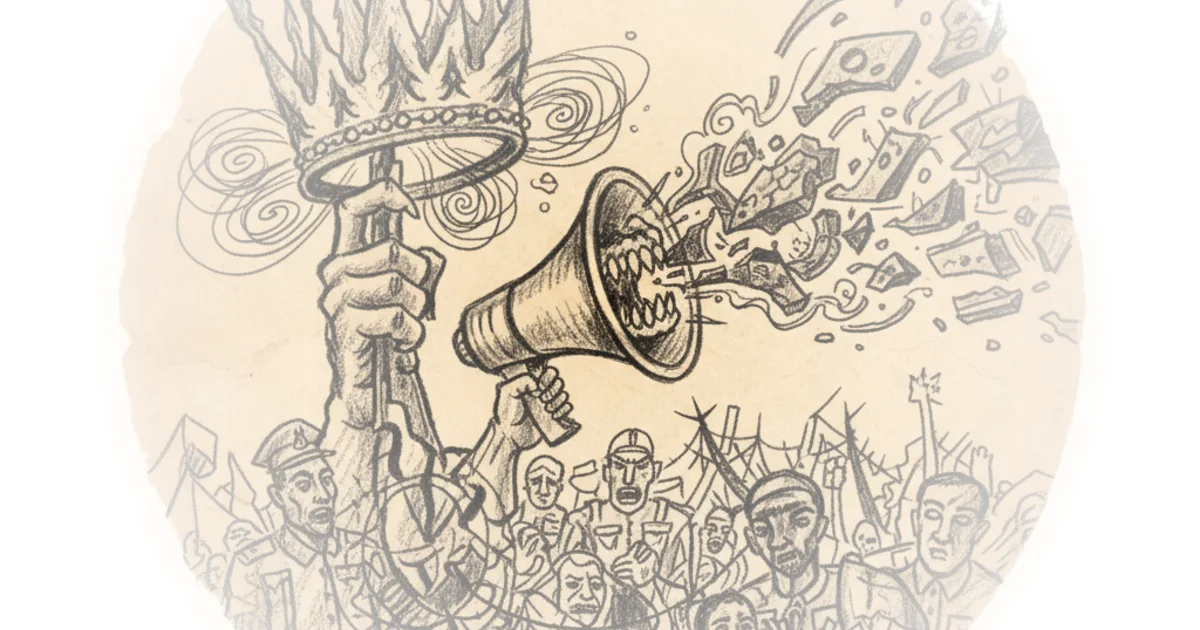
The most striking rhetorical move in the piece is Kristol's sustained parallel between Trump and King George III. This is not a casual comparison tossed off for effect. He quotes the Declaration of Independence directly and builds his entire argument around its logic of popular sovereignty and justified resistance.
Mankind are more disposed to suffer, while evils are sufferable, than to right themselves.
Kristol uses the Declaration's language about "patient sufferance" to explain why public opinion moves slowly, and why the gradual erosion of Trump's support follows a historically recognizable pattern. The colonists did not rebel overnight. Neither, he suggests, do modern voters abandon a president they once supported.
And like Mad King George, Trump will not give up easily. He has many levers of power in the executive branch at his disposal. He and his supporters have tons of money to spend on the coming elections.
The analogy is elegant, though it carries risks. Comparing any modern president to a monarch invites accusations of hyperbole, and the Declaration's authors were describing a situation that ended in armed revolution. Kristol does acknowledge this tension when he notes that "the publication of the Declaration of Independence didn't achieve independence. That took years of war." Still, the comparison does more rhetorical work than the historical parallels can quite bear.
A Catalog of Things That Will Not Happen
The structural heart of the essay is a series of conditional statements, each beginning with "Trump could" and ending with "But surely he won't." Kristol lists the policy reversals and constitutional acknowledgments that the president could theoretically announce in his address.
Trump could announce an end to his cruel and destructive mass-deportation agenda tonight. He could apologize to the people of Minnesota, whom he placed under siege, and to the families of Renee Good and Alex Pretti, killed by agents of the Trump administration carrying out his policies. But surely he won't.
The litany continues through the Epstein documents, congressional war authorization, Department of Justice independence, and tariff policy. Each item functions as both a policy critique and a demonstration of presidential stubbornness.
Trump could embrace the constitutional directive that he "take care that the laws be faithfully executed," and announce a radical change in course at the Department of Justice. But surely he won't.
This rhetorical device is effective precisely because it concedes the theoretical possibility of change while asserting its practical impossibility. It paints Trump as a man locked into his own worst instincts.
The Economy Question
Kristol makes a noteworthy observation about what is driving Trump's decline. The drop in approval has happened without a recession and without a major war, the two most common catalysts for presidential unpopularity. He pushes back directly against the old political axiom.
It turns out not to be always true that it's the economy, stupid. After all, it doesn't seem to have mostly been the economy in 1776. Almost none of the charges in the Declaration is about the material well-being of the colonists.
This is a sharp insight, though it somewhat undercuts Kristol's own case. If the public is turning against Trump despite a functioning economy, the question of what exactly is driving the shift becomes harder to pin down. Culture war exhaustion, immigration enforcement excesses, and tariff chaos all play roles, but the absence of a single galvanizing economic crisis means the discontent is diffuse. Diffuse discontent can consolidate into electoral defeat, but it can also dissipate if circumstances change.
The Bulwark's Broader Coverage
The piece sits within a larger newsletter that covers several other stories of the day. The killing of Jalisco New Generation Cartel leader Nemesio Oseguera Cervantes, known as "El Mencho," in a Mexican military operation receives substantial coverage, including the violent cartel retaliation that followed. Trump's reaction to the Supreme Court's tariff ruling gets its own section, with the president warning trading partners against renegotiating deals.
Any Country that wants to "play games" with the ridiculous supreme court decision, especially those that have "Ripped Off" the U.S.A. for years, and even decades, will be met with a much higher Tariff, and worse, than that which they just recently agreed to.
Cathy Young contributes a sharp item on a manufactured controversy involving California Governor Gavin Newsom, whose remarks about his dyslexia were stripped of context and repackaged as racial condescension by right-wing media figures.
The controversy is too fake to damage Newsom, but it's a good Who's Who of right-wing hypocrisy: It's an exact mirror image of the "woke" outrage, often based on garbled reporting, that the right once ridiculed.
Bottom Line
Kristol's essay is fundamentally optimistic beneath its surface gloom. The argument is straightforward: Trump is losing the public, the trend lines point in one direction, and the November midterms offer a democratic corrective. The Declaration of Independence framework gives the piece a gravity that elevates it above standard State of the Union punditry.
The weakness, as Kristol himself half-acknowledges, is that declining poll numbers and actual political consequences are not the same thing. Trump retains the powers of the presidency, the loyalty of most Republican officeholders, and enormous financial resources. The piece ends with Steve Bannon's memorable phrase about flooding "the zone with shit" and Kristol's observation that the public seems "increasingly sickened by the odor." Whether that revulsion translates into the kind of sustained political action the piece calls for remains the open question Kristol wisely does not try to answer.