Niall Ferguson cuts through the noise of a 2026 geopolitical crisis by challenging the comforting myth that history moves in a straight line toward peace. Instead of accepting the administration's narrative of a clean, decisive victory in Iran, he exposes a jagged reality where a "ceasefire" masks a stranglehold on the global economy. For the busy professional trying to navigate the disconnect between stock market euphoria and the closure of the world's most critical oil chokepoint, this analysis offers a necessary corrective to the official "Truths" being broadcast from Washington.
The Myth of the Arc
Ferguson begins by dismantling the popular belief in inevitable progress, a concept often invoked to justify political optimism. He contrasts the administration's rhetoric with a starker historical view. "The path of the past is not an arc," Ferguson writes. "It is nonlinear—at times jagged like an electrocardiogram, at times flat as a pancake." This framing is crucial because it strips away the moral certainty that often clouds strategic judgment. If history does not bend toward justice or peace on its own, then the current stability is not a natural outcome but a fragile, manufactured state.
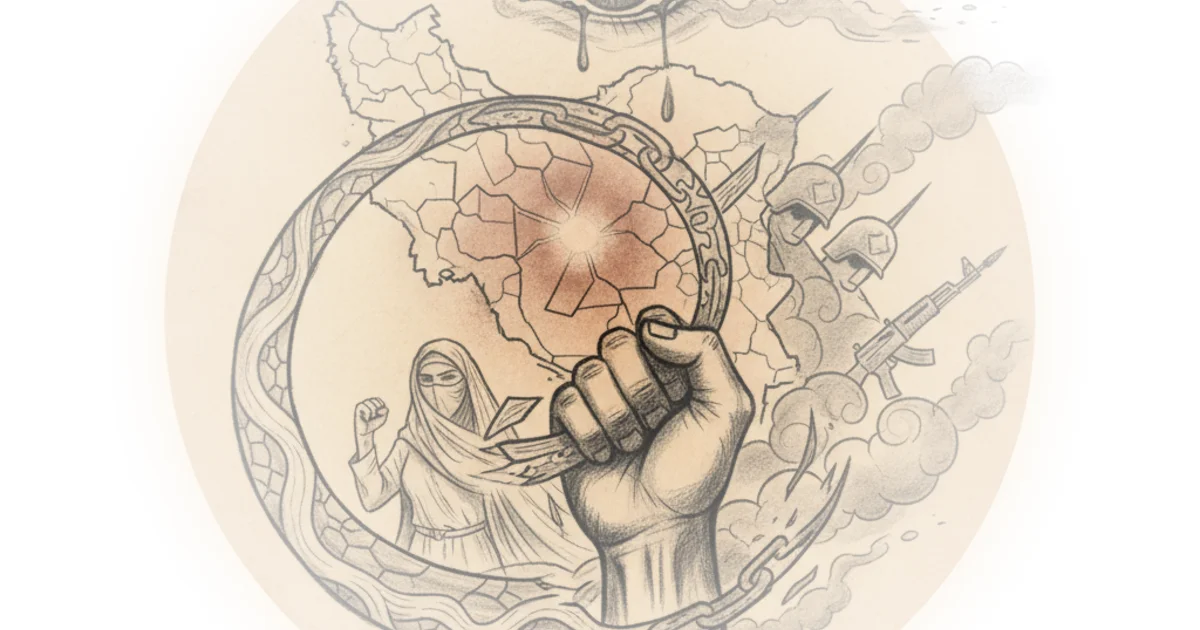
He draws a sharp distinction between the moral universe and human history, noting that the Enlightenment's promise of peace failed to prevent the bloodiest wars of the 20th century. Ferguson argues that we are currently witnessing a return to conflict in the Middle East, Eastern Europe, and Africa, proving that "trends and cycles discerned by modern sages are mostly illusions." This perspective is vital for readers who might be lulled into a false sense of security by the administration's claims of a "GREAT AND BRILLIANT DAY FOR THE WORLD."
The path of the past is not an arc. It is nonlinear—at times jagged like an electrocardiogram, at times flat as a pancake.
Ferguson then pivots to the symbolism of the proposed "Arc de Trump," a 250-foot gold monument planned for Washington, D.C. He notes that while every empire worthy of the name has built a triumphal arch, the United States has historically been an exception. Now, however, the executive branch is pushing for a structure that would dwarf the Capitol and Lincoln Memorial. The BBC reported that a panel of administration allies moved the project forward "despite overwhelmingly negative feedback from the public and preservation groups." This detail underscores a growing disconnect between the administration's self-image and the reality of public sentiment or historical precedent.
The Gap Between Social Truth and Reality
The core of Ferguson's critique targets the administration's use of social media to declare victory before the facts are settled. He dissects a barrage of posts from April 17 where the president claimed, "The U.S.A. will get all Nuclear 'Dust,' created by our great B2 Bombers—No money will exchange hands in any way, shape, or form." Ferguson points out the absurdity of this "Truth Social" reality, noting that the Strait of Hormuz remains effectively closed despite official denials.
He highlights the discrepancy between the administration's claims and the on-the-ground situation. "Like the price of oil in different markets and at different times, there is sometimes quite a wide spread between Truth, in the president's sense of the word, and reality," Ferguson observes. While the White House declares the strait "completely open and ready for business," vessels are turning back in response to Iranian threats and warning shots. This is not a minor diplomatic friction; it is a massive disruption to global supply chains.
Like the price of oil in different markets and at different times, there is sometimes quite a wide spread between Truth, in the president's sense of the word, and reality.
Ferguson brings in hard data to illustrate the severity of the situation. He quotes energy expert Rory Johnston, who notes that "over the first month of the crisis alone, the global system lost more than 200 million barrels of oil." This loss is equivalent to the entire record coordinated release of the Strategic Petroleum Reserve. Yet, the financial markets have reacted with bizarre indifference, with the S&P 500 and Nasdaq rallying even as the global economy faces a shock larger than the 1970s oil crisis.
Critics might argue that Ferguson underestimates the resilience of the modern U.S. economy, which is far more diversified and energy-independent than it was in 1973. However, he counters that the sheer scale of the disruption to urea, sulfur, and helium supplies poses a unique threat that AI and domestic energy cannot fully mitigate. The market's calm, he suggests, may be a sign of cluelessness similar to the months preceding the crashes of 1929 or 2007.
The Human and Strategic Cost
Beyond the economics, Ferguson addresses the human and strategic toll of the conflict. He notes that the U.S. and its allies attempted regime change, but the result was not a democratic transition; rather, "Iran became an Islamic Revolutionary Guard Corps-led military dictatorship. That was not an improvement." This outcome highlights the limits of air power and naval blockades in achieving political transformation without ground forces.
He also touches on the historical context of such conflicts, referencing the "Seven Weeks' War" and drawing parallels to the 1973 oil embargo. Ferguson reminds readers that the negotiation process is far from over. "The devil of any deal will be in the details, not the Truth headline," he warns. The administration's claim that the deal is "100% complete" is contradicted by the reality that the ceasefire is temporary and the naval blockade remains in force.
Ferguson's analysis of the Basij paramilitary and the broader Iranian response serves as a reminder that the conflict is not a video game. The "truth" of the administration's social media posts often ignores the suffering of civilians and the complexity of regional dynamics. He notes that the closure of the strait is a powerful lever in economic warfare, one that Iran has successfully wielded despite the U.S. military's overwhelming air superiority.
The choice was between 1) military escalation (boots on the ground or strikes on Iranian infrastructure), and 2) a diplomatic deal. Trump chose 2.
Yet, Ferguson questions whether this diplomatic path will lead to a lasting peace. He suggests that the final compromise will take much longer than the market predicts, citing the four months it took to lift the 1973 oil embargo. The administration's reliance on "Truth" over reality risks prolonging the conflict and deepening the economic scars.
Bottom Line
Ferguson's most compelling argument is that the administration's "victory" is a narrative construct that fails to account for the brutal realities of a closed strait and a destabilized global economy. His greatest vulnerability lies in the possibility that the U.S. economy's AI-driven resilience and energy independence might indeed absorb the shock better than historical precedents suggest. However, the human cost of this prolonged tension and the risk of miscalculation remain the most urgent variables to watch.