Thomas Metzinger, a leading philosopher of mind, argues that the scientific study of consciousness has been looking in the wrong direction for decades. In this conversation with Alex O'Connor, the focus shifts from complex emotions and memories to the elusive "minimal phenomenal experience"—a state of pure awareness stripped of all narrative and self-reference. This is not a meditation retreat log; it is a rigorous attempt to mathematically model the bare minimum required for a conscious experience to exist.
The Architecture of the Minimal Self
Metzinger begins by deconstructing the "whole body illusion," a phenomenon where subjects identify with a virtual avatar. He asks a piercing question: "What is actually the thing that jumps from the physical body into the virtual body if the illusion works?" The answer, he suggests, is not the body itself, but a specific sensory model. Metzinger defines this as the "simplest sense of conscious self experience," which consists merely of location in space, location in time, and a perspectival model of reality centered on the eyes.
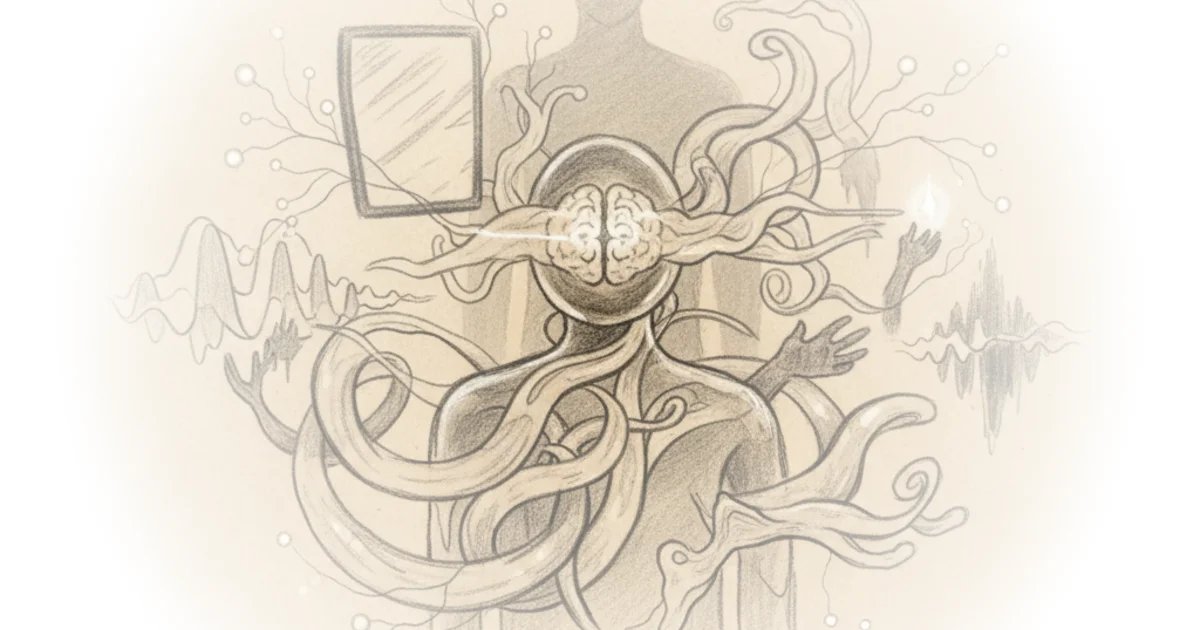
Crucially, Metzinger notes that "agency... are not necessary conditions for this simplest form of selfhood." This distinction is vital. It separates the feeling of "I am doing this" from the feeling of "I am here." By removing the need for agency, the research narrows the field to a state that is purely observational. This approach reframes the problem of consciousness from a study of complex behaviors to a study of the fundamental substrate of experience.
"If you try to think what that would be like, it's really difficult. But it still seems to make sense to say that it would be conscious."
This difficulty in simulation is the point. As Metzinger explains, the concept of "minimal phenomenal experience" (MPE) involves subtracting everything non-essential. He references his colleague Jennifer W, who helped invent the concept, noting that the project is to "test a type of scientific explanation that has never been tried on the problem of consciousness." The goal is to find the "zero person perspective," a state where the observer exists without the usual autobiographical baggage.
Critics might argue that without memory or a sense of self, the concept of "experience" becomes incoherent. How can there be a witness if the witness has no history? Metzinger acknowledges this paradox, admitting that such a state is "timeless" and "cannot be simulated" by the normal brain. Yet, he insists that dismissing it because it defies our standard conceptual criteria is an intellectual dead end.
The Epistemological Trap
The conversation takes a sharp turn when addressing the reliability of data from meditators and psychonauts. Metzinger identifies "theory contamination" as the primary obstacle. He observes that most reports come from individuals steeped in specific belief systems, whether Buddhist, Christian, or Sufi. "Most of them are not exactly within reason," he quips, highlighting the tension between mystical claims and analytical rigor.
The core of the problem is the "performative fallacy." If a person claims to have experienced a state of "ego dissolution" where no self existed, how can they report it? "How should you be able to report about a conscious experience where you were not there?" Metzinger asks. It seems logically impossible to remember a moment where the "I" that remembers was absent.
"You have to make your hands dirty. Because I'm absolutely sure there is something very relevant there."
Metzinger refuses to dismiss these reports as mere drug-induced hallucinations or "new-agey" nonsense. Instead, he advocates for a "feign ignorance" approach, treating the reports as data points that challenge our current models. He points to the work of Christopher Timmerman at UCL, who is attempting to bridge this gap by comparing the phenomenology of long-term meditators with the effects of specific molecules like 5-MeO-DMT. The aim is to move beyond vague descriptions toward a "computational phenomenology" that can be mathematically modeled.
A counterargument worth considering is that even the most rigorous scientific method may be ill-equipped to capture a phenomenon defined by its lack of structure. If the state is truly "ineffable," as Metzinger admits, then any attempt to quantify it might fundamentally alter or destroy the very thing being measured. This is the "noble silence" that some practitioners choose to maintain, warning that intellectualizing the experience might "ruin something also in my own life."
The Future of Consciousness Research
Despite the hurdles, Metzinger remains optimistic about the potential for a "minimal model explanation." He envisions a future where we can mathematically define what a "full absorption episode of pure awareness" looks like, where "the content of awareness is awareness itself." This would represent a paradigm shift, moving consciousness studies away from the classical reductive explanations that have dominated neuroscience.
The value of this discussion lies in its refusal to settle for easy answers. By stripping away the layers of memory, emotion, and agency, Metzinger forces us to confront the raw mechanics of being aware. He challenges the scientific community to stop treating altered states of consciousness as fringe curiosities and start treating them as critical data for understanding the human mind.
"If you want to... growth of knowledge in epistemic gain, you have to go there and you have to make your hands dirty."
This call to action is the piece's most compelling element. It demands that philosophers and neuroscientists engage with the messy, subjective, and often contradictory reports of human experience rather than retreating into the safety of abstract theory. While the path to a mathematical model of pure awareness remains uncertain, the attempt itself promises to reshape our understanding of what it means to be conscious.
Bottom Line
Metzinger's argument is a bold attempt to operationalize the ineffable, offering a rigorous framework to study the "zero person perspective" without succumbing to mysticism or skepticism. Its greatest strength is the reframing of consciousness as a subtractive process, yet its biggest vulnerability remains the fundamental paradox of reporting a state where the reporter does not exist. The field must now decide if it can develop new tools to measure the unmeasurable or if it will remain stuck in the limitations of current language and logic.