Brad DeLong tackles a paradox that haunts modern universities: the persistent label of "academic Marxist" applied to scholars who, by his rigorous definition, have abandoned the very core of Marxist thought. He argues that what passes for Marxism in the humanities today is often a hollowed-out identity marker, stripped of the six specific analytical threads Marx himself wove together, leaving a tradition that explains less than a simple account of creative destruction. For busy readers tracking the intellectual health of our institutions, this dissection offers a rare clarity on why the left's theoretical toolkit feels so disconnected from the messy reality of technological change.
The Six Threads That Don't Hold
DeLong begins by dismantling the popular assumption that there is a vibrant community of thinkers faithfully extending Marx's work. He points to the 1859 Preface to A Contribution to the Critique of Political Economy as the litmus test. "To pick up one (or more) of these six claims and then to try to develop it and demonstrate its truth... is what it is to be a 'Marxist' in any sense meaningful," DeLong writes. He breaks this down into theology, stage theory, sociology, political economy, and historical materialism, only to find that contemporary scholars have largely abandoned them all.
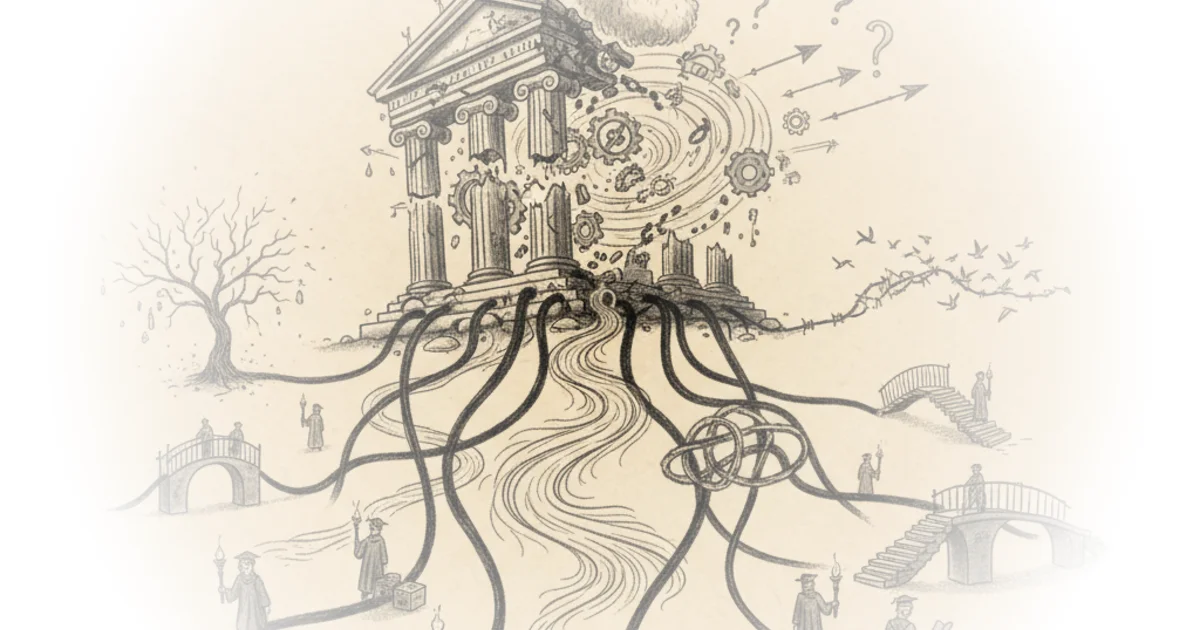
The author's analysis is striking in its specificity. He notes that while everyone agrees that social being determines consciousness, the reverse is also true, and modern leftists are often more "idealist" than materialist. Furthermore, the idea that technological change necessitates a socialist revolution has collapsed under the weight of history. "Nobody today likes the reductionism of (4) Sociology and Ideology. It simply doesn't work," DeLong asserts, pointing out that Marx's attempt to map political factions directly onto economic classes in 19th-century France was historically inaccurate then and is useless now. This is a bold claim that forces the reader to confront the gap between the label and the actual intellectual labor being performed.
The rest—teleology, ideology-as-master-key, stage theory, utopia—collapses under a messy record of overlapping, sector-specific transformations.
Critics might argue that DeLong is applying a rigid, perhaps outdated, definition of Marxism that ignores how the tradition has evolved to address culture and identity. However, his point stands that if the core mechanisms of historical materialism are discarded, the term loses its explanatory power. He suggests that since 1870, change has arrived in waves that institutions lag behind, a reality better explained by "creative destruction" than by any deterministic arc of history.
The Academic Displacement
The commentary then shifts to a podcast featuring Henry Oliver, Jeffrey Lawrence, and Julianne Werlin, which DeLong uses as a case study of the confusion surrounding the term. The guests discuss how Marxism moved into the academy after the 1960s, becoming an "intellectual tool" rather than a guide for labor politics. "After Marxism moves into the academy after the 1960s... it becomes a different thing," Lawrence notes, admitting it is now an "amalgam of different ideas" that often aligns more with progressive politics than Marxian thought.
DeLong finds this admission revealing. He argues that the people now occupying these spaces are not true Marxists but rather what Marx and Engels mocked in The German Ideology: those who think revolution is a matter of changing ideas rather than transforming the economy. He observes that at institutions like Berkeley, radical faculty have never been more than a small fraction of the total, often acting as "activist-scholars" who are "loathed (or sometimes pitied) by the mainline liberals." This paints a picture of a vocal minority dominating the discourse while the actual intellectual heavy lifting of the university remains liberal and pre-professional.
The guests in the podcast struggle to justify the study of literature without relying on a canonical "greatness" that feels increasingly ideological. Oliver asks, "Once we allow a kind of methodological approach from one tradition or another, we're just no longer really studying literature. We're using literature." DeLong agrees that the justification is missing, but he believes the guests are looking in the wrong place. They are trying to find a new framework for literature when the real issue is the abandonment of the materialist analysis that once gave the field its edge.
It is hard to find a self-described 'academic Marxist' these days: there are zero in the natural sciences, and zero in the business schools and in economics.
This section highlights a significant disconnect: the administration and the majority of faculty are liberal, not radical, yet the public perception is dominated by the "noisy" activists. DeLong's framing suggests that the "academic Marxist" is largely a myth constructed by critics like Christopher Rufo, or a self-identification by those who have abandoned the rigorous economic analysis Marx demanded.
The Urgent Need for Purpose
DeLong concludes by pivoting to what actually matters for the university: the flourishing of history, English, and drama departments. He argues that these fields are essential for teaching students the "broad sweep of the human culture and civilization" and the ability to argue in prose. "Nothing is more important," he writes, placing pre-professional education like engineering and finance as a distant second in terms of cultivating intellectual workers.
However, he critiques Oliver, Lawrence, and Werlin for failing to provide a robust justification for why we read literature beyond saying it is "great." They seek a framework to explain the role of culture in a society in flux but end up circling the drain of methodology without a clear destination. DeLong suggests that the solution isn't to revive a dead version of Marxism, but to build a confident sense of purpose for the humanities that doesn't rely on discredited teleologies. The real challenge is to explain why literature matters in a world where institutions lag behind technology, without resorting to the hollowed-out labels of the past.
You cannot have flourishing and educationally excellent history, English, and drama departments that lack a strong and confident sense of what they are for.
Bottom Line
DeLong's strongest move is stripping the label "Marxist" of its tribal utility to reveal the empty intellectual space it currently occupies in the academy, forcing a confrontation with the actual state of social science. His biggest vulnerability is perhaps his dismissal of the cultural turn's insights, which, while not strictly materialist, address real human experiences that pure economic determinism often misses. The reader should watch for how universities attempt to redefine the purpose of the humanities in the coming decade, as the old justifications crumble and the new ones remain unwritten.