Dostoevsky's view of faith has been described as existential tragic Christianity—but that phrase often confuses people who haven't followed his work closely. It sounds like an oxymoron to modern ears. Isn't Christianity the thing that helps people cope with painful reality? Doesn't belief mean you stop suffering from existential dread?
The answer lies in understanding what faith meant to him. For Dostoevsky, faith was not a noun—it was a verb. It wasn't a doctrine to be believed. It was an active process of affirmation: affirming all of existence, including the good, the bad, the mysterious, and the psychologically complex. He refused to idealize or demonize any perspective. This level of honesty is what made his writing so difficult for readers to engage with.
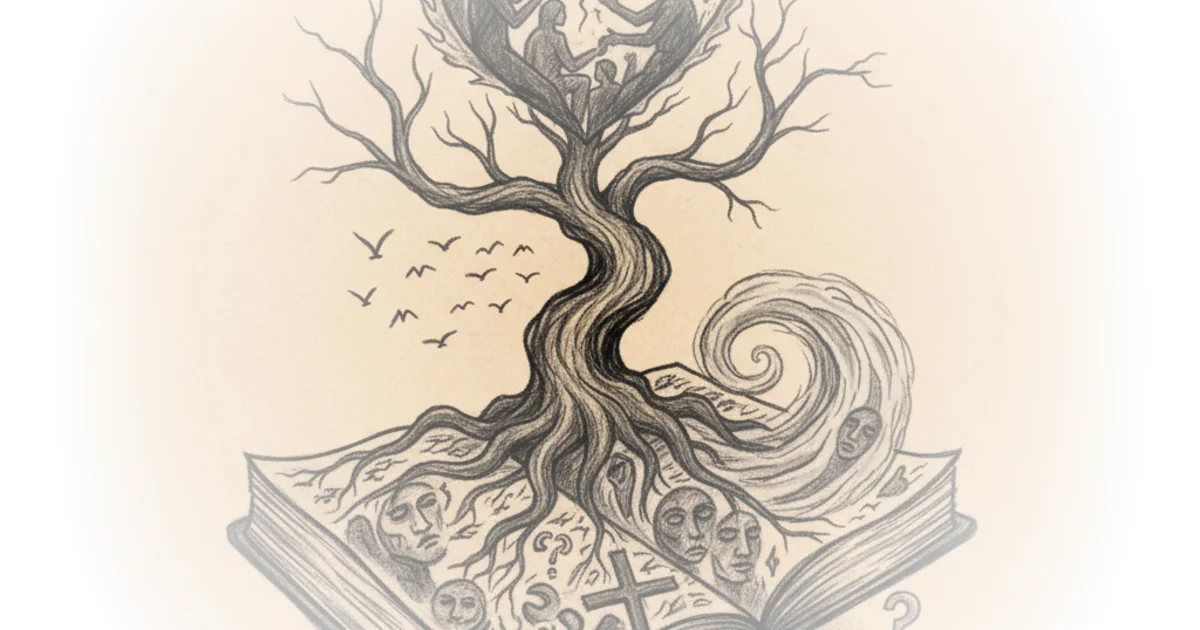
Russian Orthodox Christianity gave Dostoevsky a language to navigate purpose within a larger network of being. That path was deeply tragic, existential, and sometimes absolutely miserable—but also profoundly beautiful at levels most people never experience.
The Family as Microcosm
The Brothers Karamazov centers on the Karamazov family: three sons—Dmitri, Ivan, and Alyosha—from two marriages. Their father, Theodor, represents something Dostoevsky meant symbolically—not a self-portrait, but an archetype of what's inside all of us.
Theodor fails his family consistently. He doesn't know his sons as you'd expect a father to. Dmitri is from his first marriage; Ivan and Alyosha are from his second. As children, he left them to be cared by others while he pursued his own interests. Now that they're grown, life remains chaotic. He's involved in a love triangle with one of his sons and a woman named Grushenka. He gets drunk regularly, verbally abusive, and embarrasses everyone around him.
There's an old Russian saying: the second worst thing that can happen to a family is when the father leaves; the worst thing is if he stays.
This criticism targets self-indulgent landowners of nineteenth-century Russia—but Dostoevsky's point applies more broadly. Modern society's focus on individual achievement has led to what he sees as a considerable decline in focusing on family relationships. If you want to understand what's wrong with a society, start by examining the relationships between members of an average family.
The Grand Inquisitor
One of the most famous sections of the Brothers Karamazov is called the Grand Inquisitor. It's written so it can be read completely independently and still makes total sense—a rare quality in classic literature that makes it perfect for text-to-speech audiences.
This section becomes crucial when we consider how people today engage with political suffering. A common modern story goes: I feel lonely most of the time. I don't talk to my family much. People around me make me feel more alone. Despite all this, I care about people out there in the world who are suffering. It's time to revolutionize society.
To do this in a democracy requires becoming an informed voter—watching the news, consuming political content for two hours daily. This isn't fun; it's what it takes to make the world better.
But Dostoevsky would challenge this approach. He asks: compare those two hours watching screens against instead reflecting on how you're needed immediately by people around you—the roles you're already performing. Which one are you more capable of changing? Which one are you more qualified to know?
You might be uniquely positioned to spend time with the people closest to you—more qualified for that task than any political abstraction. How would your life change if you spent those two hours developing skills to be better for the network you're part of, rather than watching news about abstract suffering?
Dostoevsky isn't saying we should never engage politically. He's pointing out how easy it is—in societies that promote self-centeredness—to mistake waving signs in the streets for saving the world. How easy to think you care about all humanity while actually just turning humanity into a theoretical abstraction.
Faith was not a noun—it was an active process of affirmation, including both miserable and beautiful aspects of existence.
Critics might note that Dostoevsky's critique risks underestimating how real political suffering can be, or how actual revolutions have changed conditions for millions. The family-focused approach isn't always scalable to broader social problems—but it's a useful corrective to abstract political engagement disconnected from lived experience.
Bottom Line
The strongest thread in this piece is the reconceptualization of faith as verb rather than noun—an active process of affirmation that demands honesty about existence's complexity. Dostoevsky's vulnerability lies in how easily his critique of abstract political engagement could become its own abstraction—dismissing meaningful reform work without offering alternatives beyond immediate personal relationships. The tension between approaches remains unresolved, and that's precisely what makes it worth thinking through.