Cory Doctorow delivers a piercing diagnosis of why the world's most powerful leaders are increasingly obsessed with artificial intelligence: it isn't about efficiency, but about a profound psychological detachment from reality. He argues that the drive to replace human bureaucrats and workers with algorithms is rooted in a "solipsism" where the elite view everyone else not as people, but as statistical artifacts to be optimized. This is not just a tech story; it is a warning about how the fantasy of total control is reshaping governance and corporate power.
The Psychology of Control
Doctorow opens by connecting the dots between extreme wealth, authoritarianism, and a specific cognitive distortion. He writes, "With great power comes great solipsism: the more power you wield over other people, the less real they become to you." This framing is crucial because it shifts the debate from technical feasibility to human psychology. The argument suggests that when leaders view their subjects as aggregates rather than individuals, they lose the ability to govern effectively.
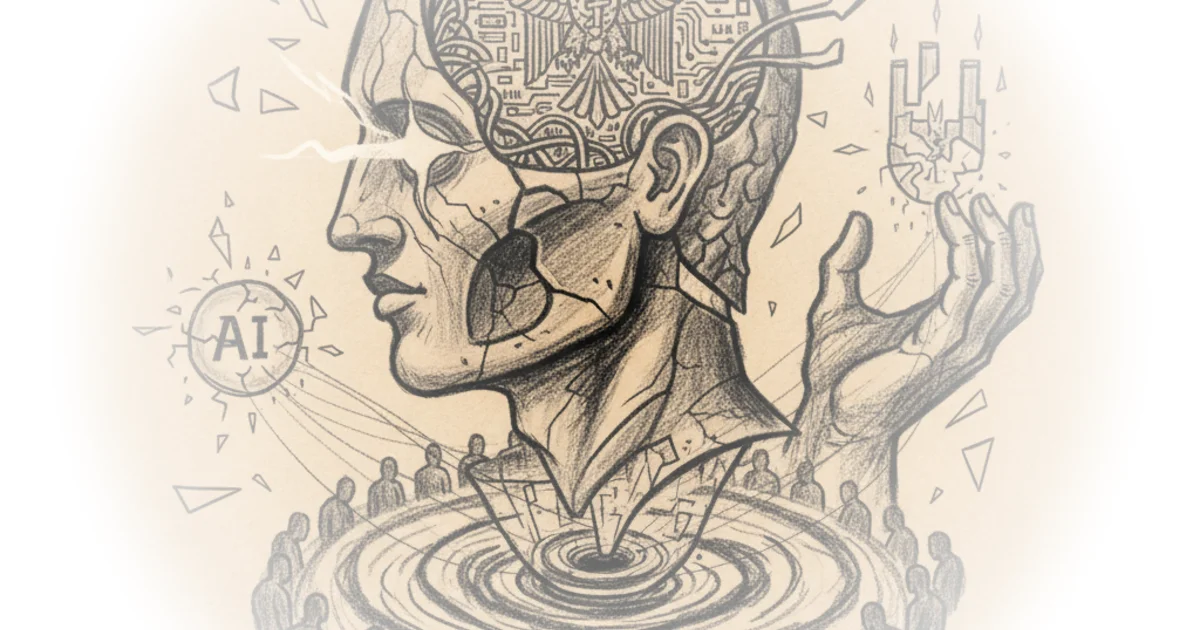
This perspective draws a sharp line between the messy reality of human interaction and the clean, predictable world of data models. Doctorow notes that social media platforms have already succumbed to this, reducing human connection to "amateur dramatics of theater kids" because real friends refuse to organize their lives to "maximize engagement." The core of his argument is that this same logic is now bleeding into the highest levels of government and industry.
"Sin is when you treat people like things."
Doctorow explains that corporate leaders are particularly vulnerable to this mindset because they are haunted by the knowledge that the business would collapse without workers, yet they desperately want to believe they are the sole drivers of success. He describes AI as a mechanism to "wire that toy steering wheel directly into the drive-train," allowing bosses to execute their will without the friction of human needs. This is a compelling metaphor for the current rush to automate, revealing it as a fantasy of omnipotence rather than a pragmatic business decision.
Critics might argue that automation is simply a natural evolution of productivity and that human error in bureaucracy is a valid reason to seek algorithmic precision. However, Doctorow counters that this ignores the essential role of human judgment in navigating complex, qualitative trade-offs.
The Political Fantasy of the Unitary Executive
The commentary then pivots to the political sphere, where Doctorow identifies a dangerous convergence between technocrats and authoritarians. He points out that politicians, much like social media bosses, deal with people as "statistical artifacts who respond to policy inputs with semi-predictable outputs." This leads to a specific political pathology: the desire to eliminate the civil service.
Doctorow cites political scientists Henry Farrell and Cosma Rohilla Shalizi to explain that the push to replace bureaucrats with chatbots is driven by a belief in "AI psychosis." The goal is not just to cut costs, but to create a system where the leader's will is transferred to the people without any "intervening loss of fidelity." He writes, "This is a political version of my maxim that 'the fact that an AI can't do your job doesn't stop an AI salesman from convincing your boss to fire you and replace you with an AI that can't do your job.'" This observation cuts through the hype, exposing the disconnect between the capabilities of current technology and the ambitions of its promoters.
The article references the historical concept of "Seeing Like a State," noting that this tendency to simplify complex social realities into manageable data points is a recurring flaw in governance. Doctorow argues that the "fascist paradigm" relies on the idea that only a singular genius can make the right decisions for everyone else, a view that treats the population as incapable of self-rule.
"To quantize a qualitative question is to incinerate all the qualitative aspects and then do mathematics on the dubious quantitative ash that is left behind."
This is perhaps the most devastating critique in the piece. It highlights the fundamental incompatibility between the nuance of human society and the rigid logic of optimization algorithms. Doctorow reminds us that statecraft is not about finding a single correct answer, but about making choices between mutually exclusive policies where benefits and costs fall on different groups. An algorithm cannot ethically decide whose priorities matter more.
The Illusion of Perfect Execution
Doctorow further dismantles the idea that AI can solve the "principal-agent problem" in government. He argues that the variability introduced by human bureaucrats is actually a feature, not a bug. When a directive from above is flawed, a seasoned public official can tweak the implementation to prevent disaster. Replacing them with a rigid algorithm removes this safety valve.
He draws on the work of Yuval Harari, noting that while Harari predicted AI would help dictators overcome "authoritarian blindness," the reality is that people under such regimes have learned to feed the algorithms false data. The result is a system that is easily manipulated and prone to catastrophic failure. Doctorow writes, "An LLM is the ultimate micro-manager, and government by Computer Says No would only work if the person writing the system prompt knew everything about everyone everywhere." This is a sobering reminder of the limits of central planning in a complex world.
The piece also touches on the historical precedent of the Technocrats, a movement that believed every social process could be expressed as a mathematical model. Doctorow connects this to modern figures who quote these early 20th-century thinkers, showing that the desire to reduce society to an equation is not new, but its implementation through AI makes it more dangerous.
"The frustrations of actually existing bureaucracy do not merely arise from inept or technically-inadequate solutions... They emerge too from the collision of multiple incommensurable demands."
By quoting Farrell and Shalizi, Doctorow underscores that there are no "optimal design solutions" for society. The attempt to impose them is not just technologically naive; it is politically destructive. It ignores the reality that different groups have different, often conflicting, needs that cannot be resolved by a simple calculation.
Bottom Line
Doctorow's strongest argument is his reframing of the AI revolution not as a technological inevitability, but as a psychological symptom of power. His vulnerability lies in the assumption that the elite are acting solely out of solipsism, potentially underestimating the genuine, if misguided, belief in efficiency that also drives these decisions. The reader should watch for how this "fascist paradigm" manifests in upcoming policy changes, specifically any attempts to bypass traditional oversight mechanisms in favor of algorithmic governance.