"Brad DeLong asks a question that shatters our sense of historical inevitability: would you have wagered on the survival of the East African plains ape 75,000 years ago? The answer is almost certainly no. This piece reframes human history not as a triumphant march of superiority, but as a precarious gamble where we were outnumbered by lions and antelopes, surviving only through a narrow, contingent path."
The Marginal Species
DeLong begins by dismantling the assumption that our dominance was preordained. He paints a stark picture of the evolutionary landscape 75,000 years ago, noting that "of the perhaps five billion mammals in the world 75,000 years ago, perhaps two million [were] Great Apes." Within that group, he argues, we were "evolutionarily very marginal: not terribly successful among the great apes." This framing is crucial because it forces us to confront the fragility of our existence. We often view our current biomass dominance as a natural outcome of intelligence, but DeLong insists our success was an accident of timing and luck rather than a guaranteed biological destiny.
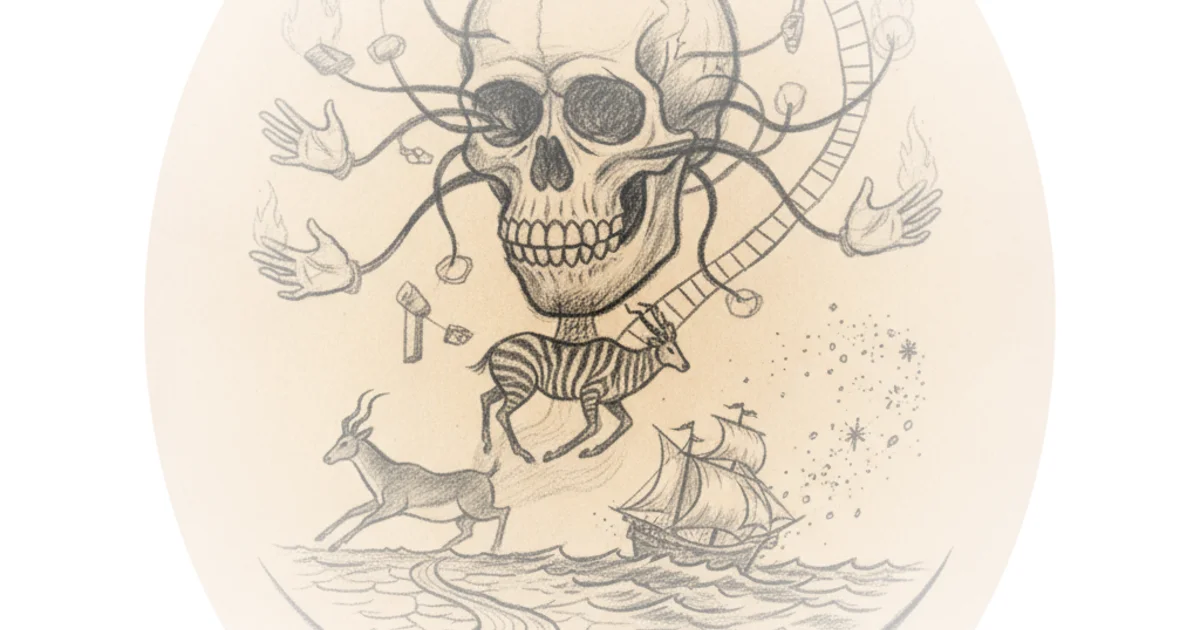
The author leans heavily on the work of Joseph Heath to explain why our specific traits—big brains, complex language, and ultrasociality—are so improbable. DeLong writes that these capabilities "look to me as initially evolutionary gambles with very serious downsides." He highlights the immense cost of our biology: "If the goal was just... controlling fire and making a few stone tools, the human brain seems strangely overengineered... massively costly and inefficient." This is a powerful counter-narrative to standard evolutionary stories that assume every trait evolves for immediate utility. Instead, DeLong suggests we are the result of a runaway process, much like the antlers of the Irish Elk, where traits grew so large they became a liability until culture stepped in to save them.
"A distant stranger to the world... gazing at the world 75,000 years ago would have been unlikely to see us as particularly interesting."
The Bottleneck and the Tweak
The piece dives into the specific population numbers that define our near-extinction event. DeLong outlines three possible scenarios for how many of us were alive then: a "10,000-person bottleneck," a 200,000-strong anatomically modern population, or a broader interbreeding group of 400,000. Even in the most generous estimate, "we were outnumbered four to one by the other great apes back then." This statistical reality check is vital; it reminds us that our entire species could have vanished with a single harsh winter or a shift in climate patterns.
To explain how we survived this bottleneck, DeLong turns to the theory of gene-culture coevolution. He paraphrases Joseph Heath's argument that culture is primary and was made possible by a "tweak" of imitativeness. "Human infants got really good... at mindlessly copying others," DeLong notes. This ability allowed complex tool-making procedures to improve over generations without each individual needing to reinvent the wheel. The author argues that this cultural accumulation, rather than raw biological intelligence alone, drove our encephalization.
This argument gains depth when viewed against historical precedents like the Youngest Toba eruption roughly 74,000 years ago, which likely caused a volcanic winter that decimated populations and created the very bottleneck DeLong describes. The survival of a small group through such an event wasn't just about being smart; it was about having the social cohesion to share resources and knowledge when the environment turned hostile.
Critics might note that emphasizing "mindless copying" risks understating the role of individual innovation and critical thinking in human progress. However, DeLong counters this by suggesting that without the baseline of cultural transmission, those innovations would never have stuck or spread widely enough to change the species' trajectory.
The Self-Domestication of the Ape
As the commentary moves toward the present, DeLong contrasts our past marginality with our current overwhelming dominance. "Today, of course we East African Plains Apes number 8.4 billion," he writes, noting that we now represent "34% of mammal biomass." The shift from being one-tenth the number of elephants to having a population 15,000 times larger is described as "gonzo astronomical" in its disparity.
He attributes this transformation to a process of self-domestication driven by cultural conformity. "Once these two steps... are in place... humans are obviously going to be more interesting to talk to once there is some possibility that they will tell you the truth," DeLong writes. This observation connects our biological evolution to the development of institutions and cooperation among unrelated individuals. It suggests that our ability to live in massive, complex societies like modern Toyota or global markets stems from a deep-seated cultural adaptation that overrode our biological instincts for smaller, kin-based groups.
"Our hands and our brains and our culture with too... [were] not at all a clear success" 75,000 years ago.
DeLong also touches on the idea of the "Machiavellian intelligence hypothesis," implying that our social complexity evolved as a response to the need for cooperation in large groups, effectively turning between-group conflict into a force for internal cohesion. This reframes human history not as a story of conquering nature through brute force, but as a story of learning to cooperate so effectively that we could manipulate our environment on a planetary scale.
Bottom Line
DeLong's most compelling contribution is the refusal to treat human dominance as inevitable; by grounding his argument in population bottlenecks and the high metabolic cost of large brains, he makes our survival feel like a miraculous fluke rather than a biological certainty. The piece's greatest strength lies in synthesizing evolutionary biology with cultural theory to explain how "mindless copying" became the engine of human civilization. However, the argument occasionally leans too heavily on the idea of "luck," potentially underestimating the adaptive pressures that specifically favored social learning even before the bottleneck. Readers should watch for how this perspective shifts our understanding of current global challenges: if our success was contingent and fragile, it suggests our future is equally vulnerable to the very institutions we built to sustain us.