In a landscape saturated with self-help platitudes, Anne Helen Petersen offers a radical alternative: the idea that our survival depends not on individual grit, but on the deliberate construction of a "kin" network that functions as a safety net. This piece moves beyond the abstract desire for community to provide a practical, structural framework for how to build it, arguing that the modern obsession with professional success has actively dismantled the very relationships we need to weather life's inevitable crises.
Redefining the Safety Net
Petersen opens by grounding the conversation in a stark reality: over 42 million people in the United States rely on federal food assistance, a number poised to swell as government support falters. Yet, rather than dwelling solely on policy failure, she pivots to a personal and cultural solution. She writes, "One of the recurring themes of this newsletter is figuring out how to take care of each other in a society that valorizes self-sufficiency above all else." This framing is crucial because it identifies the cultural barrier preventing mutual aid: the belief that needing help is a failure of character rather than a human condition.
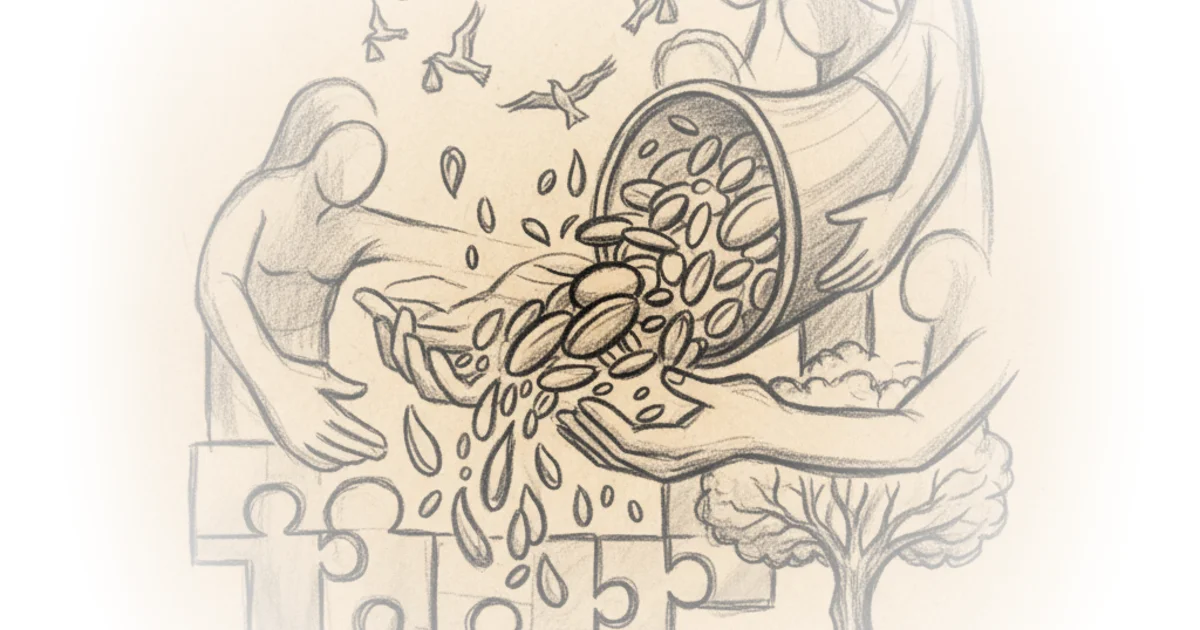
The author introduces Sophie Lucido Johnson's concept of "kin" as a vital linguistic and social tool. Petersen explains that kin are "the people in your life to whom you're deeply bound through all things; and who are essential for your individual and collective survival." This definition is powerful because it bridges the gap between the casualness of friendship and the obligation of family. It creates a category for the people who would answer a 3 a.m. call, or who have seen you at your worst and stayed. By naming this role, the piece argues we make the invisible visible, allowing us to prioritize these bonds with the same intentionality we bring to our careers.
"New Relationship Energy is a spark, but it's not an engine. We're sustained by tending and returning, building and staying."
The Mechanics of Care
The commentary shifts to the practical mechanics of maintaining these bonds, dismantling the romanticized notion that relationships should run on novelty alone. Petersen highlights Johnson's distinction between the dopamine-fueled high of new connections and the steady work of long-term care. "New Relationship Energy is that incredible, druggy feeling you get when you start dating someone new... fueled by novelty and uncertainty," she notes, before pointing out that our brains cannot sustain this chemically. The argument here is that true resilience comes from the "messy, unfun, frayed-edges parts" of relationships, not the curated highlights.
This leads to the concept of "lateral communication," a non-hierarchical approach where no single relationship holds a monopoly on one's emotional life. Petersen writes, "Thinking of relationships as lateral allows you to shift your priorities as necessary. Sometimes, you have to prioritize relationships with people at work; other times, your closest friends need to be your priority." This is a direct challenge to the traditional model where a romantic partner is expected to be the sole source of emotional support. By distributing the load, we create a more robust network capable of withstanding stress.
Critics might argue that this level of intentional communication requires a degree of emotional bandwidth and time that many working-class individuals simply do not possess. The suggestion to "notice who feeds what in you" assumes a level of leisure and introspection that is often a luxury. However, the piece counters this by suggesting that the alternative—trying to do everything alone—is ultimately more exhausting and unsustainable.
The Cost of Professionalization
The piece concludes with a poignant reflection on how modern institutions, particularly higher education, have trained a generation to prioritize career trajectories over community building. Petersen and Johnson recall their college days, noting a stark contrast between the "proximity, casualness, play, community" they valued and the "bourgeois career trajectories" they were funneled into. "We used to say that we worked really hard and played really hard, and then after graduating, we mostly just....worked really hard," Petersen observes.
This institutional shift has had lasting consequences. The pressure to professionalize early has eroded the capacity for "rest," which Petersen defines not as inactivity, but as "finding ease and choosing to rest in others." She admits her own struggle to ask for help, even when sick, noting that "childcare still feels like a bridge too far to ask for on a whim." This vulnerability underscores the central thesis: we have been conditioned to believe that asking for help is a sign of weakness, when in reality, it is the mechanism that holds society together.
"Life does not have to be as hard as you were taught it has to be. Most of life is not actually an emergency."
Bottom Line
The strongest element of this piece is its refusal to treat community building as a vague aspiration; instead, it offers a structural critique of how we organize our lives and a specific vocabulary for fixing it. Its primary vulnerability lies in the assumption that individuals have the agency to restructure their social circles without addressing the systemic economic pressures that leave them too exhausted to do so. Ultimately, the argument serves as a necessary corrective to the myth of self-sufficiency, reminding readers that resilience is a collective project, not an individual achievement.