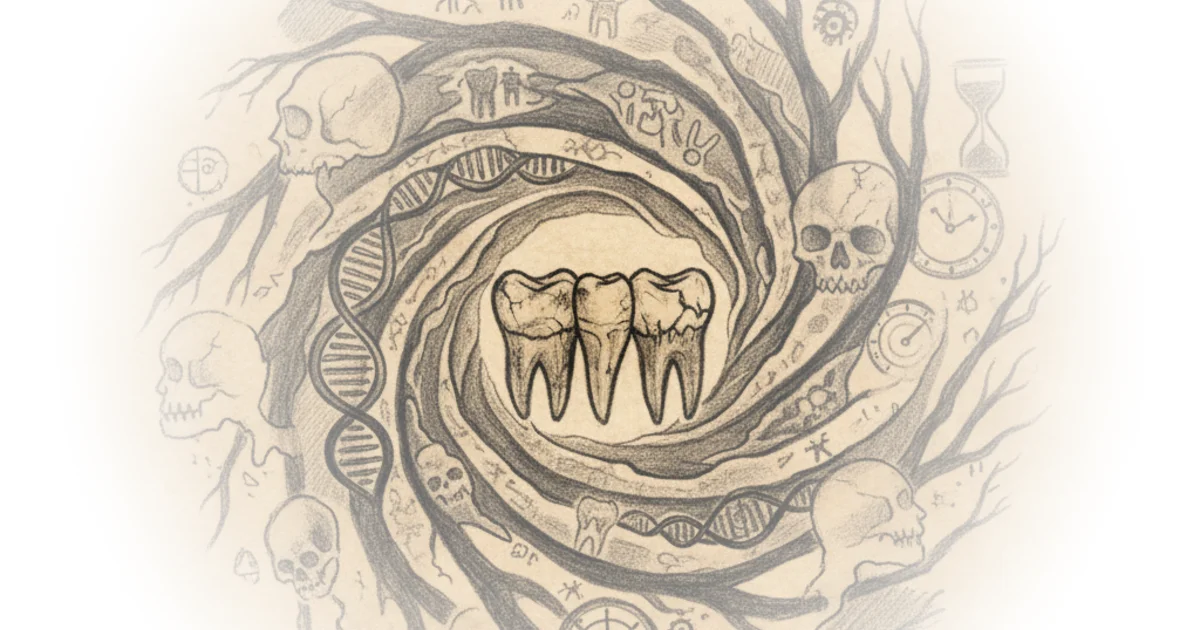
A team of researchers has recovered what may be humanity's oldest genetic material—though it's not DNA at all. These samples came from four teeth excavated in South Africa's Swat Cran, one of paleoanthropology's most significant sites. The teeth belonged to Paranthropus robustus, ancient hominins who lived between 1.8 and 2.2 million years ago.
The question of whether these creatures qualify as "human" depends entirely on how we define the term. They were upright-walking cousins of modern humans, though not our direct ancestors. Their teeth tell a story of adaptation to a tough, fibrous diet—grasses, leaves, sedges—that shaped their evolution in ways radically different from our own lineage.
The Paranthropus Robustus
This small pile of bones represents the first Paranthropus robustus remains ever found: discovered in 1938 in South Africa. The name literally means "beside man"—chunky beside us. These hominins stood perhaps 1.3 meters tall (the males) and around a meter (the females). They were short, hairy, and bore more than passing resemblance to what most people imagine when they think of apes.
What set Paranthropus robustus apart was their massive dentition—researchers call it "megadontia." Their huge jaws and broad teeth suggest a diet far removed from our own. Despite their smaller brain sizes (cranial capacity around 450 ml, roughly half that of contemporary humans), evidence suggests they produced tools—bone tools found at Dremlyn in South Africa indicate termite-digging behavior, and stone tools have been discovered there too.
They lived for over a million years, thriving across Eastern and Southern Africa. Their success is remarkable: Paranthropus robustus may not be direct ancestors, but they were our distant cousins, and evidence suggests they likely interbred with early Homo species at various points.
Why Proteins Matter
For decades, scientists have searched for increasingly older ancient DNA to fill gaps in our evolutionary tree. But there's a fundamental problem: after about two million years, DNA degrades completely—especially in Africa's hot climate. No genetic material remains that we can access with current technology.
This is where paleoproteomics enters the picture.
The magic of proteins lies in their composition. Our bones and teeth are made of proteins fused with minerals like calcium. These proteins become embedded with minerals during formation, essentially preserving them inside the tooth or bone. This preservation is why proteins can help us where DNA cannot.
The amino acid sequences within these proteins reflect the DNA that created them. When researchers measure specific amino acids using mass spectrometry—a technique that separates elements based on their mass-to-charge ratio—they can reconstruct the genetic information behind them. A change in the protein means a change in the gene, allowing them to trace evolutionary relationships even without intact DNA.
Challenges in the Field
The research faced three major obstacles. First: contamination risk. Unlike ancient DNA studies where this presents a constant challenge, paleoproteomics has an advantage—dental enamel proteins are extremely specific to the sample being tested. If proteins found match dental enamel patterns, researchers can be confident they haven't been contaminated by modern sources.
Second: acquiring suitable samples. This is a young field of science, especially when studying fossils potentially over two million years old. The four teeth used in this study were beaten up—cracked, chipped, snapped in half. These weren't museum-grade pristine samples; finding appropriate specimens took years.
Third: information loss. Even though proteins preserve well because they've bound to minerals, they're still degrading. Nothing survives perfectly for two million years. From the whole genome, only about 2% is protein-coding regions—and from those roughly 20,000 proteins in the human body, researchers might recover only a handful. The information reduction is significant.
Despite these challenges, the team successfully identified something unexpected: sexual dimorphism—the difference between males and females—suggesting intense competition among Paranthropus robustus males for mates.
What We Can Learn
The broader goal here involves one of paleoanthropology's constant struggles: untangling relationships among diverse fossils. The fossil record shows extinction was common throughout Earth's history, but today humans drive mass extinction rather than observing passively.
Paranthropus robustus exhibited extremely high morphological variation—multiple fossils found across different sites in South Africa show significant differences within the group. Are they a highly diverse group? Multiple species? Same species separated by time? These are exactly the questions paleoproteomics can help answer.
The proteins revealed that despite being cousins, Paranthropus robustus followed a radically different evolutionary path from Homo sapiens—one defined by chewing tough vegetation rather than evolving larger brains or tool use. Yet they were successful for over a million years, suggesting their strategy worked.
"They really were on a different evolutionary path to us."
Bottom Line
This research represents a breakthrough in how we study human evolution. By focusing on ancient proteins instead of DNA, scientists can push back further into history than ever before—reaching specimens that have been beyond our reach for decades. The biggest strength: proteins preserve where DNA fails, opening entirely new windows into our past. The vulnerability: we're still limited by information loss, recovering only fragments of what once existed. Next steps involve applying these same techniques to other ancient hominins—including the Denisovans, whose recent protein studies have made headlines—to see what else they can reveal about our strangest cousins.